
Pilsicainide hydrochloride
Synonym(s):N-(2,6-Dimethylphenyl)tetrahydro-1H-pyrrolizine-7a(5H)-acetamide hydrochloride;Pilzicainide hydrochloride;SUN 1165
- CAS NO.:88069-49-2
- Empirical Formula: C17H24N2O
- Molecular Weight: 272.39
- MDL number: MFCD00903769
- SAFETY DATA SHEET (SDS)
- Update Date: 2026-07-16 07:06:08
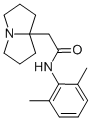
What is Pilsicainide hydrochloride?
Description
Pilsicainide hydrochloride is a new pynolizidine lidocaine derivative with antiarrhythmic activity. It is the first pharmaceutical product introduced by Suntory and was solely developed in Japan. The compound is reported to be highly effective in the treatment of premature ventricular contraction. It has no anticholinergic or CNS activity and is not as likely as other class 1C antiarrhythmics to have restricted indications.
Originator
Suntory (Japan)
The Uses of Pilsicainide hydrochloride
Pilsicainide hydrochloride has been used as a sodium channel blocker:
- to study its effects on electrophysiological parameters in guinea pig pulmonary vein preparation
- to study its effects on Ca2+?release and arrhythmic events in Andersen-Tawil syndrome induced pluripotent stem cells (ATS-iPSC)-derived cardiomyocytes
- to study its electrophysiological effects on the guinea pig atrium
What are the applications of Application
Pilsicainide hydrochloride is a pure sodium channel protein inhibitor
brand name
Sunrhythm
Biochem/physiol Actions
Pilsicainide hydrochloride is a pure sodium channel blocker and an open channel blocker of Na+1 channels. Pilsicainide was defined as a pure sodium channel blocker. The compound is classified as a class Ic antiarrhythmic drug, and was originally developed in Japan. Similar to Lidocaine, Pilsicainide binds to open channels, but slowly. Pilsicainide is capable of selectively blocking the late currents in the mutant Na(+) channels that show dominant abnormal burst openings such as in δKPQ mutants. The compound is used to induce Brugada syndrome (BS) in animal models.
Properties of Pilsicainide hydrochloride
| Melting point: | 212-214° |
| storage temp. | room temp |
| solubility | Chloroform (Slightly), Water (Slightly) |
| form | powder |
| color | white to beige |
Safety information for Pilsicainide hydrochloride
| Signal word | Danger |
| Pictogram(s) |
 Skull and Crossbones Acute Toxicity GHS06 |
| GHS Hazard Statements |
H301:Acute toxicity,oral |
| Precautionary Statement Codes |
P264:Wash hands thoroughly after handling. P264:Wash skin thouroughly after handling. P270:Do not eat, drink or smoke when using this product. P301+P310:IF SWALLOWED: Immediately call a POISON CENTER or doctor/physician. P405:Store locked up. P501:Dispose of contents/container to..… |
Computed Descriptors for Pilsicainide hydrochloride
New Products
5-bromo-4-fluoro-2-nitrobenzaldehyde (R)-(-)-2-Amino-1-propanol Cyclobutanone Fmoc-OSu 1-(2-Chloroethyl)pyrrolidine Hydrochloride 2-Amino-2-(4-methylphenyl)acetic acid β-Bromostyrene Ethyl 3-phenylpropanoate Phenethyl cinnamate Dipropyl disulfide 4 pentyn 1 ol N-Vinylformamide Methacrylate-PEG-Methacrylate, Mn:35000 2,4-Dihydroxyacetophenone 2-Chloro 5-Fluoro Pyridine Vasicinone 2-Chloroisonicotinic Acid Tween 80 or Polysorbate 80 2-Butyn-1-oL 2-Pentyn-1-oL 4-Nitrobenzotrifluoride N-(4-fluoro-2-methoxy-5-nitrophenyl)-4-(1-methyl-1H-indol-3-yl)pyrimidin-2-amine Pirtobrutinib intd. N-(4-Cyano-3-(trifluoromethyl)phenyl)-2-methyloxirane-2-carboxamideRelated products of tetrahydrofuran


You may like
-
 Pilsicainide Hydrochloride CAS 88069-49-2View Details
88069-49-2 -
Pilsicainide hydrochloride CAS 88069-49-2View Details
88069-49-2 -
7250-67-1 1-(2-Chloroethyl)pyrrolidine Hydrochloride 98+View Details
7250-67-1 -
13227-01-5 98+View Details
13227-01-5 -
7250-67-1 1-(2-Chloroethyl)pyrrolidine Hydrochloride 98+View Details
7250-67-1 -
13227-01-5 98+View Details
13227-01-5 -
7250-67-1 1-(2-Chloroethyl)pyrrolidine Hydrochloride 98+View Details
7250-67-1 -
13227-01-5 98+View Details
13227-01-5