
Phenylacetylurea
- CAS NO.:63-98-9
- Empirical Formula: C9H10N2O2
- Molecular Weight: 178.19
- MDL number: MFCD00007948
- EINECS: 200-570-2
- SAFETY DATA SHEET (SDS)
- Update Date: 2026-09-12 18:50:25
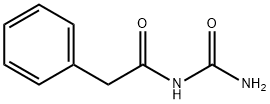
What is Phenylacetylurea?
Absorption
Almost completely absorbed.
Toxicity
Oral, mouse: LD50 = 987 mg/kg; Oral, rabbit: LD50 = 2500 mg/kg; Oral, rat: LD50 = 1600 mg/kg
Chemical properties
white to yellow powder
The Uses of Phenylacetylurea
Anticonvulsant.
Background
Phenacemide is used to control certain seizures in the treatment of epilepsy. This medicine acts on the central nervous system (CNS) to reduce the number and severity of seizures.
Indications
Used to control certain seizures in the treatment of epilepsy.
Definition
ChEBI: Phenacemide is a member of acetamides.
brand name
Phenurone (Abbott).
Pharmacokinetics
Phenacemide is a ureal anticonvulsant indicated for control of severe epilepsy, particularly mixed forms of complex partial (psychomotor or temporal lobe) seizures, refractory to other anticonvulsants. Phenacemide elevates the threshold for minimal electroshock convulsions and abolishes the tonic phase of maximal electroshock seizures. It also prevents or modifies seizures induced by pentylenetetrazol or other convulsants.
Safety Profile
Moderately toxic by ingestion and intraperitoneal routes. Experimental teratogenic effects. Used as an anticonvulsive agent. When heated to decomposition it emits toxic fumes of NOx.
Metabolism
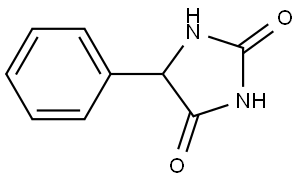
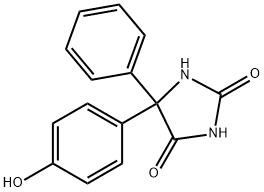
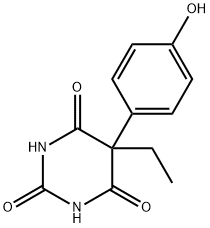
Metabolized in the liver by hepatic microsomal enzymes, where it is inactivated by p-hydroxylation.
Properties of Phenylacetylurea
| Melting point: | 214-216 °C |
| Boiling point: | 310.41°C (rough estimate) |
| Density | 1.2221 (rough estimate) |
| refractive index | 1.5600 (estimate) |
| pka | 12.38±0.70(Predicted) |
| color | Crystals from EtOH |
| Water Solubility | 182mg/L(temperature not stated) |
| CAS DataBase Reference | 63-98-9 |
| EPA Substance Registry System | Phenacemide (63-98-9) |
Safety information for Phenylacetylurea
| Signal word | Warning |
| Pictogram(s) |
 Health Hazard GHS08 |
| GHS Hazard Statements |
H341:Germ cell mutagenicity H351:Carcinogenicity |
| Precautionary Statement Codes |
P201:Obtain special instructions before use. P202:Do not handle until all safety precautions have been read and understood. P280:Wear protective gloves/protective clothing/eye protection/face protection. P308+P313:IF exposed or concerned: Get medical advice/attention. P405:Store locked up. P501:Dispose of contents/container to..… |
Computed Descriptors for Phenylacetylurea
New Products
9-Mesityl-10-methylacridinium perchlorate Sulfapyridine Fmoc-OSu (R)-(-)-2-Amino-1-propanol Cyclobutanone 5-bromo-4-fluoro-2-nitrobenzaldehyde 4 pentyn 1 ol N-Vinylformamide Phenethyl cinnamate Pyrrolo[1,2-a]pyrimidine-6-carboxylic acid, 4,6,7,8-tetrahydro-4-oxo-, sodium salt (1:1), (6S) Ethyl 3-phenylpropanoate β-Bromostyrene Methacrylate-PEG-Methacrylate, Mn:35000 2,4-Dihydroxyacetophenone 2-Chloro 5-Fluoro Pyridine Vasicinone 2-Chloroisonicotinic Acid Tween 80 or Polysorbate 80 5-Bromo-1-Pentyne 1-(2-Methyl-5-nitrophenyl)guanidine Nitrate Methyl trans-4-Aminocyclohexanecarboxylate Hydrochloride N-(4-Cyano-3-(trifluoromethyl)phenyl)-2-methyloxirane-2-carboxamide 4-Nitrobenzotrifluoride 2-Pentyn-1-oLRelated products of tetrahydrofuran
You may like
-
 N-(PHENYLACETYL)UREA CAS 63-98-9View Details
63-98-9 -
1191-95-3 Cyclobutanone 98+View Details
1191-95-3 -
Fmoc-OSu 98+View Details
82911-69-1 -
(R)-(-)-2-Amino-1-propanol 35320-23-1 98+View Details
35320-23-1 -
1191-95-3 Cyclobutanone 98+View Details
1191-95-3 -
213382-45-7 98+View Details
213382-45-7 -
Fmoc-OSu 98+View Details
82911-69-1 -
(R)-(-)-2-Amino-1-propanol 35320-23-1 98+View Details
35320-23-1