
PHENCYCLIDINE
Synonym(s):Phencyclidine
- CAS NO.:77-10-1
- Empirical Formula: C17H25N
- Molecular Weight: 243.39
- MDL number: MFCD00055598
- SAFETY DATA SHEET (SDS)
- Update Date: 2026-05-27 23:29:31
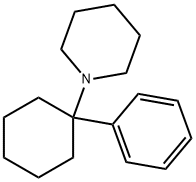
What is PHENCYCLIDINE?
The Uses of PHENCYCLIDINE
Anesthetic.
Definition
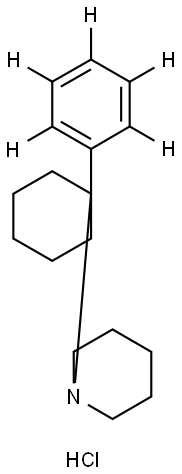
ChEBI: A member of the class of piperidines that is piperidine in which the nitrogen is substituted with a 1-phenylcyclohexyl group. Formerly used as an anaesthetic agent, it exhibits both hallucinogenic and neurotoxic effects.
brand name
Sernylan (Parke-Davis).
General Description
Phencyclidine was introduced as a dissociative anestheticfor animals. Its close structural relative ketamine is still soused and may be used in humans. In humans,PCP produces a sense of intoxication, hallucinogenic experiencesnot unlike those produced by the anticholinergic hallucinogens,and often, amnesia.
The drug affects many systems, including those of NE,DA, and 5-HT. It has been proposed that PCP (and certainother psychotomimetics) produces a unique pattern of activationof ventral tegumental area dopaminergic neurons.Itblocks glutaminergic N-methyl-D-aspartate receptors.Thisaction is the basis for many of its CNS effects. PCP itself appearsto be the active agent. The psychotic state produced bythis drug is also cited as a better model than amphetaminepsychosis for the psychotic state of schizophrenia.
Pharmacology
PCP acts as a biocide through its ability to uncouple mitochondrial oxidative phosphorylation.
Safety Profile
Poison by intraperitoneal route. Experimental reproductive effects. Caution: This is a controlled substance (depressant) listed in the U.S. Code of Federal Regulations, Title 21 Part 1308.12 (1985). The ethylamine, pyrrolidine and thiophene analogs are l
Metabolic pathway
When mice and rats are administered phencyclidine intraperitoneally, several hydroxylated metabolites are identified in the urine. A new metabolite, 1-phenyl-1- (1-piperidinyl-3-ol)cyclohexane, is identified in the urine and liver microsomal preparations.
Metabolism
Pentachlorophenolwas metabolized in rats
by conjugation with glucuronic acid and eliminated as
the glucuronide. P450 catalyzed oxidative dechlorination
also occurred to form tetrachlorohydroquinone, and this
was conjugated to form a monoglucuronide representing
27% of the dose administered. Other metabolites
have been reported, including isomeric tetrachlorophenols,
tetrachlorocatechol and tetrachlororesorcinol. Trace
amounts of benzoquinones were also noted.
Metabolites in female rats were tetrachloromonophenols,
diphenols, and hydroquinones.
Toxicity evaluation
The toxicology has been addressed in a recent risk assessment (119). Acutely, pentachlorophenol was reported to have LD50 values in the rat of 12 mg/kg (inhalation) and 146 mg/kg (M)–175 mg/kg (F) by oral gavage. More detailed studies of the toxicology of pentachlorophenol have been compromised by the toxicity of impurities present in most of the earlier samples used in the evaluation process.
Properties of PHENCYCLIDINE
| Melting point: | 46.5℃ |
| Boiling point: | bp1.0 135-137° |
| Density | 0.9762 (rough estimate) |
| refractive index | 1.5000 (estimate) |
| Flash point: | 11 °C |
| storage temp. | −20°C |
| pka | pKa 8.5 (Uncertain) |
| color | Colorless crystals |
| EPA Substance Registry System | Piperidine, 1-(1-phenylcyclohexyl)- (77-10-1) |
Safety information for PHENCYCLIDINE
| Signal word | Danger |
| Pictogram(s) |
 Flame Flammables GHS02  Skull and Crossbones Acute Toxicity GHS06  Health Hazard GHS08 |
| GHS Hazard Statements |
H225:Flammable liquids H370:Specific target organ toxicity, single exposure |
| Precautionary Statement Codes |
P210:Keep away from heat/sparks/open flames/hot surfaces. — No smoking. P260:Do not breathe dust/fume/gas/mist/vapours/spray. P280:Wear protective gloves/protective clothing/eye protection/face protection. P311:Call a POISON CENTER or doctor/physician. P301+P310:IF SWALLOWED: Immediately call a POISON CENTER or doctor/physician. |
Computed Descriptors for PHENCYCLIDINE
New Products
2-(2-Chlorophenyl)glycine Propiolic Acid 1-(3-Hydroxy-4-methoxyphenyl)-2-nitroethene (±)-amino(2-fluorophenyl)acetic acid trans-3-Benzyloxy-4-methoxy-beta-nitrostyrene 1-Pentadecanol 4-(4-Αminophenyl)-3-Morpholinone 3-Morpholino-1-(4-(2-oxopiperidin-1-yl) phenyl)-5,6-dihyropyridin-2-(1H)-one 1-(4-Aminophenyl)-3-morpholino-5,6-dihydropyridin-2(1H)-one N-cyanoacetylurethane 1H-IndazoleRelated products of tetrahydrofuran


You may like
-
 40216-83-9 trans-4-Hydroxy-L-proline methyl ester hydrochloride 98+View Details
40216-83-9 -
471-25-0 Propiolic Acid 98+View Details
471-25-0 -
84145-28-8 98+View Details
84145-28-8 -
trans-3-Benzyloxy-4-methoxy-beta-nitrostyrene 98+View Details
63909-29-5 -
2-(2-Chlorophenyl)glycine 88744-36-9 98+View Details
88744-36-9 -
40216-83-9 trans-4-Hydroxy-L-proline methyl ester hydrochloride 98+View Details
40216-83-9 -
629-76-5 98+View Details
629-76-5 -
1-(3-Hydroxy-4-methoxyphenyl)-2-nitroethene 98+View Details
39816-35-8