
PEBULATE
Synonym(s):Propyl ethyl-n-butylthiolcarbamate
- CAS NO.:1114-71-2
- Empirical Formula: C10H21NOS
- Molecular Weight: 203.34
- MDL number: MFCD00078726
- EINECS: 214-215-4
- SAFETY DATA SHEET (SDS)
- Update Date: 2026-05-27 23:33:09
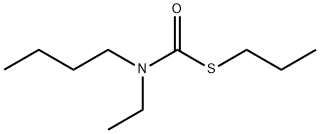
What is PEBULATE?
Chemical properties
Colorless to yellowish, flammable liquid. Aromatic odor.
The Uses of PEBULATE
Selective herbicide.
Definition
ChEBI: Pebulate is a tertiary amine.
General Description
Colorless to yellow liquid with aromatic odor. Non corrosive. Used as an herbicide.
Air & Water Reactions
Thio and dithiocarbamates slowly decompose in aqueous solution to form carbon disulfide and methylamine or other amines. Such decompositions are accelerated by acids.
Reactivity Profile
PEBULATE is a thiocarbamate. Flammable gases are generated by the combination of thiocarbamates and dithiocarbamates with aldehydes, nitrides, and hydrides. Thiocarbamates and dithiocarbamates are incompatible with acids, peroxides, and acid halides.
Potential Exposure
Pebulate is a thiocarbamate herbicide used for pre-emergence control of germinating seeds of broadleaf and grassy weeds in sugar beets, tobacco, and tomatoes. There are no registered residential uses of pebulate
Shipping
Do not discharge into drains or sewers. Dispose of waste material as hazardous waste using a licensed disposal contractor to an approved landfill. Consult with environmental regulatory agencies for guidance on acceptable disposal practices. Generators of waste containing this contaminant (≥100 kg/mo) must conform with EPA regulations governing storage, transportation, treatment, and waste disposal. If allowed, incineration with effluent gas scrubbing (carbon dioxide may be released) is recommended. In accordance with 40CFR165, follow recommendations for the disposal of pesticides and pesticide containers. Noncombustible containers should be crushed and buried under more than 40 cm of soil. Must be disposed properly by following package label directions or by contacting your local or federal environmental control agency, or by contacting your regional EPA office.
Incompatibilities
Thiocarbamate esters are combustible. They react violently with powerful oxidizers such as calcium hypochlorite. Poisonous gases are generated by the thermal decomposition of thiocarbamate compounds, including carbon disulfide, oxides of sulfur, oxides of nitrogen, hydrogen sulfide, ammonia, and methylamine.Thio and dithiocarbamates slowly decompose in aqueous solution to form carbon disulfide and methylamine or other amines. Such decompositions are accelerated by acids. Flammable gases are generated by the combination of thiocarbamates with aldehydes, nitrides, and hydrides. Thiocarbamates are incompatible with acids, peroxides, and acid halides.
Properties of PEBULATE
| Melting point: | <25℃ |
| Boiling point: | 142℃ |
| Density | 0.9458 g/cm3 (30 ºC) |
| refractive index | 1.4752 (589.3 nm 30℃) |
| storage temp. | 0-6°C |
| form | Liquid |
| pka | -1.19±0.70(Predicted) |
| color | Amber |
| Water Solubility | 92mg/L(21 ºC) |
| BRN | 1933846 |
| CAS DataBase Reference | 1114-71-2(CAS DataBase Reference) |
| EPA Substance Registry System | Pebulate (1114-71-2) |
Safety information for PEBULATE
| Signal word | Warning |
| Pictogram(s) |
 Exclamation Mark Irritant GHS07  Environment GHS09 |
| GHS Hazard Statements |
H302:Acute toxicity,oral H411:Hazardous to the aquatic environment, long-term hazard |
| Precautionary Statement Codes |
P264:Wash hands thoroughly after handling. P264:Wash skin thouroughly after handling. P270:Do not eat, drink or smoke when using this product. P273:Avoid release to the environment. P391:Collect spillage. Hazardous to the aquatic environment P301+P312:IF SWALLOWED: call a POISON CENTER or doctor/physician IF you feel unwell. P501:Dispose of contents/container to..… |
Computed Descriptors for PEBULATE
New Products
Dibenzoyl-L-tartaric acid Anhydrous (Resolution Reagent) Cis-Tosylate Dibenzo[b,f][1,4]thiazepin-11(10H)-one 1,2,3,9-Tetrahydro-9-Methyl-4H-Carbazole-4-One 1-(4-methoxyphenyl)-4-(4-Nitrophenyl)Piperazine (IT-1) BOC Piperazine 1-Benzhydrylazetane-3-carbonitrile 8-oxa-1,3-diazaspiro[4.5]decane-2,4-dione (±)-amino(2-fluorophenyl)acetic acid 2-(2-Chlorophenyl)glycine AMINO-(3-CHLORO-PHENYL)-ACETIC ACID 2'-Fluoroacetophenone METHANOL-D1(OD) TERTIARY BUTANOL-D9 N-ETHYL-D5-AMINE HYDROCHLORIDE BENZOIC ACID-D CHLOROFORM-D TOLUENE-D3 Trans,trans muconic acid HC Blue-16 4-Amino-2-chloro-6,7-dimethoxyquinazoline Ethyl 4,5-bis(2-methoxyethoxy)-2-nitrobenzoate 2,3-Dimethoxypyridine 1-(3-Chlorophenyl)piperazine hydrochlorideRelated products of tetrahydrofuran
![4-(2-oxo-5,6-dihydro-2H-cyclopenta[d][1,3]thiazol-3(4H)-yl)butanoic acid](https://img.chemicalbook.in/CAS/20200331/GIF/CB21736432.gif)
![DL-BUTHIONINE-[S,R]-SULFOXIMINE](https://img.chemicalbook.in/CAS/GIF/5072-26-4.gif)
You may like
-
 Product IntroductionView Details
 -
 Product InrtroductionView Details
 -
 DGO24View Details
 -
 DGO25View Details
 -
 DGO29View Details
 -
 DGO32View Details
 -
 DGO36View Details
 -
 DGO37View Details