
parapenzolate bromide
- CAS NO.:5634-41-3
- Empirical Formula: C21H26NO3.Br
- Molecular Weight: 420.344
- MDL number: MFCD00865182
- EINECS: 227-080-1
- SAFETY DATA SHEET (SDS)
- Update Date: 2026-05-11 16:31:51
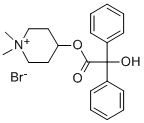
What is parapenzolate bromide?
Originator
Spacine, Unilabo , France ,1968
The Uses of parapenzolate bromide
Anticholinergic.
Manufacturing Process
N-methyl-4-piperidyl benzilate and the methiodide: An intimate mixture of 0.1 mol of N-methyl-4-piperidinol hydrochloride and 0.1 mol diphenylchloroacetyl chloride is heated at 160°C to 180°C until the evolution of hydrogen chloride ceases (usually about 4 to 5 hours). The melt is then dissolved in 500 ml of water and the resultant mixture heated on a steam bath for about ? hour, after which time complete solution is effected. The acid solution is cooled and rendered alkaline with ammonium hydroxide solution whereupon the ester is precipitated. The ester is purified either by removal by filtration and recrystallization from benzene petroleum ether or by extracting the mixture with benzene and precipitating the ester by the addition of petroleum ether. After recrystallization there is obtained about 0.06 mol of N-methyl-4-piperidyl benzilate, melting point 162°C to 163°C.
To a solution of 0.05 mol of the above obtained ester in about 100 ml of anhydrous benzene there are added 15 ml of methyl iodide. The ensuing mixture is refluxed for several hours whereupon the quaternary salt is deposited and removed by filtration. Recrystallization from ethanol or ethanolether yields the quaternary salt, melting point 199°C to 200°C.
N-methyl-4piperidyl benzilate methobromide: To a suspension of 0.15 mol of freshly prepared silver bromide in 300 ml of anhydrous methanol is added a solution of 0.1 mol of quaternary iodide obtained as above. The mixture is stirred and refluxed for several hours after which time transhalogenation is complete. The mixture is cooled, the insoluble silver salt removed by filtration and the methanolic solution of the quaternaty bromide is concentrated in vacuo. The residue is recrystallized from methanol or methanol-ether yielding the quaternary bromide in quantitative amounts, melting point 237°C to 238°C.
Therapeutic Function
Antiulcer
Properties of parapenzolate bromide
| Melting point: | 237-238 °C |
Safety information for parapenzolate bromide
Computed Descriptors for parapenzolate bromide
New Products
2-(2-Chlorophenyl)glycine Propiolic Acid 1-(3-Hydroxy-4-methoxyphenyl)-2-nitroethene (±)-amino(2-fluorophenyl)acetic acid trans-3-Benzyloxy-4-methoxy-beta-nitrostyrene 1-Pentadecanol 4-(4-Αminophenyl)-3-Morpholinone 3-Morpholino-1-(4-(2-oxopiperidin-1-yl) phenyl)-5,6-dihyropyridin-2-(1H)-one 1-(4-Aminophenyl)-3-morpholino-5,6-dihydropyridin-2(1H)-one N-cyanoacetylurethane 1H-IndazoleRelated products of tetrahydrofuran
You may like
-
 40216-83-9 trans-4-Hydroxy-L-proline methyl ester hydrochloride 98+View Details
40216-83-9 -
471-25-0 Propiolic Acid 98+View Details
471-25-0 -
84145-28-8 98+View Details
84145-28-8 -
trans-3-Benzyloxy-4-methoxy-beta-nitrostyrene 98+View Details
63909-29-5 -
2-(2-Chlorophenyl)glycine 88744-36-9 98+View Details
88744-36-9 -
40216-83-9 trans-4-Hydroxy-L-proline methyl ester hydrochloride 98+View Details
40216-83-9 -
629-76-5 98+View Details
629-76-5 -
1-(3-Hydroxy-4-methoxyphenyl)-2-nitroethene 98+View Details
39816-35-8