
N-NITROSO-N-METHYLURETHANE
- CAS NO.:615-53-2
- Empirical Formula: C4H8N2O3
- Molecular Weight: 132.12
- MDL number: MFCD00013888
- EINECS: 210-432-3
- SAFETY DATA SHEET (SDS)
- Update Date: 2026-05-28 04:40:30
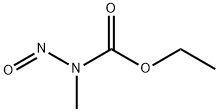
What is N-NITROSO-N-METHYLURETHANE?
Chemical properties
Yellow Oil
The Uses of N-NITROSO-N-METHYLURETHANE
N-Methyl-N-nitrosourethane is a nitrosamide which causes chromosomal damage in HeLa cells. It is also used in the synthesis of antifungal agents such as azoxybacillin.
Definition
ChEBI: N-Nitroso-N-methylurethane is a carboxylic ester.
General Description
Solid.
Reactivity Profile
N-NITROSO-N-METHYLURETHANE is a N-nitrosated carbamate ester. Incompatible with strong acids and bases. Especially incompatible with strong reducing agents such as hydrides. Flammable gaseous hydrogen may be produced by the combination with active metals or nitrides Incompatible with oxidizing acids, peroxides, and hydroperoxides.
Health Hazard
TOXIC; inhalation, ingestion or skin contact with material may cause severe injury or death. Contact with molten substance may cause severe burns to skin and eyes. Avoid any skin contact. Effects of contact or inhalation may be delayed. Fire may produce irritating, corrosive and/or toxic gases. Runoff from fire control or dilution water may be corrosive and/or toxic and cause pollution.
Fire Hazard
Non-combustible, substance itself does not burn but may decompose upon heating to produce corrosive and/or toxic fumes. Some are oxidizers and may ignite combustibles (wood, paper, oil, clothing, etc.). Contact with metals may evolve flammable hydrogen gas. Containers may explode when heated.
Safety Profile
Confirmed carcinogen with experimental carcinogenic, tumorigenic, and teratogenic data. Poison by ingestion, intraperitoneal, subcutaneous, and intravenous routes. Moderately toxic by inhalation. Experimental reproductive effects. Mutation data reported. Has been implicated as a transplacental brain carcinogen. Combustible when exposed to heat, sparks, open flame, and powerful oxidizers. Explodes when heated. A storage hazard. When heated to decomposition it emits toxic fumes of NOx.
Properties of N-NITROSO-N-METHYLURETHANE
| Boiling point: | 66 °C / 13mmHg |
| Density | 1,14 g/cm3 |
| refractive index | 1.4360 to 1.4400 |
| storage temp. | Refrigerator |
| solubility | Chloroform, Ethyl Acetate , Methanol |
| form | Oil |
| pka | -2.73±0.70(Predicted) |
| color | Clear Yellow |
| Water Solubility | 36.99g/L(24 ºC) |
| IARC | 2B (Vol. 4, Sup 7) 1987 |
| EPA Substance Registry System | N-Nitroso-N-methylurethane (615-53-2) |
Safety information for N-NITROSO-N-METHYLURETHANE
| Signal word | Danger |
| Pictogram(s) |
 Skull and Crossbones Acute Toxicity GHS06  Health Hazard GHS08 |
| GHS Hazard Statements |
H301:Acute toxicity,oral H315:Skin corrosion/irritation H319:Serious eye damage/eye irritation H335:Specific target organ toxicity, single exposure;Respiratory tract irritation H341:Germ cell mutagenicity H351:Carcinogenicity |
| Precautionary Statement Codes |
P201:Obtain special instructions before use. P202:Do not handle until all safety precautions have been read and understood. P261:Avoid breathing dust/fume/gas/mist/vapours/spray. P264:Wash hands thoroughly after handling. P264:Wash skin thouroughly after handling. P270:Do not eat, drink or smoke when using this product. P271:Use only outdoors or in a well-ventilated area. P280:Wear protective gloves/protective clothing/eye protection/face protection. P302+P352:IF ON SKIN: wash with plenty of soap and water. P305+P351+P338:IF IN EYES: Rinse cautiously with water for several minutes. Remove contact lenses, if present and easy to do. Continuerinsing. P308+P313:IF exposed or concerned: Get medical advice/attention. P332+P313:IF SKIN irritation occurs: Get medical advice/attention. P337+P313:IF eye irritation persists: Get medical advice/attention. P405:Store locked up. P403+P233:Store in a well-ventilated place. Keep container tightly closed. |
Computed Descriptors for N-NITROSO-N-METHYLURETHANE
New Products
N-Carbethoxy-4-piperidone 1-Aminocyclopentane carbonitrile Tetrabutylammonium perchlorate N,O-Dimethylhydroxylamine hydrochloride (RS)-beta-Amino-beta-(4-bromophenyl)propionic acid 2-Amino-5-bromo-4-(trifluoromethyl)pyridine N-Vinylformamide 4 pentyn 1 ol Phenethyl cinnamate Dipropyl disulfide Ethyl 3-phenylpropanoate β-Bromostyrene Methacrylate-PEG-Methacrylate, Mn:35000 2,4-Dihydroxyacetophenone 2-Chloro 5-Fluoro Pyridine Vasicinone 2-Chloroisonicotinic Acid Tween 80 or Polysorbate 80 5-Bromo-1-Pentyne 1-(2-Methyl-5-nitrophenyl)guanidine Nitrate Methyl trans-4-Aminocyclohexanecarboxylate Hydrochloride N-(4-Cyano-3-(trifluoromethyl)phenyl)-2-methyloxirane-2-carboxamide 2-Pentyn-1-oL 4-NitrobenzotrifluorideRelated products of tetrahydrofuran
You may like
-
 N-Methyl-N-nitrosourethane CAS 615-53-2View Details
615-53-2 -
144-83-2 Sulfapyridine 98+View Details
144-83-2 -
29976-53-2 98+View Details
29976-53-2 -
(RS)-beta-Amino-beta-(4-bromophenyl)propionic acid 39773-47-2 98+View Details
39773-47-2 -
6638-79-5 N,O-Dimethylhydroxylamine hydrochloride 98+View Details
6638-79-5 -
674783-97-2 98+View Details
674783-97-2 -
1-Aminocyclopentane carbonitrile 98+View Details
49830-37-7 -
Tetrabutylammonium perchlorate 1923-70-2 98+View Details
1923-70-2