
N-Hydroxynaphthalimide triflate
- CAS NO.:85342-62-7
- Empirical Formula: C13H6F3NO5S
- Molecular Weight: 345.25
- MDL number: MFCD02683478
- EINECS: 233-299-3
- SAFETY DATA SHEET (SDS)
- Update Date: 2026-05-27 23:38:32
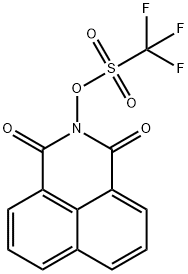
What is N-Hydroxynaphthalimide triflate?
Chemical properties
N-Hydroxynaphthalimide triflate is a low molecular weight compound with the appearance of white to light yellow powder to crystal, melting point is 212.1~214.2 °C, boiling point is 456.2±55.0 °C, density is 1.76±0.1 g/cm3, maximum absorption wavelength is 365(CH3CN) nm. It is sensitive to light and moisture and is normally stored under inert gas.
The Uses of N-Hydroxynaphthalimide triflate
HNT can be used to form patterned nanoparticles that find potential applications in volumetric manufacturing of semiconductor devices. It can also be used in the photo-responsive pore reopening of zeolites that facilitates the regulation of the gas permeation process. UV-irradiated trimethylsilyl ultrathin cellulose based films can be formed in presence of HNT as a PAG.
What are the applications of Application
N-Hydroxynaphthalimide triflate is a cationic photoinitiator and nonionic photoacid generator
What are the applications of Application
N-Hydroxynaphthalimide triflate is a cationic photoinitiator and nonionic photoacid generator used for polymer science, contact printing, and self-assembled monolayers (SAMs).
General Description
N-Hydroxynaphthalimide triflate (HNT) is a photoacid generator(PAG) that forms an acid upon exposure to UV light which can be used to generate patterned structures. It can also be used to tune the solubility of a polymer by forming acid linkages.
Properties of N-Hydroxynaphthalimide triflate
| Melting point: | 212.1-214.2 °C |
| Boiling point: | 456.2±55.0 °C(Predicted) |
| Density | 1.76±0.1 g/cm3(Predicted) |
| storage temp. | 2-8°C |
| solubility | PGMEA: 1% |
| form | powder to crystal |
| color | White to Light yellow |
| CAS DataBase Reference | 85342-62-7 |
Safety information for N-Hydroxynaphthalimide triflate
| Signal word | Warning |
| Pictogram(s) |
 Exclamation Mark Irritant GHS07 |
| GHS Hazard Statements |
H302:Acute toxicity,oral H315:Skin corrosion/irritation H319:Serious eye damage/eye irritation H335:Specific target organ toxicity, single exposure;Respiratory tract irritation |
| Precautionary Statement Codes |
P261:Avoid breathing dust/fume/gas/mist/vapours/spray. P305+P351+P338:IF IN EYES: Rinse cautiously with water for several minutes. Remove contact lenses, if present and easy to do. Continuerinsing. |
Computed Descriptors for N-Hydroxynaphthalimide triflate
| InChIKey | LWHOMMCIJIJIGV-UHFFFAOYSA-N |
New Products
Dibenzoyl-L-tartaric acid Anhydrous (Resolution Reagent) Cis-Tosylate Dibenzo[b,f][1,4]thiazepin-11(10H)-one 1,2,3,9-Tetrahydro-9-Methyl-4H-Carbazole-4-One 1-(4-methoxyphenyl)-4-(4-Nitrophenyl)Piperazine (IT-1) BOC Piperazine 1-Benzhydrylazetane-3-carbonitrile 8-oxa-1,3-diazaspiro[4.5]decane-2,4-dione (±)-amino(2-fluorophenyl)acetic acid 2-(2-Chlorophenyl)glycine AMINO-(3-CHLORO-PHENYL)-ACETIC ACID 2'-Fluoroacetophenone METHANOL-D1(OD) TERTIARY BUTANOL-D9 N-ETHYL-D5-AMINE HYDROCHLORIDE BENZOIC ACID-D CHLOROFORM-D TOLUENE-D3 Trans,trans muconic acid HC Blue-16 4-Amino-2-chloro-6,7-dimethoxyquinazoline Ethyl 4,5-bis(2-methoxyethoxy)-2-nitrobenzoate 2,3-Dimethoxypyridine 1-(3-Chlorophenyl)piperazine hydrochlorideRelated products of tetrahydrofuran
You may like
-
 N-Hydroxynaphthalimide triflate 95% CAS 85342-62-7View Details
85342-62-7 -
N-Hydroxynaphthalimide Trifluoromethanesulfonate CAS 85342-62-7View Details
85342-62-7 -
 Product IntroductionView Details
 -
 Product InrtroductionView Details
 -
 DGO24View Details
 -
 DGO25View Details
 -
 DGO29View Details
 -
 DGO32View Details