
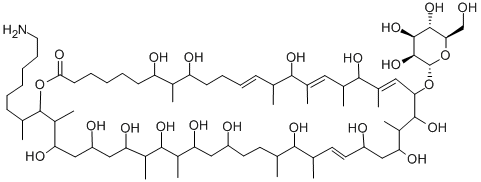
monazomycin
- CAS NO.:11006-31-8
- Empirical Formula: C72H133NO22
- Molecular Weight: 1364.82
- MDL number: MFCD01714647
- SAFETY DATA SHEET (SDS)
- Update Date: 2026-04-24 14:58:28
What is monazomycin?
The Uses of monazomycin
Monazomycin is a macrocylic polyol lactone isolated from several species of Streptoverticillium, first reported in 1963. Monazomycin is active against Gram positive bacteria with weak Gram negative activity. In solution, monazomycin exists as hydrophilic clusters which, when adsorbed onto a lipid bilayer, can induce channel formation. Monazomycin is an important bioprobe for understanding membrane channels.
The Uses of monazomycin
Monazomycin is a macrocyclic polyol lactone antibiotic isolated from Streptoverticilium.
What are the applications of Application
Monazomycin is a macrocyclic polyol lactone antibiotic isolated from Streptoverticilium
Biological Activity
monazomycin is a positively charged and polyenelike antibiotic produced by streptomyces [1].monazomycin is able to induce a voltage-dependent conductance in lipid bilayer membranes. monazomycin is selective for monovalent cations and can alter the membrane conductance when applied to one or both sides of the membrane [1]. application of micromolar amounts of monazomycin on one side of phospholipid bilayer membranes induced dramatic voltage-dependent conductance effects. the steady-state conductance was proportional to the 5th power of the monazomycin concentration and increased exponentially with positive voltage (monazomycin side positive); there was an e-fold change in conductance per 4–6 mv. the major current-carrying ions were univalent cations. monazomycin monomers cooperated to form a multimolecular conductance channel. the voltage control of conductance arose from the electric field driving monazomycin molecules at the membrane surface into the membrane and thus affecting the number of channels that were formed [2].
References
[1] bamberg e, janko k. single channel conductance at lipid bilayer membranes in presence of monazomycin[j]. biochimica et biophysica acta (bba)-biomembranes, 1976, 426(3): 447-450.
[2] muller r u, finkelstein a. voltage-dependent conductance induced in thin lipid membranes by monazomycin[j]. the journal of general physiology, 1972, 60(3): 263-284.
Properties of monazomycin
| Melting point: | 127°C |
| Boiling point: | 866.56°C (rough estimate) |
| Density | 0.9708 (rough estimate) |
| refractive index | 1.5280 (estimate) |
| storage temp. | Store at -20°C |
| solubility | Soluble in DMSO |
| form | solid |
| pka | 12.89±0.70(Predicted) |
Safety information for monazomycin
Computed Descriptors for monazomycin
New Products
Cis-Tosylate Dibenzo[b,f][1,4]thiazepin-11(10H)-one Dibenzoyl-L-tartaric acid Anhydrous (Resolution Reagent) 1,2,3,9-Tetrahydro-9-Methyl-4H-Carbazole-4-One N-BOC-piperidine-4-carboxylic acid 1-Benzhydrylazetane-3-carbonitrile AMINO-(3-CHLORO-PHENYL)-ACETIC ACID 2-(2-Chlorophenyl)glycine (±)-amino(2-fluorophenyl)acetic acid 8-oxa-1,3-diazaspiro[4.5]decane-2,4-dione TRIFLOURO ACETICACID-D METHANE SULFONIC ACID-D4 PHOSPORIC ACID-D3 85 W% IN D2O DEUTERIUM OXIDE FOR NMR TOLUENE-D3 BENZENE-D6 1-Acetyl-4-(4-hydroxyphenyl)piperazine 1-(3-Chlorophenyl)piperazine hydrochlorideRelated products of tetrahydrofuran

You may like
-
 7292-71-9 AMINO-(3-CHLORO-PHENYL)-ACETIC ACID 98+View Details
7292-71-9 -
84145-28-8 98+View Details
84145-28-8 -
2-(2-Chlorophenyl)glycine 98+View Details
88744-36-9 -
8-oxa-1,3-diazaspiro[4.5]decane-2,4-dione 39124-19-1 98+View Details
39124-19-1 -
7292-71-9 AMINO-(3-CHLORO-PHENYL)-ACETIC ACID 98+View Details
7292-71-9 -
84145-28-8 98+View Details
84145-28-8 -
2-(2-Chlorophenyl)glycine 98+View Details
88744-36-9 -
8-oxa-1,3-diazaspiro[4.5]decane-2,4-dione 39124-19-1 98+View Details
39124-19-1