
Methyltin trichloride
Synonym(s):Trichloromethylstannane
- CAS NO.:993-16-8
- Empirical Formula: CH3Cl3Sn
- Molecular Weight: 240.1
- MDL number: MFCD00000514
- EINECS: 213-608-8
- SAFETY DATA SHEET (SDS)
- Update Date: 2026-09-12 18:56:09
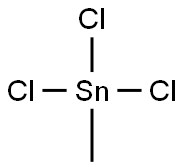
What is Methyltin trichloride?
Chemical properties
White crystals
The Uses of Methyltin trichloride
A chemical used in the synthesis of metallasilesesquiloxanes. Also used in the preparation of organotin(IV) complexes showing antibacterial activities.
What are the applications of Application
Methyltin trichloride is a chemical used in the synthesis of metallasilesesquiloxanes
Hazard
Moderately toxic. Experimental reproduc-tive effects.
Safety Profile
Moderately toxic by an unspecified route. Experimental reproductive effects. When heated to decomposition it emits toxic fumes of Cl-.
Properties of Methyltin trichloride
| Melting point: | 48-51 °C(lit.) |
| Boiling point: | 171 °C(lit.) |
| Flash point: | 105 °F |
| storage temp. | Flammables area |
| solubility | Soluble in Chloroform, Methanol. |
| form | crystal |
| color | white |
| Sensitive | Moisture Sensitive |
| Hydrolytic Sensitivity | 6: forms irreversible hydrate |
| Exposure limits | ACGIH: TWA 0.1 mg/m3; STEL 0.2 mg/m3 (Skin) NIOSH: IDLH 25 mg/m3; TWA 0.1 mg/m3 |
| InChI | InChI=1S/CH3.3ClH.Sn/h1H3;3*1H;/q;;;;+3/p-3 |
| CAS DataBase Reference | 993-16-8(CAS DataBase Reference) |
| EPA Substance Registry System | Stannane, trichloromethyl- (993-16-8) |
Safety information for Methyltin trichloride
| Signal word | Danger |
| Pictogram(s) |
 Flame Flammables GHS02  Corrosion Corrosives GHS05  Skull and Crossbones Acute Toxicity GHS06  Health Hazard GHS08 |
| GHS Hazard Statements |
H228:Flammable solids H302:Acute toxicity,oral H311:Acute toxicity,dermal H314:Skin corrosion/irritation H330:Acute toxicity,inhalation H372:Specific target organ toxicity, repeated exposure H412:Hazardous to the aquatic environment, long-term hazard |
| Precautionary Statement Codes |
P210:Keep away from heat/sparks/open flames/hot surfaces. — No smoking. P260:Do not breathe dust/fume/gas/mist/vapours/spray. P280:Wear protective gloves/protective clothing/eye protection/face protection. P303+P361+P353:IF ON SKIN (or hair): Remove/Take off Immediately all contaminated clothing. Rinse SKIN with water/shower. P305+P351+P338:IF IN EYES: Rinse cautiously with water for several minutes. Remove contact lenses, if present and easy to do. Continuerinsing. |
Computed Descriptors for Methyltin trichloride
| InChIKey | YFRLQYJXUZRYDN-UHFFFAOYSA-K |
| SMILES | [Sn](Cl)(Cl)(Cl)C |
New Products
2-(2-Chlorophenyl)glycine Propiolic Acid 1-(3-Hydroxy-4-methoxyphenyl)-2-nitroethene (±)-amino(2-fluorophenyl)acetic acid trans-3-Benzyloxy-4-methoxy-beta-nitrostyrene 1-Pentadecanol 2,4-Dihydroxybenzaldehyde Dipropyl disulfide Pyrrolo[1,2-a]pyrimidine-6-carboxylic acid, 4,6,7,8-tetrahydro-4-oxo-, sodium salt (1:1), (6S) Obidoxime hydrochloride API 4 pentyn 1 ol N-Vinylformamide Methacrylate-PEG-Methacrylate, Mn:35000 2,4-Dihydroxyacetophenone 2-Chloro 5-Fluoro Pyridine Vasicinone 2-Chloroisonicotinic Acid Tween 80 or Polysorbate 80 2-Butyn-1-oL N-(4-Cyano-3-(trifluoromethyl)phenyl)-2-methyloxirane-2-carboxamide N-(4-fluoro-2-methoxy-5-nitrophenyl)-4-(1-methyl-1H-indol-3-yl)pyrimidin-2-amine Pirtobrutinib intd. 2-Pentyn-1-oL 4-NitrobenzotrifluorideRelated products of tetrahydrofuran

You may like
-
 Methyltin trichloride CAS 993-16-8View Details
993-16-8 -
471-25-0 Propiolic Acid 98+View Details
471-25-0 -
84145-28-8 98+View Details
84145-28-8 -
trans-3-Benzyloxy-4-methoxy-beta-nitrostyrene 98+View Details
63909-29-5 -
2-(2-Chlorophenyl)glycine 88744-36-9 98+View Details
88744-36-9 -
40216-83-9 trans-4-Hydroxy-L-proline methyl ester hydrochloride 98+View Details
40216-83-9 -
629-76-5 98+View Details
629-76-5 -
1-(3-Hydroxy-4-methoxyphenyl)-2-nitroethene 98+View Details
39816-35-8
Statement: All products displayed on this website are only used for non medical purposes such as industrial applications or scientific research, and cannot be used for clinical diagnosis or treatment of humans or animals. They are not medicinal or edible.