
MAGNESIUM CHLORATE
- CAS NO.:10326-21-3
- Empirical Formula: Cl2MgO6
- Molecular Weight: 191.21
- MDL number: MFCD01732059
- EINECS: 233-711-1
- SAFETY DATA SHEET (SDS)
- Update Date: 2026-04-01 16:59:24
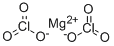
What is MAGNESIUM CHLORATE?
Description
Magnesium chlorate is white crystalline solid.Molecular weight= 191.21; Boiling point= 120℃;Freezing/Melting point= 35℃. Soluble in water (reaction).
Chemical properties
White powder; bitter taste. Very hygroscopic. Soluble in water; slightly soluble in alcohol.
Chemical properties
Magnesium chlorate is white crystalline solid.
The Uses of MAGNESIUM CHLORATE
Magnesium Chlorate can used in Defoliant, desiccant.
Reactions
Magnesium chlorate is a powerful oxidizer. There is an explosive reaction with copper(I) sulfide, an incandescent reaction with antimony(III) sulfide, arsenic(III) sulfide, tin(II) sulfide, and tin(IV) sulfide. This salt is incompatible with Al, As, C, Cu, MnO2, organic matter, organic acids, phosphorus or sulfur. Mixtures with ammonium salts, with powdered metals, silicon, sulfur, or sulfides are readily ignited and potentially unstable, even at room temperature. A combination of finely divided aluminum and magnesium chlorate can explode by heat, percussion, or friction. Magnesium chlorate is readily available commercially.
General Description
White deliquescent crystals or powder. Soluble in water and denser than water. Poses a dangerous fire risk when in contact with organic materials or heat. May be irritating to skin, eyes and mucous membranes. Used to make other chemicals.
Air & Water Reactions
Soluble in water.
Reactivity Profile
MAGNESIUM CHLORATE is a powerful oxidizer. Explosive reaction with copper(I) sulfide. Incandescent reaction with antimony(III) sulfide, arsenic(III) sulfide, tin(II) sulfide, tin(IV) sulfide. Incompatible with Al, As, C, Cu, MnO2, organic matter, organic acids, P and S. [Lewis, 3rd Ed . 786] . Mixtures with ammonium salts, with powdered metals, silicon, sulfur, or sulfides are readily ignited and potentially explosive [Bretherick 1979. p. 806]. A combination of finely divided aluminum and MAGNESIUM CHLORATE can explode by heat, percussion, or friction [Mellor 2:310. 1946-47].
Hazard
Dangerous fire risk in contact with organic materials, strong oxidizing agent.
Health Hazard
Inhalation, ingestion or contact (skin, eyes) with vapors or substance may cause severe injury, burns or death. Fire may produce irritating, corrosive and/or toxic gases. Runoff from fire control or dilution water may cause pollution.
Fire Hazard
These substances will accelerate burning when involved in a fire. Some may decompose explosively when heated or involved in a fire. May explode from heat or contamination. Some will react explosively with hydrocarbons (fuels). May ignite combustibles (wood, paper, oil, clothing, etc.). Containers may explode when heated. Runoff may create fire or explosion hazard.
Potential Exposure
Used as a drying agent and defoliant
First aid
If this chemical gets into the eyes, remove anycontact lenses at once and irrigate immediately for at least15 min, occasionally lifting upper and lower lids. Seek medical attention immediately. If this chemical contacts theskin, remove contaminated clothing and wash immediatelywith soap and water. Seek medical attention immediately. Ifthis chemical has been inhaled, remove from exposure,begin rescue breathing (using universal precautions, including resuscitation mask) if breathing has stopped and CPR ifheart action has stopped. Transfer promptly to a medicalfacility. When this chemical has been swallowed, get medical attention. Give large quantities of water and inducevomiting. Do not make an unconscious person vomit.Note to physician: Treat for methemoglobinemia.Spectrophotometry may be required for precise determination of levels of methemoglobin in urine.
Storage
olor Code—Yellow: Reactive Hazard; Store in alocation separate from other materials, especially flam mables and combustibles. Prior to working with magnesiumchlorate you should be trained on its proper handling andstorage. Magnesium chlorate must be stored to avoid con tact with aluminum, arsenic, carbon, copper, phosphorus,sulfur, magnesium oxide, metal sulfides, fuels, and strongacids, since violent reactions occur. Store in tightly closed1638 Magnesium chloratecontainers in a cool, well-ventilated area away from flammable and combustible materials. See OSHA Standard1910.104 and NFPA 43A Code for the Storage of Liquidand Solid Oxidizers for detailed handling and storageregulations.
Shipping
UN2723 Magnesium chlorate. Hazard Class: 5.1; Labels: 5.1-Oxidizer, Technical Name Required
Incompatibilities
A strong oxidizer. Potentially explosive. Violent reactions with arsenic, carbon, charcoal, copper, phosphorus, sulfur, magnesium oxide; metal sulfides (copper sulfide, arsenic sulfide, tin sulfide; fuels, and strong acids. Reacts with moisture
Properties of MAGNESIUM CHLORATE
| Melting point: | ~35℃ [MER06] |
| Density | 1.80 [MER06] |
| Water Solubility | mol/100mol H2O: 10.73 (0°C), 13.52 (25°C), 26.38 (93°C); solid phase Mg(ClO3)2 · 6H2O (0°C, 25°C), Mg(ClO3)2 · 2H2O (93°C) [KRU93] |
| EPA Substance Registry System | Magnesium chlorate (10326-21-3) |
Safety information for MAGNESIUM CHLORATE
Computed Descriptors for MAGNESIUM CHLORATE
New Products
2-(2-Chlorophenyl)glycine Propiolic Acid trans-3-Benzyloxy-4-methoxy-beta-nitrostyrene 1-(3-Hydroxy-4-methoxyphenyl)-2-nitroethene (±)-amino(2-fluorophenyl)acetic acid 1-Pentadecanol N-Vinylformamide 4 pentyn 1 ol 4-(4-Αminophenyl)-3-Morpholinone 3-Morpholino-1-(4-(2-oxopiperidin-1-yl) phenyl)-5,6-dihyropyridin-2-(1H)-one 1-(4-Aminophenyl)-3-morpholino-5,6-dihydropyridin-2(1H)-one N-cyanoacetylurethane 1H-IndazoleRelated products of tetrahydrofuran


You may like
-
 40216-83-9 trans-4-Hydroxy-L-proline methyl ester hydrochloride 98+View Details
40216-83-9 -
471-25-0 Propiolic Acid 98+View Details
471-25-0 -
84145-28-8 98+View Details
84145-28-8 -
trans-3-Benzyloxy-4-methoxy-beta-nitrostyrene 98+View Details
63909-29-5 -
2-(2-Chlorophenyl)glycine 88744-36-9 98+View Details
88744-36-9 -
40216-83-9 trans-4-Hydroxy-L-proline methyl ester hydrochloride 98+View Details
40216-83-9 -
629-76-5 98+View Details
629-76-5 -
1-(3-Hydroxy-4-methoxyphenyl)-2-nitroethene 98+View Details
39816-35-8