
L-glutamic acid monoammonium
- CAS NO.:7558-63-6
- Empirical Formula: C5H12N2O4
- Molecular Weight: 164.16
- MDL number: MFCD00039098
- EINECS: 231-447-1
- SAFETY DATA SHEET (SDS)
- Update Date: 2026-06-24 18:39:39
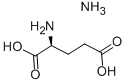
What is L-glutamic acid monoammonium?
Description
Refer to monosodium glutamate.
Description
L-Glutamic acid is a non-essential amino acid and the primary excitatory neurotransmitter in the CNS. It acts on ionotropic and metabotropic receptors to induce excitatory synaptic transmission and has roles in synaptic plasticity. Excessive release of L-glutamic acid induces excitotoxicity that is associated with various human diseases, including amyotrophic lateral sclerosis (ALS), stroke, Parkinson’s disease, Alzheimer’s disease, and Huntington’s disease. Excessive L-glutamic acid release, in its protonated glutamate form, also occurs during seizure activity and contributes to epileptogenesis and seizure-induced brain damage.
The Uses of L-glutamic acid monoammonium
L-Glutamic Acid Monoammonium Salt is a food additive; It can protect hypertensive rats from strokes.
The Uses of L-glutamic acid monoammonium
Monoammonium l-Glutamate is a flavor enhancer and salt substitute that is crystalline powder (white, free-flowing) and odorless. It is soluble in water, insoluble in common organic solvents, and is obtained by chemical synthesis. It is a low sodium alternative to monosodium glutamate. It is used in meats, soups, gravies, and sausage. It is also termed ammonium glutamate and monoammonium glutamate.
Safety Profile
Moderately toxic by intraperitoneal route. When heated to decomposition it emits toxic fumes including NOx and NH3.
Properties of L-glutamic acid monoammonium
| Melting point: | 169 - 173°C |
| storage temp. | −20°C |
| solubility | Aqueous Acid (Slightly), Methanol (Very Slightly), Water (Slightly) |
| form | White Crystalline Powder |
| color | White to Off-White |
| Odor | at 100.00?%. odorless |
| Stability: | Hygroscopic |
| EPA Substance Registry System | L-Glutamic acid, monoammonium salt (7558-63-6) |
Safety information for L-glutamic acid monoammonium
| Signal word | Warning |
| Pictogram(s) |
 Exclamation Mark Irritant GHS07 |
| GHS Hazard Statements |
H315:Skin corrosion/irritation H319:Serious eye damage/eye irritation |
| Precautionary Statement Codes |
P264:Wash hands thoroughly after handling. P264:Wash skin thouroughly after handling. P280:Wear protective gloves/protective clothing/eye protection/face protection. P302+P352:IF ON SKIN: wash with plenty of soap and water. P305+P351+P338:IF IN EYES: Rinse cautiously with water for several minutes. Remove contact lenses, if present and easy to do. Continuerinsing. P332+P313:IF SKIN irritation occurs: Get medical advice/attention. P337+P313:IF eye irritation persists: Get medical advice/attention. |
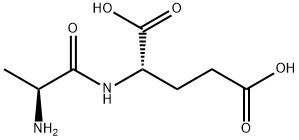
Computed Descriptors for L-glutamic acid monoammonium
New Products
9-Mesityl-10-methylacridinium perchlorate Sulfapyridine Fmoc-OSu (R)-(-)-2-Amino-1-propanol Cyclobutanone 5-bromo-4-fluoro-2-nitrobenzaldehyde 4 pentyn 1 ol N-Vinylformamide Phenethyl cinnamate Pyrrolo[1,2-a]pyrimidine-6-carboxylic acid, 4,6,7,8-tetrahydro-4-oxo-, sodium salt (1:1), (6S) Ethyl 3-phenylpropanoate β-Bromostyrene Methacrylate-PEG-Methacrylate, Mn:35000 2,4-Dihydroxyacetophenone 2-Chloro 5-Fluoro Pyridine Vasicinone 2-Chloroisonicotinic Acid Tween 80 or Polysorbate 80 5-Bromo-1-Pentyne 1-(2-Methyl-5-nitrophenyl)guanidine Nitrate Methyl trans-4-Aminocyclohexanecarboxylate Hydrochloride N-(4-Cyano-3-(trifluoromethyl)phenyl)-2-methyloxirane-2-carboxamide 4-Nitrobenzotrifluoride 2-Pentyn-1-oLRelated products of tetrahydrofuran
You may like
-
 Myelin-Associated Glycoprotein/Fc Chimera from rat CASView Details
 -
1191-95-3 Cyclobutanone 98+View Details
1191-95-3 -
Fmoc-OSu 98+View Details
82911-69-1 -
(R)-(-)-2-Amino-1-propanol 35320-23-1 98+View Details
35320-23-1 -
1191-95-3 Cyclobutanone 98+View Details
1191-95-3 -
213382-45-7 98+View Details
213382-45-7 -
Fmoc-OSu 98+View Details
82911-69-1 -
(R)-(-)-2-Amino-1-propanol 35320-23-1 98+View Details
35320-23-1