
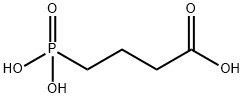
L-AP4
Synonym(s):L -AP-4;Cartilage-Derived Morphogenetic Protein-1;CDMP-1;LAP4;L-AP4
- CAS NO.:23052-81-5
- Empirical Formula: C4H10NO5P
- Molecular Weight: 183.1
- MDL number: MFCD00083244
- EINECS: 200-258-5
- SAFETY DATA SHEET (SDS)
- Update Date: 2026-07-10 17:58:43
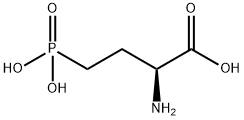
What is L-AP4?
Description
Metabotropic glutamate receptors (mGluR) function to modulate excitatory synaptic transmission in the brain. Eight subtypes (1-
Chemical properties
white to off-white crystalline powder
The Uses of L-AP4
Metabotropic glutamate receptors (mGluR) function to modulate excitatory synaptic transmission in the brain. Eight subtypes (1-8) and multiple splice variants of the mGluR have been identified and grouped based on their pharmacological properties. Group I mGluRs (subtypes 1 and 5) activate the phosphatidyl inositol pathway, while Group II (2 and 3) and Group III (4, 6, 7, and 8) inhibit adenylyl cyclase. L-AP4, an analog of L-glutamic acid, is a selective Group III mGluR agonist that functions presynaptically to suppress glutamate release (IC50 = 2.5 μM). L-AP4 has been shown to depress synaptic transmission in glutamatergic pathways in the hippocampus, olfactory bulb, and retina as well as act as an agonist at the quisqualate-sensitized AP6 site in hippocampus.
The Uses of L-AP4
L(+)-2-Amino-4-phosphonobutanoic acid (L-AP4) is a mGluR-4/6 receptor agonist.
What are the applications of Application
L(+)-2-Amino-4-phosphonobutanoic acid (L-AP4) is a mGluR-4/6 receptor agonist
Definition
ChEBI: (2S)-2-amino-4-phosphonobutanoic acid is a non-proteinogenc L-alpha-amino acid that is L-alpha-aminobutyric acid in which one of the hydrogens of the terminal methyl group has been replaced by a dihydroxy(oxido)-lambda(5)-phosphanyl group. It is a potent and selective agonist for the group III metabotropic glutamate receptors (mGluR4/6/7/8). It has a role as a metabotropic glutamate receptor agonist. It is a non-proteinogenic L-alpha-amino acid and a member of phosphonic acids.
Biological Activity
Selective group III metabotropic glutamate receptor agonist. Synaptic depressant. Agonist at the quisqualate-sensitized AP6 site in hippocampus. Also available as part of the Group III mGlu Receptor Tocriset™ and Mixed mGlu Receptor Tocriset™ .
Storage
Room temperature
Properties of L-AP4
| Melting point: | 207-215 °C |
| Boiling point: | 491.7±55.0 °C(Predicted) |
| Density | 1.628±0.06 g/cm3(Predicted) |
| storage temp. | 0-6°C |
| solubility | H2O : 50 mg/mL (273.07 mM; Need ultrasonic) |
| pka | 2.19±0.10(Predicted) |
| form | solid |
| color | White |
| Water Solubility | Soluble to 5 mM in water and to 100 mM in 1eq. NaOH |
| Sensitive | Light Sensitive |
| CAS DataBase Reference | 23052-81-5(CAS DataBase Reference) |
Safety information for L-AP4
| Signal word | Warning |
| Pictogram(s) |
 Exclamation Mark Irritant GHS07 |
| GHS Hazard Statements |
H315:Skin corrosion/irritation H319:Serious eye damage/eye irritation H335:Specific target organ toxicity, single exposure;Respiratory tract irritation |
| Precautionary Statement Codes |
P261:Avoid breathing dust/fume/gas/mist/vapours/spray. P304+P340:IF INHALED: Remove victim to fresh air and Keep at rest in a position comfortable for breathing. P305+P351+P338:IF IN EYES: Rinse cautiously with water for several minutes. Remove contact lenses, if present and easy to do. Continuerinsing. P405:Store locked up. |
Computed Descriptors for L-AP4
New Products
2-(2-Chlorophenyl)glycine Propiolic Acid 1-(3-Hydroxy-4-methoxyphenyl)-2-nitroethene (±)-amino(2-fluorophenyl)acetic acid trans-3-Benzyloxy-4-methoxy-beta-nitrostyrene 1-Pentadecanol 2,4-Dihydroxybenzaldehyde Obidoxime hydrochloride API Pyrrolo[1,2-a]pyrimidine-6-carboxylic acid, 4,6,7,8-tetrahydro-4-oxo-, sodium salt (1:1), (6S) Dipropyl disulfide 4 pentyn 1 ol N-Vinylformamide Methacrylate-PEG-Methacrylate, Mn:35000 2,4-Dihydroxyacetophenone 2-Chloro 5-Fluoro Pyridine Vasicinone 2-Chloroisonicotinic Acid Tween 80 or Polysorbate 80 2-Butyn-1-oL N-(4-Cyano-3-(trifluoromethyl)phenyl)-2-methyloxirane-2-carboxamide N-(4-fluoro-2-methoxy-5-nitrophenyl)-4-(1-methyl-1H-indol-3-yl)pyrimidin-2-amine Pirtobrutinib intd. 2-Pentyn-1-oL 4-NitrobenzotrifluorideRelated products of tetrahydrofuran
![[3H]-(L)-AP4](https://img.chemicalbook.in/StructureFile/ChemBookStructure3/GIF/CB7755385.gif)


You may like
-
 L-(+)-2-Amino-4-phosphonobutyric acid CAS 23052-81-5View Details
23052-81-5 -
471-25-0 Propiolic Acid 98+View Details
471-25-0 -
84145-28-8 98+View Details
84145-28-8 -
trans-3-Benzyloxy-4-methoxy-beta-nitrostyrene 98+View Details
63909-29-5 -
2-(2-Chlorophenyl)glycine 88744-36-9 98+View Details
88744-36-9 -
40216-83-9 trans-4-Hydroxy-L-proline methyl ester hydrochloride 98+View Details
40216-83-9 -
629-76-5 98+View Details
629-76-5 -
1-(3-Hydroxy-4-methoxyphenyl)-2-nitroethene 98+View Details
39816-35-8