
JTE-607 dihydrochloride
- CAS NO.:188791-09-5
- Empirical Formula: C25H32Cl3N3O5
- Molecular Weight: 560.9
- SAFETY DATA SHEET (SDS)
- Update Date: 2026-05-27 22:44:47
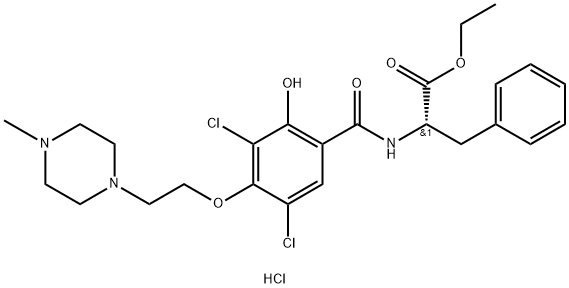
What is JTE-607 dihydrochloride?
Description
JTE-607 (188791-09-5) inhibits inflammatory cytokine production in human peripheral blood mononuclear cells (PBMC’s) without causing immunosuppression: IC50’s = 11 nM (TNF-α), 5.9 nM (IL-1β), 8.8 nM (IL-6), 7.3 nM (IL-8), and 9.1 nM (IL-10).1?It displayed efficacy in a mouse model of septic shock.2?JTE-607 also showed inhibitory activity against acute myelogenous leukemia cell lines.3,4?Recently, the mechanism of action of JTE-607 (a pro-drug, with the active species being the free acid) has been found to be inhibition of pre-messenger RNA endonuclease Cleavage and Polyadenylation Specificity Factor 3 (CPSF3).5,6?This prevents release of newly synthesized mRNA’s resulting in read-through transcription and the formation of DNA-RNA hybrid R-loop structures. Transcripts down-regulated by JTE-607 were related to DNA damage-based phenotype.
The Uses of JTE-607 dihydrochloride
JTE 607 Dihydrochloride is a cytokine release inhibitor.
Definition
ChEBI: JTE-607 dihydrochloride is the dihydrochloride salt of JTE-607. It is a cytokine inhibitor which suppresses the production of proinflammatory cytokines such as interleukin (IL-1beta), IL-6, IL-8, granulocyte macrophage colony stimulating factor (GM-CSF), and tumor necrosis factor (TNF-alpha). It acts as a pro-drug which is cleaved by carboxylesterase 1 (CES1) to its active free acid form, which then binds to cleavage and polyadenylation specificity factor 3 (CPSF3). It has a role as an anti-inflammatory agent, an antineoplastic agent, an apoptosis inducer, a prodrug, a cardioprotective agent and a CPSF3 inhibitor. It contains a JTE-607(2+).
Storage
Desiccate at RT
References
References/Citations 1) Kakutani?et al.?(1999),?JTE-607, a novel inflammatory cytokine synthesis inhibitor without immunosuppression, protects from endotoxin shock in mice; Inflamm. Res.,?48?461 2) Iwamura?et al.?(2004),?Comparative study of glucocorticoids, cyclosporine A, and JTE-607 [(-)-Ethyl-N{3,5-dichloro-2-hydroxy-4-[2-(4-methylpiperazin-1-yl)ethoxy]benzoyl]-L-phenylalaninate dihydrochloride] in a mouse septic shock model; J. Pharmacol. Exp. Ther.,?311?1256 3) Uesato?et al.?(2006),?JTE-607, a multiple cytokine production inhibitor, ameliorates disease in a SCID mouse xenograft acute myeloid leukemia model; Exp. Hematol.,?34?1385 4) Tajima?et al.?(2010),?JTE-607, a multiple cytokine production inhibitor, induces apoptosis accompanied by an increase in p21waf1/cip1 in acute myelogenous leukemia cells; Cancer Sci.,?101?774 5) Kakegawa?et al.?(2019), JTE-607, a multiple cytokine production inhibitor, targets CPSF3 and inhibits pre-mRNA; Biochem. Biophys. Res. Commun.,?518?32 6) Ross?et al.?(2020),?CPSF3-dependent pre-mRNA processing as a druggable node in AML and Ewing’s sarcoma; Nat. Chem. Biol.,?16?50
Properties of JTE-607 dihydrochloride
| storage temp. | -20° (des.) |
| solubility | Soluble in DMSO (up to 25 mg/ml). |
| form | solid |
| color | Off-white to pale yellow |
| Stability: | Stable for 1 year as supplied. Solutions in DMSO may be stored at -20° for up to 1 month. |
Safety information for JTE-607 dihydrochloride
| Signal word | Warning |
| Pictogram(s) |
 Exclamation Mark Irritant GHS07 |
| GHS Hazard Statements |
H302:Acute toxicity,oral H315:Skin corrosion/irritation H319:Serious eye damage/eye irritation H335:Specific target organ toxicity, single exposure;Respiratory tract irritation |
| Precautionary Statement Codes |
P261:Avoid breathing dust/fume/gas/mist/vapours/spray. P280:Wear protective gloves/protective clothing/eye protection/face protection. P301+P312:IF SWALLOWED: call a POISON CENTER or doctor/physician IF you feel unwell. P302+P352:IF ON SKIN: wash with plenty of soap and water. P305+P351+P338:IF IN EYES: Rinse cautiously with water for several minutes. Remove contact lenses, if present and easy to do. Continuerinsing. |
Computed Descriptors for JTE-607 dihydrochloride
New Products
2-(2-Chlorophenyl)glycine Propiolic Acid 1-(3-Hydroxy-4-methoxyphenyl)-2-nitroethene (±)-amino(2-fluorophenyl)acetic acid trans-3-Benzyloxy-4-methoxy-beta-nitrostyrene 1-Pentadecanol 2,4-Dihydroxybenzaldehyde Dipropyl disulfide Pyrrolo[1,2-a]pyrimidine-6-carboxylic acid, 4,6,7,8-tetrahydro-4-oxo-, sodium salt (1:1), (6S) Obidoxime hydrochloride API 4 pentyn 1 ol N-Vinylformamide Methacrylate-PEG-Methacrylate, Mn:35000 2,4-Dihydroxyacetophenone 2-Chloro 5-Fluoro Pyridine Vasicinone 2-Chloroisonicotinic Acid Tween 80 or Polysorbate 80 2-Butyn-1-oL N-(4-Cyano-3-(trifluoromethyl)phenyl)-2-methyloxirane-2-carboxamide N-(4-fluoro-2-methoxy-5-nitrophenyl)-4-(1-methyl-1H-indol-3-yl)pyrimidin-2-amine Pirtobrutinib intd. 2-Pentyn-1-oL 4-NitrobenzotrifluorideRelated products of tetrahydrofuran
You may like
-
 JTE-607 CAS 188791-09-5View Details
188791-09-5 -
471-25-0 Propiolic Acid 98+View Details
471-25-0 -
84145-28-8 98+View Details
84145-28-8 -
trans-3-Benzyloxy-4-methoxy-beta-nitrostyrene 98+View Details
63909-29-5 -
2-(2-Chlorophenyl)glycine 88744-36-9 98+View Details
88744-36-9 -
40216-83-9 trans-4-Hydroxy-L-proline methyl ester hydrochloride 98+View Details
40216-83-9 -
629-76-5 98+View Details
629-76-5 -
1-(3-Hydroxy-4-methoxyphenyl)-2-nitroethene 98+View Details
39816-35-8