
JM 221
- CAS NO.:129551-91-3
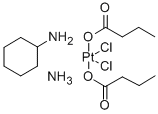
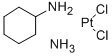
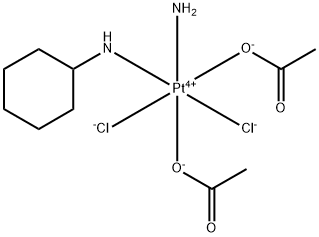
- Empirical Formula: C8H14Cl2O4Pt.C6H13N.H3N
- Molecular Weight: 556.387
- SAFETY DATA SHEET (SDS)
- Update Date: 2023-03-31 09:12:57
What is JM 221?
Description
JM-221 is a novel platinum(IV) dicarboxylate complex exhibiting enhanced cytotoxicity in human ovarian carcinoma cell line when compared to Cisplatin. Comparison with platinum accumulation from Cisplatin suggests that the increased cytotoxicity of JM-221 may be related_x000D_ to increased accumulation within the cell. JM-221 is more lipophilic than Cisplatin, which may account for improved uptake in Cisplatin resistant cells.
Safety information for JM 221
New Products
Dibenzoyl-L-tartaric acid Anhydrous (Resolution Reagent) Cis-Tosylate Dibenzo[b,f][1,4]thiazepin-11(10H)-one 1,2,3,9-Tetrahydro-9-Methyl-4H-Carbazole-4-One 1-(4-methoxyphenyl)-4-(4-Nitrophenyl)Piperazine (IT-1) BOC Piperazine 1-Benzhydrylazetane-3-carbonitrile 8-oxa-1,3-diazaspiro[4.5]decane-2,4-dione (±)-amino(2-fluorophenyl)acetic acid 2-(2-Chlorophenyl)glycine AMINO-(3-CHLORO-PHENYL)-ACETIC ACID 2'-Fluoroacetophenone METHANOL-D1(OD) TERTIARY BUTANOL-D9 N-ETHYL-D5-AMINE HYDROCHLORIDE BENZOIC ACID-D CHLOROFORM-D TOLUENE-D3 Trans,trans muconic acid HC Blue-16 4-Amino-2-chloro-6,7-dimethoxyquinazoline Ethyl 4,5-bis(2-methoxyethoxy)-2-nitrobenzoate 2,3-Dimethoxypyridine 1-(3-Chlorophenyl)piperazine hydrochlorideRelated products of tetrahydrofuran
You may like
-
 Product IntroductionView Details
 -
 Product InrtroductionView Details
 -
 DGO24View Details
 -
 DGO25View Details
 -
 DGO29View Details
 -
 DGO32View Details
 -
 DGO36View Details
 -
 DGO37View Details
Statement: All products displayed on this website are only used for non medical purposes such as industrial applications or scientific research, and cannot be used for clinical diagnosis or treatment of humans or animals. They are not medicinal or edible.