
Satraplatin
- CAS NO.:129580-63-8
- Empirical Formula: C10H20Cl2N2O4Pt
- Molecular Weight: 498.26
- MDL number: MFCD00871429
- SAFETY DATA SHEET (SDS)
- Update Date: 2026-07-17 09:03:53
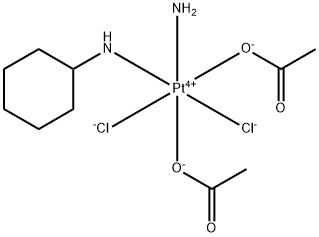
What is Satraplatin?
The Uses of Satraplatin
Antineoplastic.
Definition
ChEBI: A platinum coordination entity that consists of a central platunum atom bound to chloro (x2), acetate (x2), amino, and cyclohexylamino groups. Used for treatment of advanced prostate cancer.
Pharmaceutical Applications
Satraplatin (JM216, cis,trans,cis-[PtCl2(OAc)2(NH3)(C6H5NH2)]) is a Pt(IV) or Pt4+ complex, which is
active by oral administration, as it is more hydrophobic than cisplatin. This form of administration is very
attractive because of the convenience and freedom it provides to the patient. Satraplatin also has a milder toxicity
profile and is shows no cross-resistance with cisplatin. Satraplatin in combination with prednisone has
completed phase III clinical trials against hormone-refractory prostate cancer. The results were very encouraging,
but the overall survival rate did not improve significantly enough. As a result, the fast-track approval
of the FDA was not granted.
Structurally, satraplatin consists of a Pt(IV) centre, which is coordinated by six ligands forming a close to octahedral geometry. In general, octahedral Pt(IV) complexes (low-spin d6) are much more kinetically inert than square planar Pt(II) complexes.
Clinical Use
This newest organometallic agent currently is in clinical trials as a second-line agent for the treatment of hormone-refractory prostate cancer . There is hope that it also will find value in ovarian cancer and small cell lung cancer.
Side Effects
As with other organoplatinum complexes, the diaquo form is active. At this early stage, the toxicity profile appears to be mild, with dose-related myelosuppression, particularly neutropenia and thrombocytopenia, being the major use-limiting side effect.
Metabolism
Unlike the square-planar Pt(II) complexes currently on the market, it is active by the oral route. It is metabolized quickly in whole blood, producing up to six metabolites. The major metabolite is the desacetoxy analogue.
Properties of Satraplatin
| storage temp. | Store at -20°C |
| solubility | DMF: 0.16 mg/mL; DMSO: 0.5 mg/mL |
| form | Powder |
| color | Off-white to yellow |
Safety information for Satraplatin
Computed Descriptors for Satraplatin
New Products
5-bromo-4-fluoro-2-nitrobenzaldehyde Cyclobutanone (R)-(-)-2-Amino-1-propanol Fmoc-OSu 1-(2-Chloroethyl)pyrrolidine Hydrochloride 2-Amino-2-(4-methylphenyl)acetic acid 2,4-Dihydroxybenzaldehyde Obidoxime hydrochloride API Pyrrolo[1,2-a]pyrimidine-6-carboxylic acid, 4,6,7,8-tetrahydro-4-oxo-, sodium salt (1:1), (6S) Dipropyl disulfide 4 pentyn 1 ol N-Vinylformamide Methacrylate-PEG-Methacrylate, Mn:35000 2,4-Dihydroxyacetophenone 2-Chloro 5-Fluoro Pyridine Vasicinone 2-Chloroisonicotinic Acid Tween 80 or Polysorbate 80 2-Butyn-1-oL 2-Pentyn-1-oL 4-Nitrobenzotrifluoride N-(4-Cyano-3-(trifluoromethyl)phenyl)-2-methyloxirane-2-carboxamide N-(4-fluoro-2-methoxy-5-nitrophenyl)-4-(1-methyl-1H-indol-3-yl)pyrimidin-2-amine Pirtobrutinib intd.Related products of tetrahydrofuran

![(SP-4-2)-[(1R,2R)-1,2-Cyclohexanediamine-kN,kN']bis(tetradecanoato-kO)platinum monohydrate](https://img.chemicalbook.in/CAS/20180808/GIF/250159-48-9.gif)



You may like
-
 7250-67-1 1-(2-Chloroethyl)pyrrolidine Hydrochloride 98+View Details
7250-67-1 -
7250-67-1 1-(2-Chloroethyl)pyrrolidine Hydrochloride 98+View Details
7250-67-1 -
13227-01-5 98+View Details
13227-01-5 -
545445-44-1 3-Morpholino-1-(4-(2-oxopiperidin-1-yl) phenyl)-5,6-dihyropyridin-2-(1H)-one 98%View Details
545445-44-1 -
6629-04-5 98%View Details
6629-04-5 -
4-(4-Αminophenyl)-3-Morpholinone 98%View Details
438056-69-0 -
1-(4-Aminophenyl)-3-morpholino-5,6-dihydropyridin-2(1H)-one 1267610-26-3 98%View Details
1267610-26-3 -
 1H-Indazole | CAS No. 271-44-3 | Pharmaceutical IntermediateView Details
271-44-3