
JASPLAKINOLIDE
Synonym(s):Jaspamide;Jasplakinolide, Jaspis johnstoni - CAS 102396-24-7 - Calbiochem
- CAS NO.:102396-24-7
- Empirical Formula: C36H45BrN4O6
- Molecular Weight: 709.67
- MDL number: MFCD00873735
- SAFETY DATA SHEET (SDS)
- Update Date: 2026-07-16 07:06:08
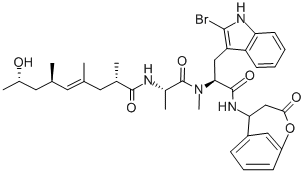
What is JASPLAKINOLIDE?
Description
Jasplakinolide is a natural macrocyclic peptide first isolated from a marine sponge. It potently inhibits the proliferation of PC3 prostate carcinoma cells (IC50 = 35 nM) by binding F-
The Uses of JASPLAKINOLIDE
Jasplakinolide is a potent inhibitor of prostrate and breast carcinoma cell proliferation. Also acts as an actin stabilizing agent, affecting chromosome movement in studies.
The Uses of JASPLAKINOLIDE
Jasplakinolide is a natural macrocyclic peptide first isolated from a marine sponge. It potently inhibits the proliferation of PC3 prostate carcinoma cells (IC50 = 35 nM) by binding F-actin (KD = 15 nM). This binding of jasplakinolide to actin, which is competitive with phalloidin, stabilizes actin filaments in vitro but disrupts actin filaments and induces irregular polymerization of monomeric actin in vivo. This compound is used to investigate the role of actin in diverse cellular roles, such as motility, transport, and development.
The Uses of JASPLAKINOLIDE
Jasplakinolide has been used to analyze its influence on sciatic nerve guidance effect in vivo in chicken embryos. It has also been used to apply on the control cells for the treatment for blocking actin dynamics.
What are the applications of Application
Jasplakinolide is a cell permeable compound which stabilizes pre-formed actin filaments and inhibits their disassembly
Definition
ChEBI: A cyclodepsipeptide isolated from Jaspis splendens and has been shown to exhibit antineoplastic activity.
Biochem/physiol Actions
Jasplakinolide is an actin-specific reagent that promotes actin polymerization and stabilizes actin filaments. In vitro, Jasplakinolidet potently induces actin polymerization by stimulating actin filament nucleation and competes with phalloidin for actin binding (Kd = 15 nM). In vivo, Jasplakinolide has been found to disrupt actin filaments and induce polymerization of monomeric actin into amorphous masses, the exact mechanism of which has not been determined yet. Jasplakinolide differs from other actin stabilizers in that it is cell permeable. This peptide has fungicidal, insecticidal and antiproliferative activity, and is useful for investigating cell processes mediated by actin polymerization and depolymerization, such as cell adhesion, locomotion, endocytosis, and vesicle sorting and release.
Storage
+4°C
Properties of JASPLAKINOLIDE
| Melting point: | 110℃ (decomposition) |
| storage temp. | -20°C |
| solubility | DMSO: >2mg/mL |
| form | Off-white solid |
| color | off white to beige |
Safety information for JASPLAKINOLIDE
Computed Descriptors for JASPLAKINOLIDE
New Products
9-Mesityl-10-methylacridinium perchlorate Sulfapyridine Fmoc-OSu (R)-(-)-2-Amino-1-propanol Cyclobutanone 5-bromo-4-fluoro-2-nitrobenzaldehyde 4 pentyn 1 ol N-Vinylformamide Phenethyl cinnamate Pyrrolo[1,2-a]pyrimidine-6-carboxylic acid, 4,6,7,8-tetrahydro-4-oxo-, sodium salt (1:1), (6S) Ethyl 3-phenylpropanoate β-Bromostyrene Methacrylate-PEG-Methacrylate, Mn:35000 2,4-Dihydroxyacetophenone 2-Chloro 5-Fluoro Pyridine Vasicinone 2-Chloroisonicotinic Acid Tween 80 or Polysorbate 80 5-Bromo-1-Pentyne 1-(2-Methyl-5-nitrophenyl)guanidine Nitrate Methyl trans-4-Aminocyclohexanecarboxylate Hydrochloride 2-Pentyn-1-oL 4-Nitrobenzotrifluoride N-(4-Cyano-3-(trifluoromethyl)phenyl)-2-methyloxirane-2-carboxamideRelated products of tetrahydrofuran


You may like
-
 Jasplakinolide CAS 102396-24-7View Details
102396-24-7 -
Jasplakinolide, Jaspis johnstoni CASView Details
-
Fmoc-OSu 98+View Details
82911-69-1 -
(R)-(-)-2-Amino-1-propanol 35320-23-1 98+View Details
35320-23-1 -
1191-95-3 Cyclobutanone 98+View Details
1191-95-3 -
213382-45-7 98+View Details
213382-45-7 -
Fmoc-OSu 98+View Details
82911-69-1 -
(R)-(-)-2-Amino-1-propanol 35320-23-1 98+View Details
35320-23-1