
Lumateperone
- CAS NO.:313368-91-1
- Empirical Formula: C24H28FN3O
- Molecular Weight: 393.5
- MDL number: MFCD28502161
- Update Date: 2026-07-22 15:57:46
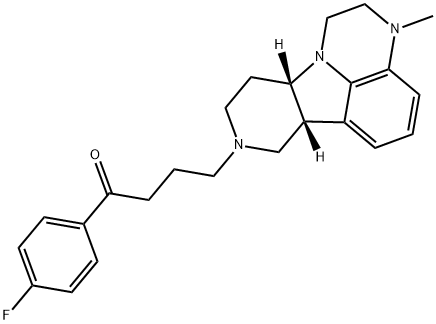
What is Lumateperone?
Absorption
Lumateperone is able to permeate multidrug resistance protein 1 (MDR1) and is very lipophilic at a pH of 7.4, which are characteristics that allow the antipsychotic to be absorbed in the small intestine and the blood brain barrier. Tmax occurs 3-4 hours after oral administration.
Toxicity
Neonates exposed to antipsychotic drugs during the third trimester are at risk for extrapyramidal and/or withdrawal symptoms following delivery. Available data from case reports on lumateperone use in pregnant women are insufficient to establish any drug associated risks for birth defects, miscarriage, or adverse maternal or fetal outcomes. There are risks to the mother associated with untreated schizophrenia and with exposure to antipsychotics, including lumateperone, during pregnancy. In animal reproduction studies, no malformations were observed with oral administration of lumateperone to pregnant rats and rabbits during organogenesis at doses up to 2.4 and 9.7 times, respectively, the maximum recommended human dose (MRHD) of 42 mg/day on a mg/m2 basis. When pregnant rats were administered lumateperone during the period of organogenesis through lactation, the number of perinatal deaths of pups was increased at 4.9 times the MRHD, with no adverse effects on pups at 2.4 times the MRHD.
Based on findings from animal studies, lumateperone may impair male and female fertility.
No specific antidotes for CAPLYTA are known. In managing overdose, provide supportive care, including close medical supervision and monitoring and consider the possibility of multiple drug involvement. In case of overdose, consult a Certified Poison Control Center (1-800-222-1222 or www.poison.org).
Lifetime carcinogenicity studies were conducted in rats and mice, and results showed no carcinogenic potential in either species. No evidence of mutagenic potential was found in the in vitro bacterial reverse mutation assay (Ames test) and the mouse lymphoma test without metabolic activation. Lumateperone was positive in the Ames test only in the presence of metabolic activation and only in the TA1537 strain and was positive in the mouse lymphoma test only in the presence of metabolic activation and only at high concentrations that inhibited cell growth; together these results were thought to be related to solubility limits and/or nonspecific effects on cellular function. Lumateperone was negative for clastogenic activity in the in vivo micronucleus assay in rats and was not genotoxic in the in vivo Comet assay in rats.
Description
Lumateperone is a novel antipsychotic agent with a unique mechanism of
action with high 5-hydroxytryptamine 2A(5-HT2A) blocking activity. A
Phase 2 study in treatment of insomnia revealed strong evidence of
efficacy, with no impairment of next-day cognition.
The Uses of Lumateperone
Lumateperone was a drug developed for the treatment of schizophrenia. May have applications in bipolar depression.
Indications
Lumateperone is approved for the treatment of schizophrenia in adults. It is also approved for the treatment of depressive episodes associated with bipolar disorder (i.e. bipolar depression) in adults, as monotherapy and/or adjunctive therapy with lithium or valproate.
Background
Schizophrenia is a complex mental illness and impacts approximately 1% of the population. Although there are several antipsychotics including aripiprazole, paliperidone and clozapine available for clinical use, they are generally accompanied by significant metabolic and/or neurological adverse effects.
Lumateperone is a newly approved 2nd generation antipsychotic currently indicated for the treatment of schizophrenia. It has a unique receptor binding profile and differs from other antipsychotics in that it modulates glutamate, serotonin and dopamine, which are all neurotransmitters that contribute to the pathophysiology of schizophrenia.
The data so far indicates that lumateperone can alleviate both positive and negative symptoms of schizophrenia. Further, not only is the new antipsychotic selective for dopamine (D2) receptors in the mesolimbic and mesocortical brain regions, but it also has minimal off-target activity. Both characteristics lend to a more favourable adverse effect profile and ultimately safer drug.
Pharmacokinetics
Lumateperone, also known as ITI-007, is an atypical antipsychotic that has proven to be effective in the treatment of schizophrenia. Lumateperone's receptor binding profile is unique, allowing it to target schizophrenia related symptoms while minimizing adverse effects. In contrast to other second generation antipsychotics such as lurasidone and brexpiprazole, lumateperone behaves as a partial agonist and as an antagonist at pre and postynaptic dopamine (D2) receptors respectively.
Patients with moderate or severe hepatic impairment (Child-Pugh class B or C) tend to have higher plasma concentrations of lumateperone than those with normal hepatic function. For this reason, patients with moderate or severe hepatic impairment should receive half the recommended daily dosage.
Metabolism
Lumateperone is extensively metabolized. The carbonyl side chain is reduced by ketone reductase to produce the primary active metabolite. Cytochrome P450 3A4 enzymes metabolize lumateperone to 2 metabolites: the active N-desmethylated carbonyl metabolite (IC200161) or the N-desmethylated alcohol metabolite (IC200565).
Storage
Store at 0-8℃
Properties of Lumateperone
| Boiling point: | 556.4±50.0 °C(Predicted) |
| Density | 1.26±0.1 g/cm3(Predicted) |
| pka | 9.10±0.20(Predicted) |
| form | Oil |
| color | Colorless to light yellow |
Safety information for Lumateperone
Computed Descriptors for Lumateperone
New Products
2-(2-Chlorophenyl)glycine Propiolic Acid 1-(3-Hydroxy-4-methoxyphenyl)-2-nitroethene (±)-amino(2-fluorophenyl)acetic acid trans-3-Benzyloxy-4-methoxy-beta-nitrostyrene 1-Pentadecanol 2,4-Dihydroxybenzaldehyde Obidoxime hydrochloride API Pyrrolo[1,2-a]pyrimidine-6-carboxylic acid, 4,6,7,8-tetrahydro-4-oxo-, sodium salt (1:1), (6S) Dipropyl disulfide 4 pentyn 1 ol N-Vinylformamide Methacrylate-PEG-Methacrylate, Mn:35000 2,4-Dihydroxyacetophenone 2-Chloro 5-Fluoro Pyridine Vasicinone 2-Chloroisonicotinic Acid Tween 80 or Polysorbate 80 2-Butyn-1-oL N-(4-Cyano-3-(trifluoromethyl)phenyl)-2-methyloxirane-2-carboxamide N-(4-fluoro-2-methoxy-5-nitrophenyl)-4-(1-methyl-1H-indol-3-yl)pyrimidin-2-amine Pirtobrutinib intd. 2-Pentyn-1-oL 4-NitrobenzotrifluorideYou may like
-
 Iti-722 95% CAS 313368-91-1View Details
313368-91-1 -
471-25-0 Propiolic Acid 98+View Details
471-25-0 -
84145-28-8 98+View Details
84145-28-8 -
trans-3-Benzyloxy-4-methoxy-beta-nitrostyrene 98+View Details
63909-29-5 -
2-(2-Chlorophenyl)glycine 88744-36-9 98+View Details
88744-36-9 -
40216-83-9 trans-4-Hydroxy-L-proline methyl ester hydrochloride 98+View Details
40216-83-9 -
629-76-5 98+View Details
629-76-5 -
1-(3-Hydroxy-4-methoxyphenyl)-2-nitroethene 98+View Details
39816-35-8