
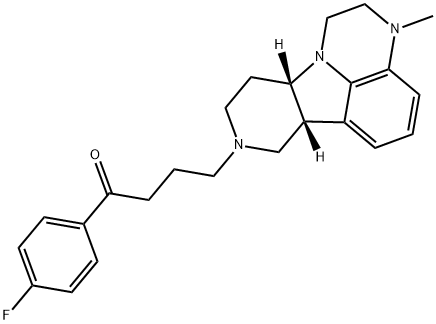
CHEMICAL AND PHYSICAL PROPERTIES
| LogP | 2.328 |
|---|
COMPUTED DESCRIPTORS
| Molecular Weight | 393.5 g/mol |
|---|---|
| XLogP3 | 3.8 |
| Hydrogen Bond Donor Count | 0 |
| Hydrogen Bond Acceptor Count | 5 |
| Rotatable Bond Count | 5 |
| Exact Mass | 393.22164069 g/mol |
| Monoisotopic Mass | 393.22164069 g/mol |
| Topological Polar Surface Area | 26.8 Ų |
| Heavy Atom Count | 29 |
| Formal Charge | 0 |
| Complexity | 593 |
| Isotope Atom Count | 0 |
| Defined Atom Stereocenter Count | 2 |
| Undefined Atom Stereocenter Count | 0 |
| Defined Bond Stereocenter Count | 0 |
| Undefined Bond Stereocenter Count | 0 |
| Covalently-Bonded Unit Count | 1 |
| Compound Is Canonicalized | Yes |
PRODUCT INTRODUCTION
description
Schizophrenia is a complex mental illness and impacts approximately 1% of the population. Although there are several antipsychotics including [aripiprazole], [paliperidone] and [clozapine] available for clinical use, they are generally accompanied by significant metabolic and/or neurological adverse effects. Lumateperone is a newly approved 2nd generation antipsychotic currently indicated for the treatment of schizophrenia. It has a unique receptor binding profile and differs from other antipsychotics in that it modulates glutamate, serotonin and dopamine, which are all neurotransmitters that contribute to the pathophysiology of schizophrenia. The data so far indicates that lumateperone can alleviate both positive and negative symptoms of schizophrenia. Further, not only is the new antipsychotic selective for dopamine (D2) receptors in the mesolimbic and mesocortical brain regions, but it also has minimal off-target activity. Both characteristics lend to a more favourable adverse effect profile and ultimately safer drug.