
Isobenzan
- CAS NO.:297-78-9
- Empirical Formula: C9H4Cl8O
- Molecular Weight: 411.75
- MDL number: MFCD00168051
- EINECS: 206-045-4
- SAFETY DATA SHEET (SDS)
- Update Date: 2026-09-12 18:52:43
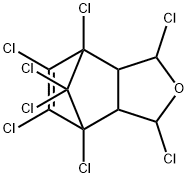
What is Isobenzan?
Chemical properties
Vap press 3 mm Hg (20C). Soluble in acetone, benzene, carbon tetrachloride, fuel oil, toluene, xylene.
The Uses of Isobenzan
Isobenzan (telodrin) is a highly toxic organochloride insecticide. It was produced only in the period from 1958 to 1965 and its use has been since discontinued.[1] It is a persistent organic pollutant that can remain in soil for 2 to 7 years, and the biological half-life of isobenzan in human blood is estimated to be about 2.8 years.
Definition
ChEBI: Isobenzan is a member of oxolanes.
General Description
Crystals. The technical product is a whitish to light-brown crystalline powder with a mild chemical odor. Used as an insecticide. Not registered as a pesticide in the U.S.
Air & Water Reactions
Insoluble in water.
Reactivity Profile
Chlorine is evolved when ISOBENZAN is heated above 410F. Avoid acids, certain metal salts, and catalytically active carriers. [EPA, 1998].
Health Hazard
ISOBENZAN is highly toxic. It is absorbed by the skin as well as by the respiratory and gastrointestinal tract. Symptoms may last for a long time because the material is eliminated slowly; its half-life in human blood is 2.77 years.
Fire Hazard
Chlorine is evolved when ISOBENZAN is heated above 410F. Avoid acids, certain metal salts, and catalytically active carriers.
Safety Profile
Poison by ingestion, skin contact,intraperitoneal, and intravenous routes. Questionablecarcinogen with experimental tumorigenic data. Used asan insecticide. When heated to decomposition it emitstoxic fumes of Clí.
Properties of Isobenzan
| Melting point: | 121℃ |
| Boiling point: | 421.5±45.0 °C(Predicted) |
| Density | 1.87 g/cm3 |
| Flash point: | 9℃ |
| storage temp. | 2-8°C |
| color | Crystals from heptane |
| Merck | 13,5144 |
| EPA Substance Registry System | Isobenzan (297-78-9) |
Safety information for Isobenzan
| Signal word | Danger |
| Pictogram(s) |
 Flame Flammables GHS02  Skull and Crossbones Acute Toxicity GHS06  Health Hazard GHS08 |
| GHS Hazard Statements |
H225:Flammable liquids H370:Specific target organ toxicity, single exposure H412:Hazardous to the aquatic environment, long-term hazard |
| Precautionary Statement Codes |
P210:Keep away from heat/sparks/open flames/hot surfaces. — No smoking. P280:Wear protective gloves/protective clothing/eye protection/face protection. P370+P378:In case of fire: Use … for extinction. P403+P235:Store in a well-ventilated place. Keep cool. |
Computed Descriptors for Isobenzan
New Products
Cyclobutanone (R)-(-)-2-Amino-1-propanol Fmoc-OSu 5-bromo-4-fluoro-2-nitrobenzaldehyde 2-Amino-2-(4-methylphenyl)acetic acid 1-(2-Chloroethyl)pyrrolidine Hydrochloride 2,4-Dihydroxybenzaldehyde Obidoxime hydrochloride API Pyrrolo[1,2-a]pyrimidine-6-carboxylic acid, 4,6,7,8-tetrahydro-4-oxo-, sodium salt (1:1), (6S) Dipropyl disulfide N-Vinylformamide 4 pentyn 1 ol Methacrylate-PEG-Methacrylate, Mn:35000 2,4-Dihydroxyacetophenone 2-Chloro 5-Fluoro Pyridine Vasicinone 2-Chloroisonicotinic Acid Tween 80 or Polysorbate 80 2-Butyn-1-oL N-(4-fluoro-2-methoxy-5-nitrophenyl)-4-(1-methyl-1H-indol-3-yl)pyrimidin-2-amine Pirtobrutinib intd. 2-Pentyn-1-oL 4-Nitrobenzotrifluoride N-(4-Cyano-3-(trifluoromethyl)phenyl)-2-methyloxirane-2-carboxamideRelated products of tetrahydrofuran



You may like
-
 7250-67-1 1-(2-Chloroethyl)pyrrolidine Hydrochloride 98+View Details
7250-67-1 -
13227-01-5 98+View Details
13227-01-5 -
7250-67-1 1-(2-Chloroethyl)pyrrolidine Hydrochloride 98+View Details
7250-67-1 -
13227-01-5 98+View Details
13227-01-5 -
545445-44-1 3-Morpholino-1-(4-(2-oxopiperidin-1-yl) phenyl)-5,6-dihyropyridin-2-(1H)-one 98%View Details
545445-44-1 -
6629-04-5 98%View Details
6629-04-5 -
4-(4-Αminophenyl)-3-Morpholinone 98%View Details
438056-69-0 -
1-(4-Aminophenyl)-3-morpholino-5,6-dihydropyridin-2(1H)-one 1267610-26-3 98%View Details
1267610-26-3