
Hexamethyldistannane
Synonym(s):Hexamethyldistannane
- CAS NO.:661-69-8
- Empirical Formula: C6H18Sn2
- Molecular Weight: 327.63
- MDL number: MFCD00008277
- EINECS: 211-549-2
- SAFETY DATA SHEET (SDS)
- Update Date: 2026-08-31 21:16:06
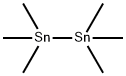
What is Hexamethyldistannane?
Chemical properties
Clear colorless liquid
The Uses of Hexamethyldistannane
Agricultural chemical.
The Uses of Hexamethyldistannane
It is used to prepare aryl tin compounds for microwave-assisted Stille cross-coupling with halo pyridines or copper-mediated O-arylation of phenols.
Hazard
A poison by ingestion.
Purification Methods
Wash it with H2O and extract with *C6H6, dry by filtering through powdered Na2SO4, remove *C6H6 on a rotary evaporator and fractionally distil the oily residue under vacuum (b 85-88o/45mm). It boils at ca 182o at atmospheric pressure, but it cannot be distilled in air because the hot vapours flash in the condenser. [Kraus & Session J Am Chem Soc 47 2361 1925, Morris & Selwood J Am Chem Soc 63 2509 1941, Pedley et al. Trans Faraday Soc 53 1612 1957, Beilstein 4 IV 4346.]
Properties of Hexamethyldistannane
| Melting point: | 23-24 °C (lit.) |
| Boiling point: | 182 °C/756 mmHg (lit.) |
| Density | 1.58 g/mL at 20 °C (lit.) |
| refractive index | n |
| Flash point: | 142 °F |
| storage temp. | Inert atmosphere,Room Temperature |
| form | solid |
| color | Colourless |
| Specific Gravity | 1.570 |
| Water Solubility | Not miscible or difficult to mix in water. |
| Sensitive | Air Sensitive |
| Hydrolytic Sensitivity | 7: reacts slowly with moisture/water |
| BRN | 3600327 |
| Exposure limits | ACGIH: TWA 0.1 mg/m3; STEL 0.2 mg/m3 (Skin) NIOSH: IDLH 25 mg/m3; TWA 0.1 mg/m3 |
| CAS DataBase Reference | 661-69-8(CAS DataBase Reference) |
| NIST Chemistry Reference | Hexamethylditin(661-69-8) |
| EPA Substance Registry System | Distannane, hexamethyl- (661-69-8) |
Safety information for Hexamethyldistannane
| Signal word | Danger |
| Pictogram(s) |
 Skull and Crossbones Acute Toxicity GHS06  Environment GHS09 |
| GHS Hazard Statements |
H410:Hazardous to the aquatic environment, long-term hazard |
| Precautionary Statement Codes |
P260:Do not breathe dust/fume/gas/mist/vapours/spray. P262:Do not get in eyes, on skin, or on clothing. P273:Avoid release to the environment. P280:Wear protective gloves/protective clothing/eye protection/face protection. |
Computed Descriptors for Hexamethyldistannane
| InChIKey | CCRMAATUKBYMPA-UHFFFAOYSA-N |
New Products
2-(2-Chlorophenyl)glycine Propiolic Acid 1-(3-Hydroxy-4-methoxyphenyl)-2-nitroethene (±)-amino(2-fluorophenyl)acetic acid trans-3-Benzyloxy-4-methoxy-beta-nitrostyrene 1-Pentadecanol 2,4-Dihydroxybenzaldehyde Dipropyl disulfide Pyrrolo[1,2-a]pyrimidine-6-carboxylic acid, 4,6,7,8-tetrahydro-4-oxo-, sodium salt (1:1), (6S) Obidoxime hydrochloride API 4 pentyn 1 ol N-Vinylformamide Methacrylate-PEG-Methacrylate, Mn:35000 2,4-Dihydroxyacetophenone 2-Chloro 5-Fluoro Pyridine Vasicinone 2-Chloroisonicotinic Acid Tween 80 or Polysorbate 80 2-Butyn-1-oL N-(4-Cyano-3-(trifluoromethyl)phenyl)-2-methyloxirane-2-carboxamide N-(4-fluoro-2-methoxy-5-nitrophenyl)-4-(1-methyl-1H-indol-3-yl)pyrimidin-2-amine Pirtobrutinib intd. 2-Pentyn-1-oL 4-NitrobenzotrifluorideRelated products of tetrahydrofuran


You may like
-
 Hexamethylditin CAS 661-69-8View Details
661-69-8 -
471-25-0 Propiolic Acid 98+View Details
471-25-0 -
84145-28-8 98+View Details
84145-28-8 -
trans-3-Benzyloxy-4-methoxy-beta-nitrostyrene 98+View Details
63909-29-5 -
2-(2-Chlorophenyl)glycine 88744-36-9 98+View Details
88744-36-9 -
40216-83-9 trans-4-Hydroxy-L-proline methyl ester hydrochloride 98+View Details
40216-83-9 -
629-76-5 98+View Details
629-76-5 -
1-(3-Hydroxy-4-methoxyphenyl)-2-nitroethene 98+View Details
39816-35-8
Statement: All products displayed on this website are only used for non medical purposes such as industrial applications or scientific research, and cannot be used for clinical diagnosis or treatment of humans or animals. They are not medicinal or edible.