
Hexahydro-1,3,5-tris(2,3-dibromopropyl)-1,3,5-triazine-2,4,6-trione
Synonym(s):Hexahydro-1,3,5-tris(2,3-dibromopropyl)-1,3,5-triazine-2,4,6-trione
- CAS NO.:52434-90-9
- Empirical Formula: C12H15Br6N3O3
- Molecular Weight: 728.69
- MDL number: MFCD00010290
- EINECS: 257-913-4
- SAFETY DATA SHEET (SDS)
- Update Date: 2026-09-01 17:14:48
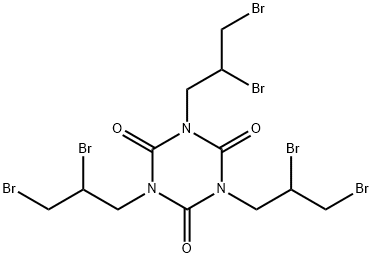
What is Hexahydro-1,3,5-tris(2,3-dibromopropyl)-1,3,5-triazine-2,4,6-trione?
The Uses of Hexahydro-1,3,5-tris(2,3-dibromopropyl)-1,3,5-triazine-2,4,6-trione
tris(2,3-dibromopropyl) isocyanurate,TBC, is a new, efficient, and additive brominated flame retardants, flame retardant effect, low volatility, good compatibility, durable, light, water and non-toxic properties.
The Uses of Hexahydro-1,3,5-tris(2,3-dibromopropyl)-1,3,5-triazine-2,4,6-trione
1,3,5-Tris(2,3-dibromopropyl) Isocyanurate is a flame retardant that has applications in assessing potential bioaccumulation and impact on endocrine activity. It has been employed in flow-cytometric proliferation assay to determine potential estrogen-disruptive effects of flame retardants in MCF-7 cells.
What are the applications of Application
Tris(2,3-dibromopropyl) isocyanurate is a non-degradable flame retatdant
General Description
Tris(2,3-dibromopropyl) isocyanurate is a non degradable heterocyclic hexabrominated flame retardant. It inhibited the expression of psaA and psbC that led to the decrease of Nannochloropsis sp.′s growth biomass.
Cytotoxicity
Tris(2,3-dibromopropyl) isocyanurate (TBC) is widely used in polymer products. It is ubiquitously found in environmental matrices. TBC inhibited basal and forskolin-induced sex hormone production but did not exhibit cytotoxicity.
Environmental Fate
The properties of TBC, e.g., the high octanol–air partition coefficient (Koa), high octanol–water partition coefficient (Kow), and high bioconcentration factor (BCF), indicate a possibility of its spread in aquatic and terrestrial ecosystems and bioaccumulation in living organisms. The presence of TBC has been confirmed in soil, sediments, river water, and such materials as microplastic, curtains, and e-waste devices. The compound has potential to bioaccumulate in the food chain of living organisms. TBC has been demonstrated to exert a harmful effect mainly on the nervous and endocrine systems, lungs, and liver.
Properties of Hexahydro-1,3,5-tris(2,3-dibromopropyl)-1,3,5-triazine-2,4,6-trione
| Melting point: | 110 °C |
| Boiling point: | 618.8±55.0 °C(Predicted) |
| Density | 2.338±0.06 g/cm3(Predicted) |
| vapor pressure | 0Pa at 20℃ |
| solubility | Soluble in chloroform. |
| form | powder to crystal |
| pka | -2.72±0.20(Predicted) |
| color | White to Almost white |
| Water Solubility | 5.07mg/L at 20℃ |
| Stability: | Light Sensitive |
| CAS DataBase Reference | 52434-90-9(CAS DataBase Reference) |
| EPA Substance Registry System | 1,3,5-Triazine-2,4,6(1H,3H,5H)-trione, 1,3,5-tris(2,3-dibromopropyl)- (52434-90-9) |
Safety information for Hexahydro-1,3,5-tris(2,3-dibromopropyl)-1,3,5-triazine-2,4,6-trione
| Signal word | Warning |
| Pictogram(s) |
 Exclamation Mark Irritant GHS07 |
| GHS Hazard Statements |
H315:Skin corrosion/irritation H319:Serious eye damage/eye irritation H335:Specific target organ toxicity, single exposure;Respiratory tract irritation |
| Precautionary Statement Codes |
P261:Avoid breathing dust/fume/gas/mist/vapours/spray. P264:Wash hands thoroughly after handling. P264:Wash skin thouroughly after handling. P271:Use only outdoors or in a well-ventilated area. P280:Wear protective gloves/protective clothing/eye protection/face protection. P302+P352:IF ON SKIN: wash with plenty of soap and water. P305+P351+P338:IF IN EYES: Rinse cautiously with water for several minutes. Remove contact lenses, if present and easy to do. Continuerinsing. |
Computed Descriptors for Hexahydro-1,3,5-tris(2,3-dibromopropyl)-1,3,5-triazine-2,4,6-trione
New Products
2-Amino-5-bromo-4-(trifluoromethyl)pyridine Sulfapyridine Fmoc-OSu (R)-(-)-2-Amino-1-propanol Cyclobutanone 5-bromo-4-fluoro-2-nitrobenzaldehyde β-Bromostyrene Ethyl 3-phenylpropanoate Phenethyl cinnamate Dipropyl disulfide N-Vinylformamide 4 pentyn 1 ol Methacrylate-PEG-Methacrylate, Mn:35000 2,4-Dihydroxyacetophenone 2-Chloro 5-Fluoro Pyridine Vasicinone 2-Chloroisonicotinic Acid Tween 80 or Polysorbate 80 2-Butyn-1-oL 2-Pentyn-1-oL 4-Nitrobenzotrifluoride N-(4-fluoro-2-methoxy-5-nitrophenyl)-4-(1-methyl-1H-indol-3-yl)pyrimidin-2-amine Pirtobrutinib intd. N-(4-Cyano-3-(trifluoromethyl)phenyl)-2-methyloxirane-2-carboxamideRelated products of tetrahydrofuran

You may like
-
 Tris(2,3-dibromopropyl)isocyanurate 97.00% CAS 52434-90-9View Details
52434-90-9 -
Tris(2,3-dibromopropyl) Isocyanurate CAS 52434-90-9View Details
52434-90-9 -
Fmoc-OSu 98+View Details
82911-69-1 -
(R)-(-)-2-Amino-1-propanol 35320-23-1 98+View Details
35320-23-1 -
1191-95-3 Cyclobutanone 98+View Details
1191-95-3 -
213382-45-7 98+View Details
213382-45-7 -
Fmoc-OSu 98+View Details
82911-69-1 -
(R)-(-)-2-Amino-1-propanol 35320-23-1 98+View Details
35320-23-1