
Hexahydro-1,3,5-trinitro-1,3,5-triazine
Synonym(s):Hexahydro-1,3,5-trinitro-1,3,5-triazine;Hexahydro-1,3,5-trinitro-1,3,5-triazine solution
- CAS NO.:121-82-4
- Empirical Formula: C3H6N6O6
- Molecular Weight: 222.12
- MDL number: MFCD00458725
- EINECS: 204-500-1
- SAFETY DATA SHEET (SDS)
- Update Date: 2026-09-12 18:54:22
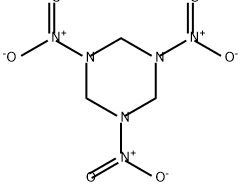
What is Hexahydro-1,3,5-trinitro-1,3,5-triazine?
Description
Hexahydro-1,3,5-trinitro-s-triazine is a whitecrystalline compound; Boiling point=.260℃; Freezing/Melting point=203-204℃; Exothermicdecomposition=100℃; Hazard Identification (based onNFPA-704 M Rating System): Health 2, Flammability(explosive), Reactivity (see incompatibilities). Insoluble inwater
Chemical properties
Hexahydro-1,3,5-trinitro-S-triazine is a white crystalline compound.
The Uses of Hexahydro-1,3,5-trinitro-1,3,5-triazine
Cyclonite is a high explosive and principal constituent of plastic bombs. It is preparedby treating hexamethylenetetramine with nitric acid,ammoniumnitrate,andaceticanhydride: It is also used as a rat poison.
The Uses of Hexahydro-1,3,5-trinitro-1,3,5-triazine
High explosive; rodenticide.RDX is a convulsant.
Definition
ChEBI: An N-nitro compound that is 1,3,5-triazinane in which all three of the hydrogens attached to the nitrogens have been replaced by nitro groups. It is widely used in both industrial and military explosives.
Definition
Cyclonite: A highly explosive nitrocompound, (CH2N.NO2)3. It has acyclic structure with a six-memberedring of alternating CH2 groups andnitrogen atoms, with each nitrogenbeing attached to a NO2 group. It ismade by nitrating hexamine,C6H12N4, which is obtained from ammoniaand methanal. Cyclonite is avery powerful explosive used mainlyfor military purposes. It is also calledRDX. The abbreviation is for ‘ResearchDepartment composition X’,used at the Chemical Research andDevelopment Department, Woolwich.
General Description
Cyclotrimethylene trinitramine is an explosive. The explosion can be initiated by a sudden shock, high temperature or a combination of the two. The primary hazard is from blast effect and not from flying projectiles and fragments. Under prolonged exposure to heat or fire they can explode.
Air & Water Reactions
Insoluble in water.
Reactivity Profile
CYCLOTRIMETHYLENE TRINITRAMINE is incompatible with strong oxidizing agents, combustible materials and heat. Detonates on contact with mercury fulminate . Danger of explosion when dry. The self heating and explosive decomposition of the explosive and aqueous alkali (calcium hydroxide) has been studied, [Chem Abs., 1988, 109, 112968].
Health Hazard
Cyclonite is a highly toxic substance. Repeated exposure can cause nausea, vomiting, and convulsions.
LD50 value, oral (rats): 100 mg/kg.
Fire Hazard
MAY EXPLODE AND THROW FRAGMENTS 1600 meters (1 MILE) OR MORE IF FIRE REACHES CARGO.
Safety Profile
Poison by ingestion, intraperitoneal, and intravenous routes. An experimental teratogen. Other experimental reproductive effects. A corrosive irritant to skin, eyes, and mucous membranes. Cases of epileptifonn convulsions have been reported from exposure. It is one of the most powerful high explosives in use today. Has more shattering power than TNT and is often mixed with TNT as a bursting charge for aerial bombs, mines, and torpedoes. It is easily initiated by mercury fulrmnate, which may be used as a booster. When heated to decomposition it emits toxic fumes of NOx. See also MINES, NITRATES, and EXPLOSIVES, HIGH.
Potential Exposure
A potential danger to those involved in the manufacture of this material and its handling in munitions and solid-propellant manufacture. It is also used as a rat poison; a powerful military explosive; a base charge for detonators; and in plastic explosives.
First aid
If this chemical gets into the eyes, remove anycontact lenses at once and irrigate immediately for at least15 min, occasionally lifting upper and lower lids. Seek medical attention immediately. If this chemical contacts theskin, remove contaminated clothing and wash immediatelywith soap and water. Seek medical attention immediately. Ifthis chemical has been inhaled, remove from exposure,begin rescue breathing (using universal precautions, including resuscitation mask) if breathing has stopped and CPR ifheart action has stopped. Transfer promptly to a medicalfacility. When this chemical has been swallowed, get medcal attention. Give large quantities of water and inducevomiting. Do not make an unconscious person vomit.
Storage
Explosive. Color Code—Red Stripe: FlammabilityHazard: Store separately from all other flammable materals. Prior to working with this chemical you should betrained on its proper handling and storage. Detached storagein a secure area is recommended. Store in tightly closedcontainers in a cool well-ventilated area away from otherexplosives, combustibles, or strong oxidizers (such as chlorine, bromine, and fluorine). Also keep cyclonite away fromshock and heat sources. Use only nonsparking tools andequipment, especially when opening and closing containersof this chemical. Sources of ignition, such as smoking andopen flames, are prohibited where this chemical is used,handled, or stored in a manner that could create a potentialfire or explosion hazard. Wherever this chemical is used,handled, manufactured, or stored, use explosion-proof electrical equipment and fittings.
Shipping
UN0483 Cyclotrimethylenetrinitramine, desensi- tized or Cyclonite, desensitized or Hexogen, desensitized or RDX, desensitized, Hazard Class: 1D; Labels: 1D- Explosive (with a mass explosion hazard); D-Substances or articles which may mass detonate (with blast and/or frag- ment hazard) when exposed to fire. UN0072 Cyclotrimethylenetrinitramine, wetted or Cyclonite, wetted or Hexogen, wetted or RDX, wetted with not ,15% water by mass, Hazard Class: 1D; Labels: 1D-Explosive (with a mass explosion hazard); D-Substances or articles which may mass detonate (with blast and/or fragment hazard) when exposed to fire.
Purification Methods
RDX crystallises from acetone. [Bachmann & Sheehan J Am Chem Soc 71 1842 1949, Beilstein 26 II 5, 26 III/IV 22.] EXPLOSIVE.
Incompatibilities
Heat, physical damage, shock, and deto- nators. Detonates on contact with mercury fulminate. Keep away from other explosives, combustibles, oxidizers (such as chlorates, nitrates, perchlorates, permanganates, perox- ides; bromine, chlorine, and fluorine); reducing agents; and aqueous alkaline solutions.
Waste Disposal
Pour over soda ash, neutralize and flush to sewer with water. Also HMX may be recov- ered from solid propellant waste.
Properties of Hexahydro-1,3,5-trinitro-1,3,5-triazine
| Melting point: | 205-206° |
| Boiling point: | 363.28°C (rough estimate) |
| Density | d420 1.82 |
| vapor pressure | 0Pa at 20℃ |
| refractive index | 1.6700 (estimate) |
| Flash point: | 2℃ |
| storage temp. | 2-8°C |
| form | Colorless crystals |
| pka | -15.06±0.20(Predicted) |
| Water Solubility | 59.75mg/L(25 ºC) |
| Exposure limits | TLV-TWA skin 1.5 mg/m3 (ACGIH and MSHA). |
| Stability: | Unstable. Explosive. |
| EPA Substance Registry System | Cyclonite (121-82-4) |
Safety information for Hexahydro-1,3,5-trinitro-1,3,5-triazine
| Signal word | Danger |
| Pictogram(s) |
 Flame Flammables GHS02  Exclamation Mark Irritant GHS07  Health Hazard GHS08 |
| GHS Hazard Statements |
H225:Flammable liquids H319:Serious eye damage/eye irritation H373:Specific target organ toxicity, repeated exposure |
| Precautionary Statement Codes |
P210:Keep away from heat/sparks/open flames/hot surfaces. — No smoking. P261:Avoid breathing dust/fume/gas/mist/vapours/spray. P305+P351+P338:IF IN EYES: Rinse cautiously with water for several minutes. Remove contact lenses, if present and easy to do. Continuerinsing. P337+P313:IF eye irritation persists: Get medical advice/attention. P403+P235:Store in a well-ventilated place. Keep cool. |
Computed Descriptors for Hexahydro-1,3,5-trinitro-1,3,5-triazine
New Products
2-(2-Chlorophenyl)glycine Propiolic Acid 1-(3-Hydroxy-4-methoxyphenyl)-2-nitroethene (±)-amino(2-fluorophenyl)acetic acid trans-3-Benzyloxy-4-methoxy-beta-nitrostyrene 1-Pentadecanol 2,4-Dihydroxybenzaldehyde Dipropyl disulfide Pyrrolo[1,2-a]pyrimidine-6-carboxylic acid, 4,6,7,8-tetrahydro-4-oxo-, sodium salt (1:1), (6S) Obidoxime hydrochloride API 4 pentyn 1 ol N-Vinylformamide Methacrylate-PEG-Methacrylate, Mn:35000 2,4-Dihydroxyacetophenone 2-Chloro 5-Fluoro Pyridine Vasicinone 2-Chloroisonicotinic Acid Tween 80 or Polysorbate 80 2-Butyn-1-oL N-(4-Cyano-3-(trifluoromethyl)phenyl)-2-methyloxirane-2-carboxamide N-(4-fluoro-2-methoxy-5-nitrophenyl)-4-(1-methyl-1H-indol-3-yl)pyrimidin-2-amine Pirtobrutinib intd. 2-Pentyn-1-oL 4-NitrobenzotrifluorideRelated products of tetrahydrofuran


You may like
-
 40216-83-9 trans-4-Hydroxy-L-proline methyl ester hydrochloride 98+View Details
40216-83-9 -
471-25-0 Propiolic Acid 98+View Details
471-25-0 -
84145-28-8 98+View Details
84145-28-8 -
trans-3-Benzyloxy-4-methoxy-beta-nitrostyrene 98+View Details
63909-29-5 -
2-(2-Chlorophenyl)glycine 88744-36-9 98+View Details
88744-36-9 -
40216-83-9 trans-4-Hydroxy-L-proline methyl ester hydrochloride 98+View Details
40216-83-9 -
629-76-5 98+View Details
629-76-5 -
1-(3-Hydroxy-4-methoxyphenyl)-2-nitroethene 98+View Details
39816-35-8