
HAFNIUM FLUORIDE
Synonym(s):Hafnium tetrafluoride
- CAS NO.:13709-52-9
- Empirical Formula: F4Hf
- Molecular Weight: 254.48
- MDL number: MFCD00016127
- EINECS: 237-258-0
- SAFETY DATA SHEET (SDS)
- Update Date: 2026-05-28 00:46:23
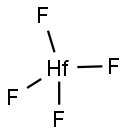
What is HAFNIUM FLUORIDE?
Chemical properties
Off-white powder
Physical properties
White monoclinic crystals; refractive index 1.56; density 7.1 g/cm3; sublimes at 970°C.
The Uses of HAFNIUM FLUORIDE
Hafnium(IV) fluoride is used as Vacuum deposition.
Production Methods
Hafnium tetrafluoride is prepared by careful thermal decomposition of ammonium fluorohafniate in an oxygen- free atmosphere or by passing anhydrous hydrogen fluoride over hafnium tetrachloride at 300℃. Direct synthesis from the elements is incomplete because the product merely forms a film on the metal. Ammonium fluorohafniate can be prepared by crystallization from an aqueous hydrofluoric acid solution by adding ammonium fluoride.
Properties of HAFNIUM FLUORIDE
| Melting point: | 310°C (subl.) |
| Boiling point: | 970°C |
| Density | 7.100 |
| solubility | reacts with H2O |
| form | Powder |
| color | White |
| Water Solubility | React with water. |
| Sensitive | Moisture Sensitive |
| Exposure limits | ACGIH: TWA 2.5 mg/m3; TWA 0.5 mg/m3 NIOSH: IDLH 250 mg/m3; IDLH 50 mg/m3; TWA 0.5 mg/m3 |
| CAS DataBase Reference | 13709-52-9(CAS DataBase Reference) |
Safety information for HAFNIUM FLUORIDE
| Signal word | Danger |
| Pictogram(s) |
 Corrosion Corrosives GHS05  Skull and Crossbones Acute Toxicity GHS06 |
| GHS Hazard Statements |
H315:Skin corrosion/irritation H318:Serious eye damage/eye irritation H331:Acute toxicity,inhalation H335:Specific target organ toxicity, single exposure;Respiratory tract irritation |
| Precautionary Statement Codes |
P280:Wear protective gloves/protective clothing/eye protection/face protection. P302+P352:IF ON SKIN: wash with plenty of soap and water. |
Computed Descriptors for HAFNIUM FLUORIDE
New Products
2-(2-Chlorophenyl)glycine Propiolic Acid trans-3-Benzyloxy-4-methoxy-beta-nitrostyrene 1-(3-Hydroxy-4-methoxyphenyl)-2-nitroethene (±)-amino(2-fluorophenyl)acetic acid 1-Pentadecanol N-Vinylformamide 4 pentyn 1 ol Tween 80 or Polysorbate 80 4-(4-Αminophenyl)-3-Morpholinone 3-Morpholino-1-(4-(2-oxopiperidin-1-yl) phenyl)-5,6-dihyropyridin-2-(1H)-one 1-(4-Aminophenyl)-3-morpholino-5,6-dihydropyridin-2(1H)-one N-cyanoacetylurethane 1H-IndazoleRelated products of tetrahydrofuran
You may like
-
 40216-83-9 trans-4-Hydroxy-L-proline methyl ester hydrochloride 98+View Details
40216-83-9 -
471-25-0 Propiolic Acid 98+View Details
471-25-0 -
84145-28-8 98+View Details
84145-28-8 -
trans-3-Benzyloxy-4-methoxy-beta-nitrostyrene 98+View Details
63909-29-5 -
2-(2-Chlorophenyl)glycine 88744-36-9 98+View Details
88744-36-9 -
40216-83-9 trans-4-Hydroxy-L-proline methyl ester hydrochloride 98+View Details
40216-83-9 -
629-76-5 98+View Details
629-76-5 -
1-(3-Hydroxy-4-methoxyphenyl)-2-nitroethene 98+View Details
39816-35-8
Statement: All products displayed on this website are only used for non medical purposes such as industrial applications or scientific research, and cannot be used for clinical diagnosis or treatment of humans or animals. They are not medicinal or edible.