
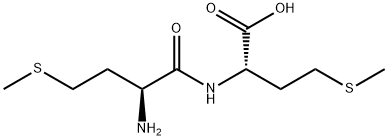
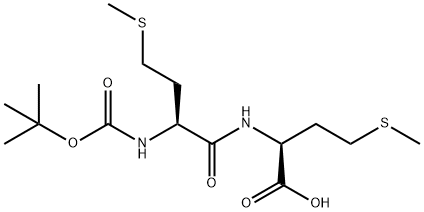
H-DL-Met-DL-Met-OH
- CAS NO.:52715-93-2
- Empirical Formula: C10H20N2O3S2
- Molecular Weight: 280.41
- MDL number: MFCD00190958
- EINECS: 258-124-8
- SAFETY DATA SHEET (SDS)
- Update Date: 2026-09-12 18:55:25
What is H-DL-Met-DL-Met-OH?
Description
L-Methionine is an essential natural amino acid for humans and other animals. Researchers began to isolate it from casein and investigate its biochemistry in the early 1930s. Today, most methionine in nutritional supplements is manufactured as its?D,L?racemic mixture. Both enantiomers contribute to nutrition.
Like other animals, farmed fish and other seafood need methionine in their diets. Historically, these farmed animals received their essential amino acids by being fed wild fish. Because this practice is unsustainable, farmed seafood species increasingly are being fed vegetable-derived and manufactured nutrients.
Scientists have found, however, that when farmed seafood, including shrimp, are fed large amounts of an amino acid, the uptake of other amino acids into their systems is depressed. One solution to this problem is to feed the larger amounts as dipeptides, which are absorbed more slowly.
This is where methionine’s condensation dimer methionylmethionine comes in. Evonik Industries, a specialty chemical company based in Essen, Germany, recently introduced Met-Met, a methionylmethionine product that is a mixture of all four of the possible optical isomers. (The?L,L?isomer is shown here.)
Shrimp take up each of the isomers in Met-Met at different rates, so that large amounts of methionine don’t overwhelm the digestion of other amino acids. This advance alone allows the wild fish content of shrimp food to be decreased by more than 50%.
Chemical & Engineering News?reporter Alex Scott reports about how chemists are helping to eliminate wild fish from the diets of farmed fish. Go to?cenm.ag/fishfarm.
The Uses of H-DL-Met-DL-Met-OH
DL-Methionyl-DL-methionine is a a replacement for feed for aquatic animal species, this dipeptide differs from free dl-methionine. It exists as an incomplete breakdown product of protein digestion or catabolism.
Properties of H-DL-Met-DL-Met-OH
| Melting point: | >185°C (dec.) |
| storage temp. | Refrigerator |
| solubility | Aqueous Acid (Slightly) |
| form | Solid |
| color | White to Off-White |
| EPA Substance Registry System | Methionine, methionyl- (52715-93-2) |
Safety information for H-DL-Met-DL-Met-OH
Computed Descriptors for H-DL-Met-DL-Met-OH
New Products
Cyclobutanone (R)-(-)-2-Amino-1-propanol Fmoc-OSu 5-bromo-4-fluoro-2-nitrobenzaldehyde 2-Amino-2-(4-methylphenyl)acetic acid 1-(2-Chloroethyl)pyrrolidine Hydrochloride 2,4-Dihydroxybenzaldehyde Obidoxime hydrochloride API Pyrrolo[1,2-a]pyrimidine-6-carboxylic acid, 4,6,7,8-tetrahydro-4-oxo-, sodium salt (1:1), (6S) Dipropyl disulfide N-Vinylformamide 4 pentyn 1 ol Methacrylate-PEG-Methacrylate, Mn:35000 2,4-Dihydroxyacetophenone 2-Chloro 5-Fluoro Pyridine Vasicinone 2-Chloroisonicotinic Acid Tween 80 or Polysorbate 80 2-Butyn-1-oL N-(4-fluoro-2-methoxy-5-nitrophenyl)-4-(1-methyl-1H-indol-3-yl)pyrimidin-2-amine Pirtobrutinib intd. 2-Pentyn-1-oL 4-Nitrobenzotrifluoride N-(4-Cyano-3-(trifluoromethyl)phenyl)-2-methyloxirane-2-carboxamideRelated products of tetrahydrofuran



You may like
-
 7250-67-1 1-(2-Chloroethyl)pyrrolidine Hydrochloride 98+View Details
7250-67-1 -
13227-01-5 98+View Details
13227-01-5 -
7250-67-1 1-(2-Chloroethyl)pyrrolidine Hydrochloride 98+View Details
7250-67-1 -
13227-01-5 98+View Details
13227-01-5 -
545445-44-1 3-Morpholino-1-(4-(2-oxopiperidin-1-yl) phenyl)-5,6-dihyropyridin-2-(1H)-one 98%View Details
545445-44-1 -
6629-04-5 98%View Details
6629-04-5 -
4-(4-Αminophenyl)-3-Morpholinone 98%View Details
438056-69-0 -
1-(4-Aminophenyl)-3-morpholino-5,6-dihydropyridin-2(1H)-one 1267610-26-3 98%View Details
1267610-26-3