
Guazatine acetate salt
- CAS NO.:115044-19-4
- Empirical Formula: C24H53N7O6
- Molecular Weight: 535.72
- MDL number: MFCD01724078
- SAFETY DATA SHEET (SDS)
- Update Date: 2026-05-28 03:12:47
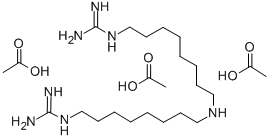
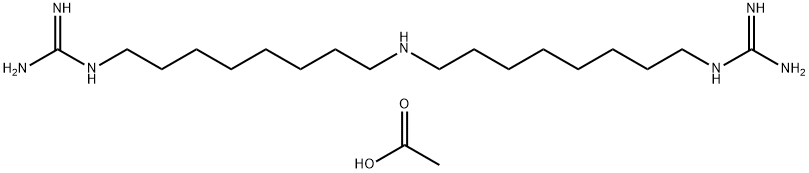
What is Guazatine acetate salt ?
The Uses of Guazatine acetate salt
Guazatine is used as a seed treatment for control of Sqtoria nodorum, Tilletia caries, Fusarium spp. and Helminthosporium spp. in cereals and maize and it also acts as a bird repellent. It is also used to control Pyricularia oryzae (rice blast) and Cercuspora spp. in peanuts and soyabeans, Septoria spp. in wheat and pineapple disease in sugar cane. It is also used as a post harvest dip for seed potatoes, citrus fruit and pineapples and as a wood protectant.
What are the applications of Application
Guazatine acetate salt is a non-systemic contact fungicide
Definition
ChEBI: Iminoctadine is a member of the class of guanidines that is dioctylamine in which a hydrogen from each of the terminal methyl groups is replaced by a guanidino group. Once used as a fungicidal seed dressing, it is no longer approved for use in the European Union. It has a role as an antifungal agrochemical. It is a member of guanidines, a secondary amino compound and an aliphatic nitrogen antifungal agent.
Metabolic pathway
The deamidation of guazatine (GZ) is a primary mode of GZ-biotransformation in rats but is not significantly mediated by either hydrolysis or transamidation to glycine or ornithine. In photolysis, Pm is formed by photooxidation of the methylene group (probably at the 3 or 5 position). One of the minor photoproducts identified is considered to be an intermediate of Pm formation. In apple plants, the same degradation products are identified on the surface of the leaves as photodegradation products.
Properties of Guazatine acetate salt
| form | neat |
| BRN | 1995978 |
| EPA Substance Registry System | Guazatine, acetate (115044-19-4) |
Safety information for Guazatine acetate salt
| Signal word | Danger |
| Pictogram(s) |
 Skull and Crossbones Acute Toxicity GHS06  Environment GHS09 |
| GHS Hazard Statements |
H330:Acute toxicity,inhalation H400:Hazardous to the aquatic environment, acute hazard |
| Precautionary Statement Codes |
P260:Do not breathe dust/fume/gas/mist/vapours/spray. P273:Avoid release to the environment. P280:Wear protective gloves/protective clothing/eye protection/face protection. P301+P312:IF SWALLOWED: call a POISON CENTER or doctor/physician IF you feel unwell. |
Computed Descriptors for Guazatine acetate salt
New Products
9-Mesityl-10-methylacridinium perchlorate Sulfapyridine Fmoc-OSu (R)-(-)-2-Amino-1-propanol Cyclobutanone 5-bromo-4-fluoro-2-nitrobenzaldehyde 4 pentyn 1 ol N-Vinylformamide Phenethyl cinnamate Pyrrolo[1,2-a]pyrimidine-6-carboxylic acid, 4,6,7,8-tetrahydro-4-oxo-, sodium salt (1:1), (6S) Ethyl 3-phenylpropanoate β-Bromostyrene Methacrylate-PEG-Methacrylate, Mn:35000 2,4-Dihydroxyacetophenone 2-Chloro 5-Fluoro Pyridine Vasicinone 2-Chloroisonicotinic Acid Tween 80 or Polysorbate 80 5-Bromo-1-Pentyne 1-(2-Methyl-5-nitrophenyl)guanidine Nitrate Methyl trans-4-Aminocyclohexanecarboxylate Hydrochloride N-(4-Cyano-3-(trifluoromethyl)phenyl)-2-methyloxirane-2-carboxamide 4-Nitrobenzotrifluoride 2-Pentyn-1-oLRelated products of tetrahydrofuran


You may like
-
 1191-95-3 Cyclobutanone 98+View Details
1191-95-3 -
213382-45-7 98+View Details
213382-45-7 -
Fmoc-OSu 98+View Details
82911-69-1 -
(R)-(-)-2-Amino-1-propanol 35320-23-1 98+View Details
35320-23-1 -
1191-95-3 Cyclobutanone 98+View Details
1191-95-3 -
213382-45-7 98+View Details
213382-45-7 -
Fmoc-OSu 98+View Details
82911-69-1 -
(R)-(-)-2-Amino-1-propanol 35320-23-1 98+View Details
35320-23-1