
SAFETY INFORMATION
| Signal word | Danger |
|---|---|
| Pictogram(s) |
 Skull and Crossbones Acute Toxicity GHS06  Environment GHS09 |
| GHS Hazard Statements |
H330:Acute toxicity,inhalation H400:Hazardous to the aquatic environment, acute hazard |
| Precautionary Statement Codes |
P260:Do not breathe dust/fume/gas/mist/vapours/spray. P273:Avoid release to the environment. P280:Wear protective gloves/protective clothing/eye protection/face protection. P301+P312:IF SWALLOWED: call a POISON CENTER or doctor/physician IF you feel unwell. |
COMPUTED DESCRIPTORS
| Molecular Weight | 355.6 g/mol |
|---|---|
| XLogP3 | 1.7 |
| Hydrogen Bond Donor Count | 5 |
| Hydrogen Bond Acceptor Count | 3 |
| Rotatable Bond Count | 18 |
| Exact Mass | 355.34234434 g/mol |
| Monoisotopic Mass | 355.34234434 g/mol |
| Topological Polar Surface Area | 141 Ų |
| Heavy Atom Count | 25 |
| Formal Charge | 0 |
| Complexity | 302 |
| Isotope Atom Count | 0 |
| Defined Atom Stereocenter Count | 0 |
| Undefined Atom Stereocenter Count | 0 |
| Defined Bond Stereocenter Count | 0 |
| Undefined Bond Stereocenter Count | 0 |
| Covalently-Bonded Unit Count | 1 |
| Compound Is Canonicalized | Yes |
PRODUCT INTRODUCTION
description
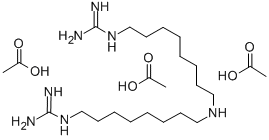
Iminoctadine is a member of the class of guanidines that is dioctylamine in which a hydrogen from each of the terminal methyl groups is replaced by a guanidino group. Once used as a fungicidal seed dressing, it is no longer approved for use in the European Union. It has a role as an antifungal agrochemical. It is a member of guanidines, a secondary amino compound and an aliphatic nitrogen antifungal agent.