
Gamma oryzanol
Synonym(s):
- CAS NO.:11042-64-1
- Empirical Formula: C40H58O4
- Molecular Weight: 602.89
- MDL number: MFCD00867548
- EINECS: 600-960-6
- SAFETY DATA SHEET (SDS)
- Update Date: 2026-07-13 20:36:59
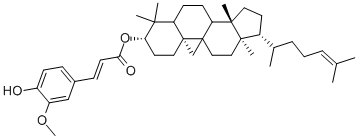
What is Gamma oryzanol?
Description
Gamma oryzanol is a lipid fraction found in rice bran oil, first isolated from it in the 1950s. Several lipid fractions were isolated at that time, the third (γ) fraction being oryzanol. It is composed of ferulic acid esters and phytosterols, structurally similar to cholesterol. The phytosterols and triterpenoids it contains include campesterol, stigmasterol, β-sitosterol, cycloartenol, and cycloartenol. Due to the low absorption rate of phytosterols, some believe they can lower blood cholesterol by inhibiting intestinal cholesterol absorption. In contrast, the ferulic acid portion of γ-oryzanol is easily absorbed by body tissues, and in vitro experiments have confirmed that ferulic acid possesses antioxidant activity.
Chemical properties
White to Off-White Solid
Occurrence
Gamma oryzanol is found in rice bran oil, which is commercially available in Japan for use in salads and frying. Crude rice bran oil contains approximately 1.56% oryzanol. A typical American diet provides 180 mg of phytosterols daily, of which about 4% is gamma-oryzanol. One cup of brown rice provides 18 mg of gamma oryzanol, while the same amount of white rice contains only 4 mg. Ferulic acid, a component of gamma-oryzanol, is naturally found in grain bran, fruits, and vegetables, and is also a metabolite of caffeic acid in coffee.
The Uses of Gamma oryzanol
Gamma Oryzanol is a mixture of 6 substances derived from rice bran oil, including sterols and ferulic acid, called Cycloartanyl Ferulate or Triterpene alcohol ferulate. It has been approved in Japan for several conditions, including menopausal symptoms, mild anxiety, stomach upset, and high cholesterol. In the US, it is widely used as a sports supplement, as well as for reducing cholesterol. gamma oryzanol is widely used as a food additive, pharmaceutical material. In cosmetic area, the application to creams and sunscreens exploiting its skin age resistor function and ultraviolet absorbing effect.
What are the applications of Application
γ-Oryzanol is a potent membrane antioxidant
Preparation
Extraction of gamma oryzanol from processes oil.
Gamma oryzanol can be extracted by liquid-liquid extraction method by using organic solvent or by using supercritical extraction method. The following procedure was followed to extract gamma oryzanol from the oil.
Rice Bran Oil (1 kg)→NaOH and water was added→Stirred and stored for one day at room temperature→Acidified to pH 4 using H2SO4→Heated to 80°C→50g NaCl was added→Oily layer was obtained→ Methanol was added→ Mixture was cooled to 0°C for 2 hrs.→ Waxy component precipitated→ Solution of 5g H2SO4 in 300 ml methanol→ Stored for one day→ Stirred at 40°C to remove/evaporate methanol→ To 100g residue 100g n-hexane was added→ Solvent Distillation→ Treatment of 100 ml methanol was given→ Residue was extracted 3 times with 50ml 0.5N→ methanolicNaOH→ Neutralised with methanolic acetic acid to pH 6.8-7→ Stored to precipitate gamma oryzanol.
The yield of gamma oryzanol was found to be 2.2%
Definition
ChEBI: Gamma-Oryzanol (TN) is a triterpenoid.
General Description
Gamma oryzanol is found in the by-products of the rice industry, such as rice bran and rice bran oil. It exhibits a wide range of biological activities, including anticarcinogenic, anti-inflammatory, antihyperlipidemic, and neuroprotective properties, which are primarily due to its high antioxidant capacity.
Side Effects
No side effects were observed in horses, dogs, and humans with gamma oryzanol. Animal toxicity studies have shown that the compound is extremely safe; no significant adverse reactions were observed in human trials at the recommended dose. However, some studies have indicated that if moderate to high doses (up to 600 mg) are ingested daily for several months, some individuals may experience discomfort such as dry mouth, drowsiness, hot flashes, irritability, and dizziness.
Safety Profile
A poison by skin contact. Moderately toxic by intravenous route. Low toxicity by ingestion. Experimental reproductive effects. When heated to decompositionit emits acrid smoke and irritating vapors.
Dosage
A typical dosage of gamma oryzanol is 500 mg daily.
Properties of Gamma oryzanol
| Melting point: | 135-137°C |
| Boiling point: | 571.92°C (rough estimate) |
| Density | 0.9751 (rough estimate) |
| refractive index | 1.4760 (estimate) |
| storage temp. | Sealed in dry,Room Temperature |
| Water Solubility | Practically insoluble in water |
| solubility | Chloroform (Slightly), Ethyl Acetate (Slightly), Methanol (Slightly) |
| form | powder to crystaline |
| color | White to Light yellow |
| Odor | little or no odor |
| Merck | 14,6886 |
| CAS DataBase Reference | 11042-64-1(CAS DataBase Reference) |
Safety information for Gamma oryzanol
| Signal word | Danger |
| Pictogram(s) |
 Skull and Crossbones Acute Toxicity GHS06 |
| GHS Hazard Statements |
H310:Acute toxicity,dermal |
| Precautionary Statement Codes |
P262:Do not get in eyes, on skin, or on clothing. P264:Wash hands thoroughly after handling. P264:Wash skin thouroughly after handling. P270:Do not eat, drink or smoke when using this product. P280:Wear protective gloves/protective clothing/eye protection/face protection. P405:Store locked up. |
Computed Descriptors for Gamma oryzanol
New Products
5-bromo-4-fluoro-2-nitrobenzaldehyde (R)-(-)-2-Amino-1-propanol Cyclobutanone Fmoc-OSu 1-(2-Chloroethyl)pyrrolidine Hydrochloride 2-Amino-2-(4-methylphenyl)acetic acid β-Bromostyrene Ethyl 3-phenylpropanoate Phenethyl cinnamate Dipropyl disulfide 4 pentyn 1 ol N-Vinylformamide Methacrylate-PEG-Methacrylate, Mn:35000 2,4-Dihydroxyacetophenone 2-Chloro 5-Fluoro Pyridine Vasicinone 2-Chloroisonicotinic Acid Tween 80 or Polysorbate 80 2-Butyn-1-oL 2-Pentyn-1-oL 4-Nitrobenzotrifluoride N-(4-fluoro-2-methoxy-5-nitrophenyl)-4-(1-methyl-1H-indol-3-yl)pyrimidin-2-amine Pirtobrutinib intd. N-(4-Cyano-3-(trifluoromethyl)phenyl)-2-methyloxirane-2-carboxamideRelated products of tetrahydrofuran

You may like
-
 γ-Oryzanol CAS 11042-64-1View Details
11042-64-1 -
γ-Oryzanol, 98% CAS 11042-64-1View Details
11042-64-1 -
gamma-Oryzanol CAS 11042-64-1View Details
11042-64-1 -
Γ-Oryzanol CASView Details
-
Gamma-Oryzanol CASView Details
-
7250-67-1 1-(2-Chloroethyl)pyrrolidine Hydrochloride 98+View Details
7250-67-1 -
7250-67-1 1-(2-Chloroethyl)pyrrolidine Hydrochloride 98+View Details
7250-67-1 -
13227-01-5 98+View Details
13227-01-5