
F16
- CAS NO.:36098-33-6
- Empirical Formula: C16H15IN2
- Molecular Weight: 362.21
- MDL number: MFCD00050298
- SAFETY DATA SHEET (SDS)
- Update Date: 2026-07-16 07:06:08
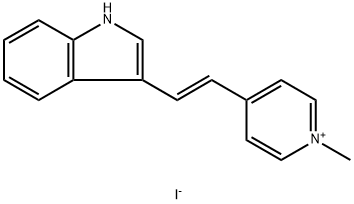
What is F16?
The Uses of F16
F16 is a cell-permeable mitochondrial toxin with apoptotic and necrotic action in tumor cell lines.
What are the applications of Application
F16 is a cell-permeable mitochondrial toxin with apoptotic and necrotic action in tumor cell lines
Biological Activity
f16 is a small, cationic, lipophilic, and fluorescent molecule capable of binding preferentially to mitochondrial membranes and disrupts their function. f16 is a potential antitumor agent.f16 affected growth in some mouse and human breast cancer cell lines. f16 resulted in a dramatic decrease in the number of cells in s phase and an increase in the percentage of cells in g1 phase [1]. prolonged incubation with 3 μm f16 led to increased cell death of f16-sensitive cells but not of f16-resistant ones. f16 accumulation in mitochondria induced mitochondrial damage characterized by imbalance of volumetric homeostasis, failure to synthesize atp, cytochrome c release and increased production of reactive oxy gen species [1]. f16 incubation decreased the cellular atp pool in both parental eph4-a6 and bcl-2-overexpressing eph4-a6.c13 and eph4-a6.c18 cells in a time-dependent manner [1]. treatment with f16 promoted early release of cytochrome c in transformed eph4-a6 cells. treatment with f16 (0.3-3 μm) resulted in the characteristic apoptotic dna laddering in the eph4-a6 cells. f16-induced mitochondrial dysfunction triggers apoptosis or necrosis. f16 induced necrosis in various cell lines resistant to apoptosis [2].
References
[1] fantin v r, berardi m j, scorrano l, et al. a novel mitochondriotoxic small molecule that selectively inhibits tumor cell growth[j]. cancer cell, 2002, 2(1): 29-42.
[2] fantin v r, leder p. f16, a mitochondriotoxic compound, triggers apoptosis or necrosis depending on the genetic background of the target carcinoma cell[j]. cancer research, 2004, 64(1): 329-336.
Properties of F16
| storage temp. | Store at -20°C |
| solubility | ≤500μg/ml in ethanol;20mg/ml in DMSO;25mg/ml in dimethyl formamide |
| form | Orange solid. |
| color | Yellow to orange |
Safety information for F16
Computed Descriptors for F16
New Products
9-Mesityl-10-methylacridinium perchlorate Sulfapyridine Fmoc-OSu (R)-(-)-2-Amino-1-propanol Cyclobutanone 5-bromo-4-fluoro-2-nitrobenzaldehyde 4 pentyn 1 ol N-Vinylformamide Phenethyl cinnamate Pyrrolo[1,2-a]pyrimidine-6-carboxylic acid, 4,6,7,8-tetrahydro-4-oxo-, sodium salt (1:1), (6S) Ethyl 3-phenylpropanoate β-Bromostyrene Methacrylate-PEG-Methacrylate, Mn:35000 2,4-Dihydroxyacetophenone 2-Chloro 5-Fluoro Pyridine Vasicinone 2-Chloroisonicotinic Acid Tween 80 or Polysorbate 80 5-Bromo-1-Pentyne 1-(2-Methyl-5-nitrophenyl)guanidine Nitrate Methyl trans-4-Aminocyclohexanecarboxylate Hydrochloride N-(4-Cyano-3-(trifluoromethyl)phenyl)-2-methyloxirane-2-carboxamide 4-Nitrobenzotrifluoride 2-Pentyn-1-oLRelated products of tetrahydrofuran

You may like
-
 1191-95-3 Cyclobutanone 98+View Details
1191-95-3 -
213382-45-7 98+View Details
213382-45-7 -
Fmoc-OSu 98+View Details
82911-69-1 -
(R)-(-)-2-Amino-1-propanol 35320-23-1 98+View Details
35320-23-1 -
1191-95-3 Cyclobutanone 98+View Details
1191-95-3 -
213382-45-7 98+View Details
213382-45-7 -
Fmoc-OSu 98+View Details
82911-69-1 -
(R)-(-)-2-Amino-1-propanol 35320-23-1 98+View Details
35320-23-1