
ETHIPROLE
Synonym(s):5-Amino-1-(2,6-dichloro-α,α,α-trifluoro-p-tolyl)-4-(ethylsulfinyl)pyrazole-3-carbonitrile
- CAS NO.:181587-01-9
- Empirical Formula: C13H9Cl2F3N4OS
- Molecular Weight: 397.2
- MDL number: MFCD07366662
- EINECS: 446-630-3
- SAFETY DATA SHEET (SDS)
- Update Date: 2026-07-31 15:25:14
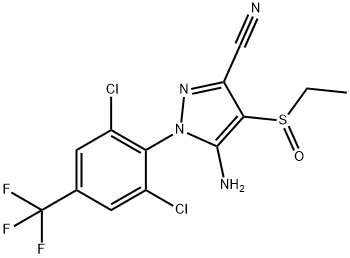
What is ETHIPROLE?
The Uses of ETHIPROLE
Ethiprole is a phenylpyrazole based insecticide used in rice ecosystem on Trichogramma japonicum, and egg parasitoid of rice lepidopterans.
The Uses of ETHIPROLE
Insecticide for chewing and sucking insects.
Definition
ChEBI: Ethiprole is a member of pyrazoles and a ring assembly.
General Description
Ethiprole, is a pyrazole insecticide, which can be used to control a broad spectrum of insects(1), like those with chewing and sucking mouthparts that tend to damage the plants. It can be mainly used for rice and cotton cultivation.
Flammability and Explosibility
Non flammable
Properties of ETHIPROLE
| Melting point: | ~174° |
| Boiling point: | 563.5±50.0 °C(Predicted) |
| Density | 1.69±0.1 g/cm3(Predicted) |
| vapor pressure | 0Pa at 25℃ |
| storage temp. | 0-6°C |
| solubility | Chloroform (Slightly), Ethyl Acetate (Slightly) |
| form | Solid |
| pka | -3.91±0.20(Predicted) |
| form | neat |
| color | White to light yellow |
| Water Solubility | 9.2mg/L at 20℃ |
| Stability: | Light Sensitive |
| EPA Substance Registry System | 1H-Pyrazole-3-carbonitrile, 5-amino-1-[2,6-dichloro-4-(trifluoromethyl)phenyl]-4-(ethylsulfinyl (181587-01-9) |
Safety information for ETHIPROLE
| Signal word | Warning |
| Pictogram(s) |
 Health Hazard GHS08  Environment GHS09 |
| GHS Hazard Statements |
H373:Specific target organ toxicity, repeated exposure H410:Hazardous to the aquatic environment, long-term hazard |
| Precautionary Statement Codes |
P260:Do not breathe dust/fume/gas/mist/vapours/spray. P273:Avoid release to the environment. P314:Get medical advice/attention if you feel unwell. P391:Collect spillage. Hazardous to the aquatic environment P501:Dispose of contents/container to..… |
Computed Descriptors for ETHIPROLE
New Products
N-Carbethoxy-4-piperidone 1-Aminocyclopentane carbonitrile Tetrabutylammonium perchlorate N,O-Dimethylhydroxylamine hydrochloride (RS)-beta-Amino-beta-(4-bromophenyl)propionic acid 2-Amino-5-bromo-4-(trifluoromethyl)pyridine N-Vinylformamide 4 pentyn 1 ol Phenethyl cinnamate Dipropyl disulfide Ethyl 3-phenylpropanoate β-Bromostyrene Methacrylate-PEG-Methacrylate, Mn:35000 2,4-Dihydroxyacetophenone 2-Chloro 5-Fluoro Pyridine Vasicinone 2-Chloroisonicotinic Acid Tween 80 or Polysorbate 80 5-Bromo-1-Pentyne 1-(2-Methyl-5-nitrophenyl)guanidine Nitrate Methyl trans-4-Aminocyclohexanecarboxylate Hydrochloride N-(4-Cyano-3-(trifluoromethyl)phenyl)-2-methyloxirane-2-carboxamide 2-Pentyn-1-oL 4-NitrobenzotrifluorideRelated products of tetrahydrofuran

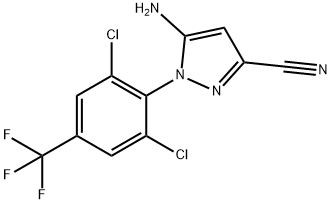
![5-AMINO-1-[4-(-TRIFLUOROMETHYL)PHENYL]-1H-PYRAZOLE-3-CARBONITRILE](https://img.chemicalbook.in/StructureFile/ChemBookStructure9/GIF/CB0133140.gif)
You may like
-
 Ethiprole 98.00% CAS 181587-01-9View Details
181587-01-9 -
Ethiprole CAS 181587-01-9View Details
181587-01-9 -
Ethiprole CAS 181587-01-9View Details
181587-01-9 -
144-83-2 Sulfapyridine 98+View Details
144-83-2 -
29976-53-2 98+View Details
29976-53-2 -
674783-97-2 98+View Details
674783-97-2 -
1-Aminocyclopentane carbonitrile 98+View Details
49830-37-7 -
Tetrabutylammonium perchlorate 1923-70-2 98+View Details
1923-70-2
Statement: All products displayed on this website are only used for non medical purposes such as industrial applications or scientific research, and cannot be used for clinical diagnosis or treatment of humans or animals. They are not medicinal or edible.