
Domoic acid
- CAS NO.:14277-97-5
- Empirical Formula: C15H21NO6
- Molecular Weight: 311.33
- MDL number: MFCD06795841
- SAFETY DATA SHEET (SDS)
- Update Date: 2026-09-12 18:50:38
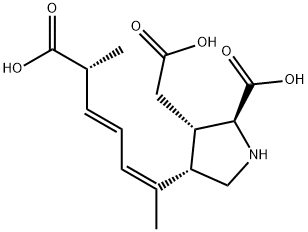
What is Domoic acid?
Description
Domoic acid is a neurotoxin produced by marine algae. A recent study found that domoic acid can spread farther and is more persistent than previously thought. The effects of domoic acid have repercussions up the food chain; shellfish poisoning can result in die-offs of mammals such as sea lions and whales. It can also cause digestion and memory problems in humans who consume large amounts of seafood.
Update: November 20, 2015
This fall (2015), the Pacific Ocean off the west coast of the United States is so contaminated with domoic acid that?officials postponed the Dungeness crab harvesting season. The unusually high algae bloom is attributed to warmer temperatures caused by the El Ni?o climate condition.
Chemical properties
Off-White Solid
The Uses of Domoic acid
Labelled Domoic Acid. Domoic Acid is an excitatory amino acid isolated from the red alga Chondria armata Okamura, Rhodomelaceae. Domoic acid shown to be responsible for amnesic shellfish poisoning ass ociated with ingestion of certain cultured blue mussels. Domoic Acid is a structural analog of Kainic acid (K135000).
The Uses of Domoic acid
Domoic Acid is an excitatory amino acid isolated from the red alga Chondria armata Okamura, Rhodomelaceae. Domoic acid shown to be responsible for amnesic shellfish poisoning associated with ingestion of certain cultured blue mussels. Domoic acid is a structural analog of Kainic acid (K135000). DA. EU regulated marine toxin.
The Uses of Domoic acid
Domoic acid has been used:
- as an excitatory neurotoxin to determine brain transcriptional response
- to study its cytotoxic, genotoxic and immunotoxic effects on the marine mussel M. edulis
- to study its neurobehavioral effects on mouse fetuses
Definition
ChEBI: A L-proline derivative that is L-proline substituted by a carboxymethyl group at position 3 and a 6-carboxyhepta-2,4-dien-2-yl group at position 4. It is an analog of kainic acid and is the neurotoxin associated with the a nesic shellfish poisoning (ASP).
General Description
Domoic acid, a heterocyclic amino acid neurotoxin is synthesized by various marine algaes. It possess some structural similarity to kainic acid.
Biological Activity
More potent and possibly more selective than kainate at kainate receptors, as demonstrated in electrophysiological studies.
Biochem/physiol Actions
Domoic acid is a potent agonist at receptors for excitatory amino acids glutamate and kainate. It has highest affinity for AMPA/kainate receptor of any kainate agonist. It can causes excessive excitation of neurons leading to depletion of energy stores.
Purification Methods
Domoic acid (~300 mg) is purifed on a Dowex1 column (3.5 x 40 mm, 200-400 mesh, acetate form), washed with H2O until neutral, then eluted with increasing concentrations of AcOH (8L) from 0 to 0.25M. The fraction containing domoic acid (in 50mL) is collected, evaporated to dryness under reduced pressure and recrystallised from aqueous EtOH. It is a glutamate and a Kainate receptor agonist. [Impellizzeri et al. Phytochemistry 14 1549 1975, Takemoto & Diago Arch Pharm 293 627 1960, Beilstein 22/4 V 371.]
Properties of Domoic acid
| Melting point: | 213-217℃ |
| Boiling point: | 451.38°C (rough estimate) |
| Density | 1.1800 (rough estimate) |
| refractive index | 1.5130 (estimate) |
| storage temp. | -20°C |
| solubility | methanol: 0.6 mg/mL |
| pka | 2.08±0.60(Predicted) |
| form | solid |
| color | white |
| Water Solubility | Soluble in water at 8mg/ml. Soluble in methanol at 0.6mg/ml. |
| Merck | 13,3451 |
| BRN | 46376 |
| Stability: | Light Sensitive |
| EPA Substance Registry System | Domoic acid (14277-97-5) |
Safety information for Domoic acid
| Signal word | Danger |
| Pictogram(s) |
 Exclamation Mark Irritant GHS07  Health Hazard GHS08 |
| GHS Hazard Statements |
H302:Acute toxicity,oral H370:Specific target organ toxicity, single exposure |
| Precautionary Statement Codes |
P260:Do not breathe dust/fume/gas/mist/vapours/spray. P264:Wash hands thoroughly after handling. P264:Wash skin thouroughly after handling. P270:Do not eat, drink or smoke when using this product. P301+P312:IF SWALLOWED: call a POISON CENTER or doctor/physician IF you feel unwell. P405:Store locked up. |
Computed Descriptors for Domoic acid
New Products
2-(2-Chlorophenyl)glycine Propiolic Acid 1-(3-Hydroxy-4-methoxyphenyl)-2-nitroethene (±)-amino(2-fluorophenyl)acetic acid trans-3-Benzyloxy-4-methoxy-beta-nitrostyrene 1-Pentadecanol 2,4-Dihydroxybenzaldehyde Dipropyl disulfide Pyrrolo[1,2-a]pyrimidine-6-carboxylic acid, 4,6,7,8-tetrahydro-4-oxo-, sodium salt (1:1), (6S) Obidoxime hydrochloride API 4 pentyn 1 ol N-Vinylformamide Methacrylate-PEG-Methacrylate, Mn:35000 2,4-Dihydroxyacetophenone 2-Chloro 5-Fluoro Pyridine Vasicinone 2-Chloroisonicotinic Acid Tween 80 or Polysorbate 80 2-Butyn-1-oL N-(4-Cyano-3-(trifluoromethyl)phenyl)-2-methyloxirane-2-carboxamide N-(4-fluoro-2-methoxy-5-nitrophenyl)-4-(1-methyl-1H-indol-3-yl)pyrimidin-2-amine Pirtobrutinib intd. 2-Pentyn-1-oL 4-NitrobenzotrifluorideRelated products of tetrahydrofuran

You may like
-
 40216-83-9 trans-4-Hydroxy-L-proline methyl ester hydrochloride 98+View Details
40216-83-9 -
471-25-0 Propiolic Acid 98+View Details
471-25-0 -
84145-28-8 98+View Details
84145-28-8 -
trans-3-Benzyloxy-4-methoxy-beta-nitrostyrene 98+View Details
63909-29-5 -
2-(2-Chlorophenyl)glycine 88744-36-9 98+View Details
88744-36-9 -
40216-83-9 trans-4-Hydroxy-L-proline methyl ester hydrochloride 98+View Details
40216-83-9 -
629-76-5 98+View Details
629-76-5 -
1-(3-Hydroxy-4-methoxyphenyl)-2-nitroethene 98+View Details
39816-35-8