
Dinocap
- CAS NO.:39300-45-3
- Empirical Formula: C18H24N2O6
- Molecular Weight: 364.39
- MDL number: MFCD00054268
- EINECS: 254-408-0
- SAFETY DATA SHEET (SDS)
- Update Date: 2026-07-31 15:25:13
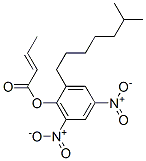
What is Dinocap?
Description
Dinocap is shown in both the 2,4-dinitro and 2,6-dinitro configurations with 1-methylheptyl and 1-ethylhexyl chains, respectively, but may also have a 1-propylpentyl configuration for the “octyl” chain. It is a dark brown liquid with a bp = 138 to 140 ?C, vp = 5.3×10?6 mPa, a Kow LogP = 4.54, and is almost insoluble (<0.1 mgL?1) in water (5).
The Uses of Dinocap
Acaricide; fungicide.
What are the applications of Application
Dinocap is an acaricide and pesticide
Definition
ChEBI: 2,4-dinitro-6-(octan-2-yl)phenyl (E)-but-2-enoate is an enoate ester obtained by formal condensation of the carboxy group of 3-methylacrylic acid with the phenolic hydroxy group of 2,4-dinitro-6-(octan-2-yl)phenol. It is a C-nitro compound and an enoate ester.
General Description
Dark oily liquid. Nearly insoluble in water. Used as a fungicide and acaricide.
Air & Water Reactions
Nearly insoluble in water. Hydrolysis of the ester group occurs with alkaline pHs.
Reactivity Profile
A dinitrophenyl derivative.
Agricultural Uses
Fungicide, Acaricide: Dinocap is a foliar fungicide/miticide used to control powdery mildew. It is applied to limit mites in apples and grapes crops outside the U.S., mainly in Europe, the Middle East and northern Africa. It is also used to control powdery mildew on fruit, vegetables and ornamentals. DAS, the registrant of dinocap, intends to support tolerances for dinocap residues in/on apples and grapes to permit legal importation of these commodities into the U.S. Not approved for use in EU countries. Not currently registered in the U.S. There are 17 global suppliers.
Trade name
ACTUAL DINOCAP®; ARATHANE®; CAPRANE®; CR 1639®; CEKUCAP® 25 WP; CROTOTHANE®; DICAP®; DIKAR®; EZENOAN®; ISCOTHANE®; ISOCOTHANE®; KARATHANE®[C]; KARATHANE® WD[C]; KARATHENE®[C]; MILDANE®; MILDEX®
Safety Profile
Poison by ingestion and intravenous routes. An experimental teratogen. Other experimental reproductive effects. Mutation data reported. Questionable carcinogen with experimental neoplastigenic data. See NITRATES. When heated to decomposition it emits toxic fumes of NOx.
Toxicity evaluation
Dinocap shows moderate acute toxicity to mammals (acute oral LD50 in rats of 1,000 to 5,000 mg/kg) with moderate dermal irritation but substantial eye irritation in rabbits (Rohm & Haas MSDS C&P MSDS reference listing; MDL MSDS database listing). Dinocap is teratogenic to mice and hamsters at 10 to 100 mg/kg/day (48–51), although no evidence of teratogenic effects were seen in rabbits (Rohm & Haas MSDS C&P MSDS reference listing). Dinocap is classified as “toxic” to fish but is listed as “nontoxic” to bees (52).
Properties of Dinocap
| Boiling point: | 138-140°C |
| Density | 1.10 |
| refractive index | 1.5700 (estimate) |
| solubility | Chloroform (Slightly), Methanol (Slightly) |
| form | Liquid |
| Water Solubility | practically insoluble |
| Merck | 13,3316 |
| CAS DataBase Reference | 39300-45-3(CAS DataBase Reference) |
| EPA Substance Registry System | Dinocap (39300-45-3) |
Safety information for Dinocap
| Signal word | Danger |
| Pictogram(s) |
 Exclamation Mark Irritant GHS07  Health Hazard GHS08  Environment GHS09 |
| GHS Hazard Statements |
H315:Skin corrosion/irritation H317:Sensitisation, Skin H373:Specific target organ toxicity, repeated exposure H410:Hazardous to the aquatic environment, long-term hazard |
| Precautionary Statement Codes |
P201:Obtain special instructions before use. P261:Avoid breathing dust/fume/gas/mist/vapours/spray. P273:Avoid release to the environment. P280:Wear protective gloves/protective clothing/eye protection/face protection. P308+P313:IF exposed or concerned: Get medical advice/attention. P501:Dispose of contents/container to..… |
Computed Descriptors for Dinocap
New Products
5-bromo-4-fluoro-2-nitrobenzaldehyde (R)-(-)-2-Amino-1-propanol Cyclobutanone Fmoc-OSu 1-(2-Chloroethyl)pyrrolidine Hydrochloride 2-Amino-2-(4-methylphenyl)acetic acid β-Bromostyrene Ethyl 3-phenylpropanoate Phenethyl cinnamate Dipropyl disulfide 4 pentyn 1 ol N-Vinylformamide Methacrylate-PEG-Methacrylate, Mn:35000 2,4-Dihydroxyacetophenone 2-Chloro 5-Fluoro Pyridine Vasicinone 2-Chloroisonicotinic Acid Tween 80 or Polysorbate 80 2-Butyn-1-oL 2-Pentyn-1-oL 4-Nitrobenzotrifluoride N-(4-fluoro-2-methoxy-5-nitrophenyl)-4-(1-methyl-1H-indol-3-yl)pyrimidin-2-amine Pirtobrutinib intd. N-(4-Cyano-3-(trifluoromethyl)phenyl)-2-methyloxirane-2-carboxamideRelated products of tetrahydrofuran



You may like
-
 Fmoc-OSu 98+View Details
82911-69-1 -
(R)-(-)-2-Amino-1-propanol 35320-23-1 98+View Details
35320-23-1 -
7250-67-1 1-(2-Chloroethyl)pyrrolidine Hydrochloride 98+View Details
7250-67-1 -
13227-01-5 98+View Details
13227-01-5 -
7250-67-1 1-(2-Chloroethyl)pyrrolidine Hydrochloride 98+View Details
7250-67-1 -
13227-01-5 98+View Details
13227-01-5 -
7250-67-1 1-(2-Chloroethyl)pyrrolidine Hydrochloride 98+View Details
7250-67-1 -
13227-01-5 98+View Details
13227-01-5