
Dichlorophenylphosphine
Synonym(s):3-(1,3-benzodioxol-5-yl)-4-phenyl-2,5-Furandione;Phenyldichlorophosphine;Phenylphosphine dichloride;Phenylphosphonous dichloride;PhPCl2
- CAS NO.:644-97-3
- Empirical Formula: C6H5Cl2P
- Molecular Weight: 178.98
- MDL number: MFCD00000528
- EINECS: 211-425-8
- SAFETY DATA SHEET (SDS)
- Update Date: 2026-05-28 02:55:05
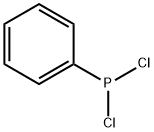
What is Dichlorophenylphosphine?
Chemical properties
Colorless to light yellow liqui
The Uses of Dichlorophenylphosphine
Dichlorophenylphosphine and its derivatives are used as an intermediate to make plasticizers, antioxidants, stabilizers, catalysts and high pressure lubricant additives and in lacquer formulatings.
The Uses of Dichlorophenylphosphine
Organic synthesis, for derivation of plasticizers, polymers, antioxidants; oil additives.
General Description
A colorless, fuming liquid. Density 1.32 g / cm3. Flash point 102°C. Corrosive to metals and tissue.
Air & Water Reactions
Reacts with water, including moisture in air or soil, to liberate heat and hydrochloric acid [Merck, 11th ed. 1989].
Reactivity Profile
Dichlorophenylphosphine is incompatible with water, with bases (including amines), with strong oxidizing agents, and with alcohols. May react vigorously or explosively if mixed with diisopropyl ether or other ethers in the presence of trace amounts of metal salts [J. Haz. Mat., 1981, 4, 291].
Hazard
Highly corrosive to skin, tissue. Flammable.
Health Hazard
Inhalation causes irritation of nose and throat; pulmonary edema may develop following severe exposures. Contact with skin or eyes causes severe burns. Ingestion causes severe burns of mouth and stomach.
Flammability and Explosibility
Non flammable
Safety Profile
A poison irritant to skin, eyes, and mucous membranes and poison by ingestion and inhalation. When heated to decomposition it emits very toxic fumes of Cland POx. See also PHOSPHINE.
Purification Methods
Distil it in a vacuum byfractionating through a 20cm column packed with glass helices (better use a spinning band column) [Buchner & Lockhart J Am Chem Soc 73 755 1951, NMR: Müller et al. J Am Chem Soc 78 3557 1956, IR: Daasch & Smith Anal Chem 23 853 1951]. It forms a yellow Ni complex: Ni(C6H5Cl2P)4 (m 91-92o, from H2O) [Quin J Am Chem Soc 79 3681 1957 ] and a yellow complex with molybdenum carbonyl: Mo(CO)3.(C6H5Cl2P)3 (m 106-110o dec) [Abel et al. J Chem Soc 2323 1959]. [Beilstein 16 IV 972.]
Properties of Dichlorophenylphosphine
| Melting point: | −51 °C(lit.) |
| Boiling point: | 222 °C759 mm Hg(lit.) |
| Density | 1.319 g/mL at 25 °C(lit.) |
| refractive index | n |
| Flash point: | >230 °F |
| storage temp. | Store below +30°C. |
| form | Liquid |
| color | Clear colorless to slightly yellow |
| Specific Gravity | 1.319 (20℃) |
| Water Solubility | Reacts |
| Sensitive | Moisture Sensitive |
| BRN | 508189 |
| CAS DataBase Reference | 644-97-3(CAS DataBase Reference) |
| NIST Chemistry Reference | Phosphonous dichloride, phenyl-(644-97-3) |
| EPA Substance Registry System | Phosphonous dichloride, P-phenyl- (644-97-3) |
Safety information for Dichlorophenylphosphine
| Signal word | Danger |
| Pictogram(s) |
 Corrosion Corrosives GHS05  Skull and Crossbones Acute Toxicity GHS06 |
| GHS Hazard Statements |
H301:Acute toxicity,oral H314:Skin corrosion/irritation H335:Specific target organ toxicity, single exposure;Respiratory tract irritation |
| Precautionary Statement Codes |
P261:Avoid breathing dust/fume/gas/mist/vapours/spray. P270:Do not eat, drink or smoke when using this product. P280:Wear protective gloves/protective clothing/eye protection/face protection. P303+P361+P353:IF ON SKIN (or hair): Remove/Take off Immediately all contaminated clothing. Rinse SKIN with water/shower. P305+P351+P338:IF IN EYES: Rinse cautiously with water for several minutes. Remove contact lenses, if present and easy to do. Continuerinsing. |
Computed Descriptors for Dichlorophenylphosphine
New Products
5-bromo-4-fluoro-2-nitrobenzaldehyde (R)-(-)-2-Amino-1-propanol Cyclobutanone Fmoc-OSu 1-(2-Chloroethyl)pyrrolidine Hydrochloride 2-Amino-2-(4-methylphenyl)acetic acid β-Bromostyrene Ethyl 3-phenylpropanoate Phenethyl cinnamate Dipropyl disulfide 4 pentyn 1 ol N-Vinylformamide Methacrylate-PEG-Methacrylate, Mn:35000 2,4-Dihydroxyacetophenone 2-Chloro 5-Fluoro Pyridine Vasicinone 2-Chloroisonicotinic Acid Tween 80 or Polysorbate 80 2-Butyn-1-oL 2-Pentyn-1-oL 4-Nitrobenzotrifluoride N-(4-fluoro-2-methoxy-5-nitrophenyl)-4-(1-methyl-1H-indol-3-yl)pyrimidin-2-amine Pirtobrutinib intd. N-(4-Cyano-3-(trifluoromethyl)phenyl)-2-methyloxirane-2-carboxamideRelated products of tetrahydrofuran


You may like
-
 Dichlorophenylphosphine, 97% CAS 644-97-3View Details
644-97-3 -
Dichlorophenylphosphine 98.00% CAS 644-97-3View Details
644-97-3 -
7250-67-1 1-(2-Chloroethyl)pyrrolidine Hydrochloride 98+View Details
7250-67-1 -
13227-01-5 98+View Details
13227-01-5 -
7250-67-1 1-(2-Chloroethyl)pyrrolidine Hydrochloride 98+View Details
7250-67-1 -
13227-01-5 98+View Details
13227-01-5 -
7250-67-1 1-(2-Chloroethyl)pyrrolidine Hydrochloride 98+View Details
7250-67-1 -
13227-01-5 98+View Details
13227-01-5