
Dibutyltin dichloride
Synonym(s):Dibutyldichlorostannane, Dibutyldichlorotin;Dibutyldichlorotin;Dibutyltin dichloride
- CAS NO.:683-18-1
- Empirical Formula: C8H18Cl2Sn
- Molecular Weight: 303.84
- MDL number: MFCD00000518
- EINECS: 211-670-0
- SAFETY DATA SHEET (SDS)
- Update Date: 2026-06-24 18:39:39
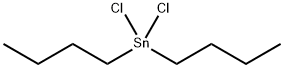
What is Dibutyltin dichloride?
Chemical properties
Dibutyltin dichloride is a white to beige crystalline low melting mass. soluble in organic solvents such as benzene, toluene, ether and alcohols. It is difficult to dissolve in water. Decomposition (hydrolysis) occurs in hot water. Dibutyltin dichloride is flammable, low volatile and has a pungent odor.
The Uses of Dibutyltin dichloride
Dibutyltin dichloride is used as an organotin intermediate. It serves as heat and light stabilizer for polyvinyl chloride plastics. It is also used in the preparation of methyl 2-(methoxycarbonylmethyl)-5-iodobenzene by reacting with 2,5-diiodobenzoic acid. It acts as an esterification catalyst and a veterinary vermicide and tapeworm remedy. Further, it is used as ion exchange agent, process regulators and processing aids.
Preparation
Dibutyltin dichloride is manufactured from crude tetrabutyltin and tin tetrachloride and is usually catalysed with aluminium trichloride (Blunden & Evans, 1989; Gaver, 1997; Thoonen et al., 2001)
Safety Profile
Poison by ingestion, intravenous, and intraperitoneal routes. Moderately toxic by skin contact. A severe skin and eye irritant. Experimental reproductive effects. Mutation data reported. See also TIN COMPOUNDS. Combustible when exposed to heat or flame. A dangerous material; emits highly toxic fumes of HCl; wdl react with water or steam to produce heat and toxic fumes; can react vigorously with oxidizing materials. To Poison by ingestion, intravenous, and intraperitoneal routes. Moderately toxic by skin contact. A severe skin and eye irritant. Experimental reproductive effects. Mutation data reported. See also TIN COMPOUNDS. Combustible when exposed to heat or flame. A dangerous material; emits highly toxic fumes of HCl; wdl react with water or steam to produce heat and toxic fumes; can react vigorously with oxidizing materials. Tofight fue, use water, foam, CO2, dry chemical.
Properties of Dibutyltin dichloride
| Melting point: | 39 °C |
| Boiling point: | 135 °C10 mm Hg(lit.) |
| Density | 1.4 |
| vapor pressure | 0.0016 hPa (25 °C) |
| refractive index | 1.4991 |
| Flash point: | >230 °F |
| storage temp. | Store below +30°C. |
| solubility | 0.32g/l |
| form | Crystalline |
| color | White |
| Specific Gravity | 1.36 |
| Water Solubility | 320 mg/L, hydrolises in hot water |
| Sensitive | Moisture Sensitive |
| BRN | 3535484 |
| Exposure limits | ACGIH: TWA 0.1 mg/m3; STEL 0.2 mg/m3 (Skin) NIOSH: IDLH 25 mg/m3; TWA 0.1 mg/m3 |
| CAS DataBase Reference | 683-18-1(CAS DataBase Reference) |
| NIST Chemistry Reference | Di-n-butyltindichloride(683-18-1) |
| EPA Substance Registry System | Dibutyltin dichloride (683-18-1) |
Safety information for Dibutyltin dichloride
| Signal word | Danger |
| Pictogram(s) |
 Corrosion Corrosives GHS05  Skull and Crossbones Acute Toxicity GHS06  Health Hazard GHS08  Environment GHS09 |
| GHS Hazard Statements |
H301:Acute toxicity,oral H312:Acute toxicity,dermal H314:Skin corrosion/irritation H317:Sensitisation, Skin H330:Acute toxicity,inhalation H341:Germ cell mutagenicity H370:Specific target organ toxicity, single exposure H372:Specific target organ toxicity, repeated exposure H410:Hazardous to the aquatic environment, long-term hazard |
| Precautionary Statement Codes |
P260:Do not breathe dust/fume/gas/mist/vapours/spray. P273:Avoid release to the environment. P280:Wear protective gloves/protective clothing/eye protection/face protection. P303+P361+P353:IF ON SKIN (or hair): Remove/Take off Immediately all contaminated clothing. Rinse SKIN with water/shower. P305+P351+P338:IF IN EYES: Rinse cautiously with water for several minutes. Remove contact lenses, if present and easy to do. Continuerinsing. |
Computed Descriptors for Dibutyltin dichloride
New Products
5-bromo-4-fluoro-2-nitrobenzaldehyde (R)-(-)-2-Amino-1-propanol Cyclobutanone Fmoc-OSu 1-(2-Chloroethyl)pyrrolidine Hydrochloride 2-Amino-2-(4-methylphenyl)acetic acid β-Bromostyrene Ethyl 3-phenylpropanoate Phenethyl cinnamate Dipropyl disulfide 4 pentyn 1 ol N-Vinylformamide Methacrylate-PEG-Methacrylate, Mn:35000 2,4-Dihydroxyacetophenone 2-Chloro 5-Fluoro Pyridine Vasicinone 2-Chloroisonicotinic Acid Tween 80 or Polysorbate 80 2-Butyn-1-oL 2-Pentyn-1-oL 4-Nitrobenzotrifluoride N-(4-fluoro-2-methoxy-5-nitrophenyl)-4-(1-methyl-1H-indol-3-yl)pyrimidin-2-amine Pirtobrutinib intd. N-(4-Cyano-3-(trifluoromethyl)phenyl)-2-methyloxirane-2-carboxamideRelated products of tetrahydrofuran

You may like
-
 Dibutyltin Dichloride CAS 683-18-1View Details
683-18-1 -
Dibutyltin dichloride CAS 683-18-1View Details
683-18-1 -
Dibutyltin dichloride CAS 683-18-1View Details
683-18-1 -
7250-67-1 1-(2-Chloroethyl)pyrrolidine Hydrochloride 98+View Details
7250-67-1 -
7250-67-1 1-(2-Chloroethyl)pyrrolidine Hydrochloride 98+View Details
7250-67-1 -
13227-01-5 98+View Details
13227-01-5 -
7250-67-1 1-(2-Chloroethyl)pyrrolidine Hydrochloride 98+View Details
7250-67-1 -
13227-01-5 98+View Details
13227-01-5