
Dibutyltin oxide
Synonym(s):Dibutyloxostannane;Dibutyloxotin;Dibutyltin oxide
- CAS NO.:818-08-6
- Empirical Formula: C8H18OSn
- Molecular Weight: 248.94
- MDL number: MFCD00001992
- EINECS: 212-449-1
- SAFETY DATA SHEET (SDS)
- Update Date: 2026-06-24 18:39:39
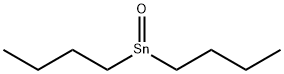
What is Dibutyltin oxide?
Chemical properties
white fine powder
The Uses of Dibutyltin oxide
Dibutyltin oxide is used in studies pertaining to discovering novel antitumor agents. Antifungal activity.
The Uses of Dibutyltin oxide
Di-n-butyltin oxide is used as a reagent and a catalyst. It is particularly useful in regioselective alkylation, acylation and sulfonation reactions for starting materials containing alcohol functional groups. It is used in studies pertaining to discovering novel antitumor agents, antifungal activity.
Flammability and Explosibility
Non flammable
Safety Profile
Poison by ingestion and intraperitoneal routes. A skin and eye irritant. Flammable when exposed to flame; can react with oxidizing materials. To fight fire, use dry chemical, fog, CO2. When heated to decomposition it emits acrid smoke and irritating fumes. See also TIN COMPOUNDS.
Purification Methods
It is prepared by hydrolysis of di-n-butyltin dichloride with KOH. Hence wash it with a little aqueous M KOH, then H2O and dry at ~80o/10mm until the IR is free from OH bands. [Cummings Aust J Chem 18 98 1965, Beilstein 4 I 588.]
Properties of Dibutyltin oxide
| Melting point: | ≥300 °C(lit.) |
| Boiling point: | >300°C |
| Density | 1,5 g/cm3 |
| vapor pressure | 0Pa at 25℃ |
| Flash point: | 81-83°C |
| storage temp. | Store below +30°C. |
| solubility | Methanol (Very Slightly, Heated) |
| form | Powder |
| Specific Gravity | 1.58 |
| color | White |
| Water Solubility | 4.0 mg/L (20 ºC) |
| BRN | 4126243 |
| CAS DataBase Reference | 818-08-6(CAS DataBase Reference) |
| EPA Substance Registry System | Stannane, dibutyloxo- (818-08-6) |
Safety information for Dibutyltin oxide
| Signal word | Danger |
| Pictogram(s) |
 Corrosion Corrosives GHS05  Exclamation Mark Irritant GHS07  Health Hazard GHS08  Environment GHS09 |
| GHS Hazard Statements |
H302:Acute toxicity,oral H315:Skin corrosion/irritation H317:Sensitisation, Skin H318:Serious eye damage/eye irritation H341:Germ cell mutagenicity H360:Reproductive toxicity H370:Specific target organ toxicity, single exposure H372:Specific target organ toxicity, repeated exposure H411:Hazardous to the aquatic environment, long-term hazard |
| Precautionary Statement Codes |
P273:Avoid release to the environment. P280:Wear protective gloves/protective clothing/eye protection/face protection. P301+P312:IF SWALLOWED: call a POISON CENTER or doctor/physician IF you feel unwell. P302+P352:IF ON SKIN: wash with plenty of soap and water. P305+P351+P338:IF IN EYES: Rinse cautiously with water for several minutes. Remove contact lenses, if present and easy to do. Continuerinsing. |
Computed Descriptors for Dibutyltin oxide
New Products
2-Bromo-4-hydroxypyridine Dibenzoyl-L-tartaric acid Anhydrous (Resolution Reagent) Dibenzo[b,f][1,4]thiazepin-11(10H)-one 1,2,3,9-Tetrahydro-9-Methyl-4H-Carbazole-4-One Cis-Tosylate 1-(4-methoxyphenyl)-4-(4-Nitrophenyl)Piperazine (IT-1) 2'-Fluoroacetophenone 1-aminocyclobutanecarbonitrile hydrochloride AMINO-O-TOLYL-ACETIC ACID N-Methyl-2-amino-2-methylpropionamide 4-(FMOC-AMINO)-TETRAHYDROPYRAN-4-CARBOXYLIC ACID 1-Aminocyclobutanecarboxylic Acid Hydrochloride METHANOL-D1(OD) TERTIARY BUTANOL-D9 N-ETHYL-D5-AMINE HYDROCHLORIDE BENZOIC ACID-D CHLOROFORM-D TOLUENE-D3 2-(2-Bromophenyl)ethanol Boc-D-Glu(OMe)-OMe 2,5 Dibromopyridine Ethyl 4-hydroxy-3-oxobutanoate Dimethyl (2S)-2-((tert-butoxycarbonyl)amino)-4-(cyanomethyl)pentanedioate 1-(3-Chlorophenyl)piperazine hydrochlorideRelated products of tetrahydrofuran





You may like
-
 Di-n-butyltin oxide CAS 818-08-6View Details
818-08-6 -
Di-n-butyltin oxide CAS 818-08-6View Details
818-08-6 -
Dibutyltin oxide CAS 818-08-6View Details
818-08-6 -
Dibutyltin(IV) oxide 98% CAS 818-08-6View Details
818-08-6 -
Dibutyltin oxide CAS 818-08-6View Details
818-08-6 -
Dibutyltin(IV) oxide CAS 818-08-6View Details
818-08-6 -
 Di-butyl tin oxide, For Industrial, 98%View Details
818-08-6 -
 Nickel Acetate | Eastmen Chemicals - Manufacturer, Supplier, Exporter metallic saltsView Details