
D-Glucose-13C6-1 2 3 4 5 6 6-d7
- CAS NO.:201417-01-8
- Empirical Formula: C6H5D7O6
- Molecular Weight: 193.15
- MDL number: MFCD00274634
- SAFETY DATA SHEET (SDS)
- Update Date: 2026-09-12 18:51:19
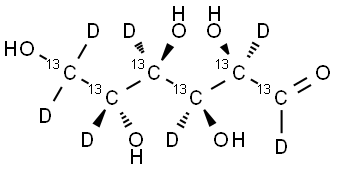
What is D-Glucose-13C6-1 2 3 4 5 6 6-d7?
The Uses of D-Glucose-13C6-1 2 3 4 5 6 6-d7
D-GLUCOSE-13C6-1 2 3 4 5 6 6-D7 99 ATO& is a simple sugar that is present in plants. A monosaccharide that may exist in open chain or cyclic conformation if in solution. It plays a vital role in photosynthesis and fuels the energy required for cellular respiration. D-GLUCOSE-13C6-1 2 3 4 5 6 6-D7 99 ATO& is used in various metabolic processes including enzymic synthesis of cyclohexyl-α and β-D-glucosides. Can also be used as a diagnostic tool in detection of type 2 diabetes mellitus and potentially Huntington's disease through analysis of blood-glucose in type 1 diabetes mellitus.
The Uses of D-Glucose-13C6-1 2 3 4 5 6 6-d7
Labelled D-Glucose. Used in enzymic synthesis of cyclohexyl-α and β-D-glucosides
The Uses of D-Glucose-13C6-1 2 3 4 5 6 6-d7
Labelled D-Glucose is a simple sugar that is present in plants. A monosaccharide that may exist in open chain or cyclic conformation if in solution. It plays a vital role in photosynthesis and fuels the energy required for cellular respiration. D-Glucose is used in various metabolic processes including enzymic synthesis of cyclohexyl-α and β-D-glucosides. Can also be used as a diagnostic tool in detection of type 2 diabetes mellitus and potentially Huntington''s disease through analysis of blood-glucose in type 1 diabetes mellitus.
General Description
D- Glucose is a monosaccharide (simple sugar). It is a vital source of energy for living organisms. It exists in a cyclic form, containing six carbon atoms. It is present naturally in all plants and fruits in free or bound state. It is synthesized by the process, gluconeogenesis, in the liver and kidney.
Biochem/physiol Actions
D-Glucose is involved in the metabolic processes, such as glycolysis and Kreb′s cycle for the generation of adenosine triphosphates. It is stored in the form of glycogen in liver. D-Glucose moieties constitutes to form cellulose by β-1,4-glycosidic linkage.
Properties of D-Glucose-13C6-1 2 3 4 5 6 6-d7
| Melting point: | 150-152 °C(lit.) |
| storage temp. | -20°C Freezer |
| solubility | Methanol (Slightly, Heated), Water (Sparingly) |
| form | Solid |
| color | White to Off-White |
Safety information for D-Glucose-13C6-1 2 3 4 5 6 6-d7
Computed Descriptors for D-Glucose-13C6-1 2 3 4 5 6 6-d7
New Products
9-Mesityl-10-methylacridinium perchlorate Sulfapyridine Fmoc-OSu (R)-(-)-2-Amino-1-propanol Cyclobutanone 5-bromo-4-fluoro-2-nitrobenzaldehyde 4 pentyn 1 ol N-Vinylformamide Phenethyl cinnamate Pyrrolo[1,2-a]pyrimidine-6-carboxylic acid, 4,6,7,8-tetrahydro-4-oxo-, sodium salt (1:1), (6S) Ethyl 3-phenylpropanoate β-Bromostyrene Methacrylate-PEG-Methacrylate, Mn:35000 2,4-Dihydroxyacetophenone 2-Chloro 5-Fluoro Pyridine Vasicinone 2-Chloroisonicotinic Acid Tween 80 or Polysorbate 80 5-Bromo-1-Pentyne 1-(2-Methyl-5-nitrophenyl)guanidine Nitrate Methyl trans-4-Aminocyclohexanecarboxylate Hydrochloride N-(4-Cyano-3-(trifluoromethyl)phenyl)-2-methyloxirane-2-carboxamide 4-Nitrobenzotrifluoride 2-Pentyn-1-oLRelated products of tetrahydrofuran

![D-[1,2,3-13C3]GLYCERALDEHYDE](https://img.chemicalbook.in/CAS/GIF/478529-54-3.gif)

![DL-[1,2-13C2]GLYCERALDEHYDE](https://img.chemicalbook.in/CAS/GIF/478529-51-0.gif)
You may like
-
 1191-95-3 Cyclobutanone 98+View Details
1191-95-3 -
213382-45-7 98+View Details
213382-45-7 -
Fmoc-OSu 98+View Details
82911-69-1 -
(R)-(-)-2-Amino-1-propanol 35320-23-1 98+View Details
35320-23-1 -
1191-95-3 Cyclobutanone 98+View Details
1191-95-3 -
213382-45-7 98+View Details
213382-45-7 -
Fmoc-OSu 98+View Details
82911-69-1 -
(R)-(-)-2-Amino-1-propanol 35320-23-1 98+View Details
35320-23-1