
Cyproheptadine hydrochloride
- CAS NO.:969-33-5
- Empirical Formula: C21H21N.ClH
- Molecular Weight: 323.86
- MDL number: MFCD00012538
- EINECS: 213-535-1
- SAFETY DATA SHEET (SDS)
- Update Date: 2026-09-12 18:51:23
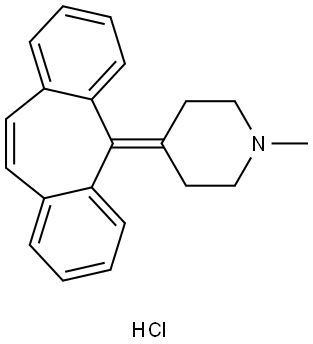
What is Cyproheptadine hydrochloride?
Originator
Periactin,Merck Sharp and Dohme,US,1961
The Uses of Cyproheptadine hydrochloride
Cyproheptadine hydrochloride is an antihistamine in which antiserotonin activity has been demonstrated both in vivo and in vitro. As yet, however, there is no evidence that this action contributes to clinical therapeutic effects. Anticholinergic and sedative effects are observed. Cyproheptadine may be more effective than other H1 blockers in the management of cold urticaria.
The Uses of Cyproheptadine hydrochloride
Antipruritic;5-HT antagonist
What are the applications of Application
Cyproheptadine hydrochloride is a non-selective 5-HT2 antagonist
Definition
ChEBI: The hydrochloride salt of cyproheptadine. Note that the drug named cyproheptadine hydrochloride generally refers to cyproheptadine hydrochloride sesquihydrate.
Manufacturing Process
(A) Preparation of 1-Methyl-4-Piperidyl-Magnesium Chloride: Magnesium
turnings (5.45 g, 0.22 g-atom) were placed in a 500 ml 3-necked flask
provided with a condenser, Hershberg stirrer and dropping funnel and
protected with a drying tube. An atmosphere of dry nitrogen was maintained
in the apparatus throughout the reaction. The magnesium was covered with 20 ml of dry tetrahydrofuran. A crystal of iodine and 1.2 g of ethyl bromide
were added and after the reaction had subsided (formation of ethylmagnesium
bromide) a solution of 29.4 g (0.22 mol) of 4-chloro-1-methyl-piperidine in
dry tetrahydrofuran (total volume, 103 ml) was added dropwise at such a rate
that gentle reflux was maintained.
The solution of 4-chloro-1-methylpiperidine in tetrahydrofuran was dried over
calcium hydride at ice-bath temperature prior to use. When the addition of the
halide was complete the reaction mixture was refluxed with stirring for one
hour. In some subsequent experiments this period of refluxing was omitted
with no deleterious result.
The solution of 4-chloro-1-methylpiperidine in tetrahydrofuran was dried over
calcium hydride at ice-bath temperature prior to use. When the addition of the
halide was complete the reaction mixture was refluxed with stirring for one
hour. In some subsequent experiments this period of refluxing was omitted
with no deleterious result.
The solvent was evaporated from the combined benzene extracts to give 33.4
g of a clear light brown resin. Crystallization from an alcohol-water mixture
gave 19.5 g of 1-methyl-4-(5-hydroxy-5-dibenzo[a,e]cycloheptatrienyl)-
piperidine, MP 156° to 157°C. Two recrystallizations from alcohol-water
mixtures followed by two recrystallizations from benzene-hexane mixtures
gave analytically pure product, MP 166.7° to 167.7°C.
(C) Preparation of 1-Methyl-4-(5-Dibenzo[a,e]Cycloheptatrienylidene)-
Piperidine Hydrochloride: 1-Methyl-4-(5-hydroxy-5-dibenzo[a,e]
cycloheptatrienyl)-piperidine (3.05 g, 0.01 mol) was dissolved in glacial acetic
acid, 15 ml. The solution was saturated with dry hydrogen chloride with
external cooling. A white solid separated. Acetic anhydride (3.07 g, 0.03 mol)
was added and the mixture heated on the steam bath for one hour. The solid
dissolved in the first 5 minutes of the heating period.
The reaction mixture was poured into 25 ml of water and the mixture made
strongly basic with 10N sodium hydroxide solution. The mixture was extracted
3 times with 50 ml portions of benzene, the combined extracts washed with
water and concentrated to a volume of approximately 50 ml. The solution was
saturated with dry hydrogen chloride and the white crystalline product
collected and dried. The yield of product, MP 251.6° to 252.6°C (dec.) was
2.5 g. Recrystallization from a mixture of absolute alcohol and absolute ether
gave a product, MP 252.6° to 253.6°C. A sample was analyzed after drying
for 7 hours at 110°C over phosphorus pentoxide in vacuo.
(D) Preparation of 1-Methyl-4-(5-Dibenzo[a,e]Cycloheptatrienylidene)-
Piperidine: The hydrochloride salt, 4.3 g, was suspended in 100 ml of warm
water and the mixture made strongly alkaline by the addition of 15 ml of 5%
sodium hydroxide. The mixture was extracted with four 50 ml portions of
benzene and the extracts dried over sodium sulfate. Evaporation of the
benzene on the steam-bath at reduced pressure left 3.7 g (97%) of the base,MP 110.3° to 111.3°C. Recrystallization from a mixture of alcohol and water
gave product, MP 112.3° to 113.3°C.
brand name
Periactin (Merck).
Therapeutic Function
Antipruritic, Antihistaminic, Appetite stimulant
General Description
Cyproheptadinehydrochloride, 4-(5H-dibenzo-[a,d]-cyclohepten-5-ylidine)-1-methylpiperidine hydrochloride sesquihydrate(Periactin), is slightly soluble in water and sparingly solublein alcohol.
Cyproheptadine possesses both antihistamine and antiserotoninactivity and is used as an antipruritic agent. It isindicated for the treatment of hypersensitivity reactions,perennial, and seasonal allergic rhinitis; vasomotor rhinitis;allergic conjunctivitis, uncomplicated allergic skin manifestationsof urticaria and angioedema; amelioration of allergicreactions to blood or plasma; and cold urticaria. It is alsoused off-label for nightmares associated with posttraumaticstress disorder (PTSD), prevention of migraine, suppressionof vascular headaches, and appetite stimulation. Sedation isthe most prominent side effect, and this is usually brief, disappearingafter 3 or 4 days of treatment.
Biological Activity
Non-selective 5HT 2 antagonist, migraine prophylactic.
Safety Profile
Poison by ingestion and intraperitoneal routes. Human systemic effects by ingestion: jaundice, liver function tests impaired, gastrointestinal effects. An experimental teratogen. Experimental reproductive effects. Human mutation data reported. Whenheated
Drug interactions
Potentially hazardous interactions with other drugs
Analgesics: sedative properties increased with opioid
analgesics.
Metabolism
Undergoes almost complete metabolism in the liver. The main metabolite found in humans is a quaternary ammonium glucuronide conjugate of cyproheptadine. 40% is excreted in the urine mainly as metabolites and 2-20% via the faeces.
Storage
Room temperature
References
[1] levine b, green-johnson d, hogan s, smialek je. a cyproheptadine fatality. j anal toxicol. 1998 jan-feb;22(1):72-4.
[2] lin oa, karim za, vemana hp, espinosa ev, khasawneh ft. the antidepressant 5-ht2a receptor antagonists pizotifen and cyproheptadine inhibit serotonin-enhanced platelet function. plos one. 2014 jan 23;9(1):e87026.
Properties of Cyproheptadine hydrochloride
| Melting point: | 254-256.5 °C(Solv: ethanol (64-17-5); ethyl ether (60-29-7)) |
| storage temp. | Inert atmosphere,Room Temperature |
| solubility | ethanol: soluble |
| form | solid |
| color | Crystals from EtOH/Et2O |
| Water Solubility | Soluble in water (15mM) |
| Stability: | Hygroscopic |
Safety information for Cyproheptadine hydrochloride
Computed Descriptors for Cyproheptadine hydrochloride
Cyproheptadine hydrochloride manufacturer
Attar Global
Festiva Pharma
New Products
5-bromo-4-fluoro-2-nitrobenzaldehyde Cyclobutanone (R)-(-)-2-Amino-1-propanol Fmoc-OSu 1-(2-Chloroethyl)pyrrolidine Hydrochloride 2-Amino-2-(4-methylphenyl)acetic acid 2,4-Dihydroxybenzaldehyde Obidoxime hydrochloride API Pyrrolo[1,2-a]pyrimidine-6-carboxylic acid, 4,6,7,8-tetrahydro-4-oxo-, sodium salt (1:1), (6S) Dipropyl disulfide 4 pentyn 1 ol N-Vinylformamide Methacrylate-PEG-Methacrylate, Mn:35000 2,4-Dihydroxyacetophenone 2-Chloro 5-Fluoro Pyridine Vasicinone 2-Chloroisonicotinic Acid Tween 80 or Polysorbate 80 2-Butyn-1-oL 2-Pentyn-1-oL 4-Nitrobenzotrifluoride N-(4-Cyano-3-(trifluoromethyl)phenyl)-2-methyloxirane-2-carboxamide N-(4-fluoro-2-methoxy-5-nitrophenyl)-4-(1-methyl-1H-indol-3-yl)pyrimidin-2-amine Pirtobrutinib intd.Related products of tetrahydrofuran


You may like
-
 969-33-5 Cyproheptadine HCl IP/BP/Ph. Eur /USP >98%View Details
969-33-5 -
 969-33-5 98%View Details
969-33-5 -
 Cyproheptadine hydrochloride 99%View Details
969-33-5 -
 Cyproheptadine hydrochloride 969-33-5 98%View Details
969-33-5 -
 Cyproheptadine HCl 97% (HPLC) CAS 969-33-5View Details
969-33-5 -
 Cyproheptadine HCL API MANUFACTURER INDIA, 41354-29-4View Details
41354-29-4 -
 CYPROHEPTADINE HYDROCHLORIDE (969-33-5)View Details
969-33-5 -
 Cyproheptadine HCL APIView Details
969-33-5