
CRIMIDINE
Synonym(s):2-Chloro-4-dimethylamino-6-methylpyrimidine
- CAS NO.:535-89-7
- Empirical Formula: C7H10ClN3
- Molecular Weight: 171.63
- MDL number: MFCD00055517
- EINECS: 208-622-6
- SAFETY DATA SHEET (SDS)
- Update Date: 2026-07-31 15:25:14
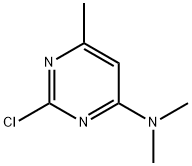
What is CRIMIDINE?
Description
Crimidine is a brown, waxy solid. Molecularweight=171.65; Boiling point=about 145℃; Freezing/Melting point=87℃. Hazard Identification (based onNFPA-704 M Rating System): Health 4, Flammability 1,Reactivity 0. Slightly soluble in water.
Chemical properties
Crimidine is a brown, waxy solid
The Uses of CRIMIDINE
Crimidine can be used for pesticidal utility.
The Uses of CRIMIDINE
Rodenticide.
Definition
ChEBI: Crimidine is a member of pyrimidines and an organohalogen compound.
General Description
Brown waxy solid or colorless crystals. Used as a rodenticide. Not registered as a pesticide in the U.S.
Reactivity Profile
CRIMIDINE neutralizes acids in exothermic reactions to form salts plus water. May be incompatible with isocyanates, halogenated organics, peroxides, phenols (acidic), epoxides, anhydrides, and acid halides. Flammable gaseous hydrogen may be generated in combination with strong reducing agents, such as hydrides.
Health Hazard
Super toxic; probable oral lethal dose in humans is less than 5 mg/kg or less than 7 drops for a 70 kg (150 lb.) person. May cause serious central nervous system damage leading to convulsions.
Fire Hazard
CRIMIDINE emits highly toxic chloride fumes when heated to decomposition. Avoid acids and acid fumes. Very stable in neutral medium. Avoid decomposing heat.
Potential Exposure
Crimidine is used as a rodenticide. Not registered for use in the United States as a pesticide
First aid
Eye Contact: Immediately remove any contactlenses and flush with large amounts of water for at least15 min, occasionally lifting upper and lower lids. Seek medical attention immediately. Skin Contact: Quickly removecontaminated clothing. Immediately wash area with largeamounts of water. Seek medical attention immediately.Inhalation: Remove the person from exposure, trying toavoid rapid, jerky motions or noise. Begin rescue breathing(using universal precautions, including resuscitation mask)if breathing has stopped and CPR if heart action hasstopped. If seizures occur, begin seizure first aid measures.Call for immediate medical attention to visit the patientprior to transfer if possible. Any facility using this chemicalshould have 24-h rapid access to medical personnel withtraining and equipment for emergency treatment. All areaemployees should be trained in first aid measures forCastrix, including seizure management and CPR.
Storage
Color Code—Blue: Health Hazard/Poison: Storein a secure poison location. Prior to working with Castrixyou should be trained on its proper handling and storage.Castrix must be stored to avoid contact with strong acids(such as hydrochloric, sulfuric, and nitric) and acid fumes,since violent reactions occur. Store in tightly closed containers in a cool, well-ventilated area.
Shipping
UN2588 Pesticides, solid, toxic, Hazard Class: 6.1; Labels: 6.1-Poisonous materials, Technical Name Required.
Incompatibilities
Acids and acid fumes, strong bases.
Waste Disposal
In accordance with 40CFR165 recommendations for the disposal of pesticides and pesticide containers. Must be disposed properly by following package label directions or by contacting your local 934 Crimidine or federal environmental control agency, or by contacting your regional EPA office.
Properties of CRIMIDINE
| Melting point: | 87° |
| Boiling point: | 283.13°C (rough estimate) |
| Density | 1.2232 (rough estimate) |
| refractive index | 1.6010 (estimate) |
| storage temp. | 0-6°C |
| solubility | Chloroform (Slightly), Methanol (Slightly) |
| form | neat |
| pka | 3.45±0.10(Predicted) |
| color | White to Off-White |
| Merck | 13,2615 |
| BRN | 127995 |
| EPA Substance Registry System | Crimidine (535-89-7) |
Safety information for CRIMIDINE
| Signal word | Danger |
| Pictogram(s) |
 Skull and Crossbones Acute Toxicity GHS06 |
| GHS Hazard Statements |
H300:Acute toxicity,oral |
Computed Descriptors for CRIMIDINE
New Products
9-Mesityl-10-methylacridinium perchlorate Sulfapyridine Fmoc-OSu (R)-(-)-2-Amino-1-propanol Cyclobutanone 5-bromo-4-fluoro-2-nitrobenzaldehyde 4 pentyn 1 ol N-Vinylformamide Phenethyl cinnamate Pyrrolo[1,2-a]pyrimidine-6-carboxylic acid, 4,6,7,8-tetrahydro-4-oxo-, sodium salt (1:1), (6S) Ethyl 3-phenylpropanoate β-Bromostyrene Methacrylate-PEG-Methacrylate, Mn:35000 2,4-Dihydroxyacetophenone 2-Chloro 5-Fluoro Pyridine Vasicinone 2-Chloroisonicotinic Acid Tween 80 or Polysorbate 80 5-Bromo-1-Pentyne 1-(2-Methyl-5-nitrophenyl)guanidine Nitrate Methyl trans-4-Aminocyclohexanecarboxylate Hydrochloride N-(4-Cyano-3-(trifluoromethyl)phenyl)-2-methyloxirane-2-carboxamide 4-Nitrobenzotrifluoride 2-Pentyn-1-oLRelated products of tetrahydrofuran
![2-CHLORO-4-(4-CHLORO-3-METHYL-PHENYL)-6-[4-(3-TRIFLUOROMETHYL-PYRIDIN-2-YL)-PIPERAZIN-1-YL]-PYRIMIDINE](https://img.chemicalbook.in/CAS/20200119/GIF/CB01516898.gif)

![1-[2-CHLORO-6-(4-FLUOROPHENYL)PYRIMIDIN-4-YL]-4-PHENYLPIPERIDIN-4-OL](https://img.chemicalbook.in/CAS/20200119/GIF/CB31516394.gif)


![5-CHLORO-6-[4-(2-CHLORO-6-PHENYL-PYRIMIDIN-4-YL)-3-METHYL-PIPERAZIN-1-YL]-NICOTINIC ACID ETHYL ESTER](https://img.chemicalbook.in/CAS/20200401/GIF/CB91517621.gif)
You may like
-
 1191-95-3 Cyclobutanone 98+View Details
1191-95-3 -
213382-45-7 98+View Details
213382-45-7 -
Fmoc-OSu 98+View Details
82911-69-1 -
(R)-(-)-2-Amino-1-propanol 35320-23-1 98+View Details
35320-23-1 -
1191-95-3 Cyclobutanone 98+View Details
1191-95-3 -
213382-45-7 98+View Details
213382-45-7 -
Fmoc-OSu 98+View Details
82911-69-1 -
(R)-(-)-2-Amino-1-propanol 35320-23-1 98+View Details
35320-23-1