
COPPER (II) ARSENITE
- CAS NO.:10290-12-7
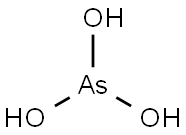
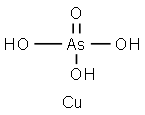
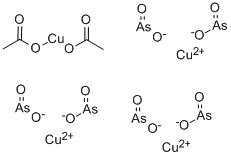
- Empirical Formula: AsCuH3O3
- Molecular Weight: 189.49
- MDL number: MFCD00049910
- EINECS: 233-644-8
- SAFETY DATA SHEET (SDS)
- Update Date: 2026-05-26 16:21:34
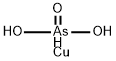
What is COPPER (II) ARSENITE?
Chemical properties
An odorless, yellow-green powder. Low vapor pressure.
Chemical properties
Cupric Acid Orthoarsenite (Scheele’s Green), CuHAsO2, green powder, insoluble in H2O, soluble in alcohol, acids, and NH4OH. Used as a wood preservative.
The Uses of COPPER (II) ARSENITE
As pigment, wood preservative, insecticide, fungicide, rodenticide.
General Description
COPPER (II) ARSENITE is a fine, light-green powder. COPPER (II) ARSENITE is insoluble in water. COPPER (II) ARSENITE is very toxic by ingestion. COPPER (II) ARSENITE is used as an insecticide and fungicide.
Air & Water Reactions
Insoluble in water.
Reactivity Profile
COPPER (II) ARSENITE has weak oxidizing or reducing powers. Redox reactions can however still occur. The majority of compounds in this class are slightly soluble or insoluble in water. If soluble in water, then the solutions are usually neither strongly acidic nor strongly basic. These compounds are not water-reactive.
Health Hazard
Dust irritates eyes. Ingestion causes gastric disturbance, tremors, muscular cramps, and nervous collapse that may cause death.
Fire Hazard
Special Hazards of Combustion Products: Poisonous, volatile arsenic oxides may be formed in fires.
Safety Profile
Confirmed human carcinogen. Poison. When heated to decomposition it emits toxic fumes of As. See also ARSENIC COMPOUNDS and COPPER COMPOUNDS.
Potential Exposure
Formerly used in agriculture as insecticide, rodenticide, and fungicide. Also used in pigments and animal medications. Not currently registered for use in the United States
Shipping
UN1586 copper arsenite, Hazard Class: 6.1; Labels: 6.1-Poisonous materials. Use dry chemical, carbon dioxide; water spray; or foam extinguishers. If material or contaminated runoff enters waterways, notify downstream users of potentially contaminated waters. Notify local health and fire officials and pollution control agencies. From a secure, explosion-proof location, use water spray to cool exposed containers. If cooling streams are ineffective (venting sound increases in volume and pitch, tank discolors, or shows any signs of deforming), withdraw immediately to a secure position. If employees are expected to fight fires, they must be trained and equipped in OSHA 1910.156. The only respirators recommended for firefighting are SCBAs that have full facepieces and are operated in a pressure-demand or other positive-pressure mode.
Waste Disposal
Copper-containing soluble wastes can be concentrated through the use of ion exchange, reverse osmosis, or evaporators to the point where copper can be electrolytically removed and sent to a reclaiming firm. If recovery is not feasible, the copper can be precipitated through the use of caustics and the sludge deposited in a chemical waste landfill
Properties of COPPER (II) ARSENITE
| Melting point: | decomposes [HAW93] |
| solubility | insoluble in H2O, ethanol; soluble in acid solutions |
| form | yellow-green powder |
| color | yellow-green |
| Water Solubility | insoluble H2O, alcohol; soluble acids, ammonia [MER06] |
| EPA Substance Registry System | Cupric arsenite (10290-12-7) |
Safety information for COPPER (II) ARSENITE
Computed Descriptors for COPPER (II) ARSENITE
New Products
2-(2-Chlorophenyl)glycine Propiolic Acid 1-(3-Hydroxy-4-methoxyphenyl)-2-nitroethene (±)-amino(2-fluorophenyl)acetic acid trans-3-Benzyloxy-4-methoxy-beta-nitrostyrene 1-Pentadecanol 2,4-Dihydroxybenzaldehyde Dipropyl disulfide Pyrrolo[1,2-a]pyrimidine-6-carboxylic acid, 4,6,7,8-tetrahydro-4-oxo-, sodium salt (1:1), (6S) Obidoxime hydrochloride API 4 pentyn 1 ol N-Vinylformamide Methacrylate-PEG-Methacrylate, Mn:35000 2,4-Dihydroxyacetophenone 2-Chloro 5-Fluoro Pyridine Vasicinone 2-Chloroisonicotinic Acid Tween 80 or Polysorbate 80 2-Butyn-1-oL N-(4-Cyano-3-(trifluoromethyl)phenyl)-2-methyloxirane-2-carboxamide N-(4-fluoro-2-methoxy-5-nitrophenyl)-4-(1-methyl-1H-indol-3-yl)pyrimidin-2-amine Pirtobrutinib intd. 2-Pentyn-1-oL 4-NitrobenzotrifluorideRelated products of tetrahydrofuran

You may like
-
 40216-83-9 trans-4-Hydroxy-L-proline methyl ester hydrochloride 98+View Details
40216-83-9 -
471-25-0 Propiolic Acid 98+View Details
471-25-0 -
84145-28-8 98+View Details
84145-28-8 -
trans-3-Benzyloxy-4-methoxy-beta-nitrostyrene 98+View Details
63909-29-5 -
2-(2-Chlorophenyl)glycine 88744-36-9 98+View Details
88744-36-9 -
40216-83-9 trans-4-Hydroxy-L-proline methyl ester hydrochloride 98+View Details
40216-83-9 -
629-76-5 98+View Details
629-76-5 -
1-(3-Hydroxy-4-methoxyphenyl)-2-nitroethene 98+View Details
39816-35-8