
CLOFOCTOL
Synonym(s):2-(2,4-Dichlorobenzyl)-4-(1,1,3,3-tetramethylbutyl)phenol
- CAS NO.:37693-01-9
- Empirical Formula: C21H26Cl2O
- Molecular Weight: 365.34
- MDL number: MFCD00079014
- EINECS: 253-632-6
- SAFETY DATA SHEET (SDS)
- Update Date: 2026-07-27 17:00:41

What is CLOFOCTOL?
Originator
Octofene,Debat,France,1978
The Uses of CLOFOCTOL
Clofoctol is a bacteriostatic antibiotic used against gram-positive bacteria.
The Uses of CLOFOCTOL
antibacterial
Definition
ChEBI: 2-[(2,4-dichlorophenyl)methyl]-4-(2,4,4-trimethylpentan-2-yl)phenol is a diarylmethane.
Manufacturing Process
The following were introduced into a 1 liter flask provided with a reflux
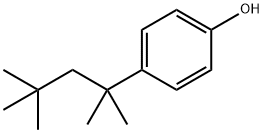
condenser: 206 g (1 mol) of p-(1,1,3,3-tetramethylbutyl)-phenol, 147 g (0.75
mol) of 2,4-dichlorobenzyl chloride, 27 g (0.2 mol) of pure melted zinc
chloride, and 750 ml of anhydrous chloroform.
The mixture was heated to reflux for 24 hours. The chloroformic reaction
mixture was washed with water, and then dried over anhydrous sodium
sulfate. The chloroform was evaporated off and the oil obtained was
fractionally distilled under a pressure of 0.2 mm Hg. The fraction distilling at
140°C to 160°C, being the desired product indicated above, was collected and
crystallized. Yield: 94 g (32% of theory); MP 78°C (after recrystallization in
petroleum ether).
Therapeutic Function
Antiinfective, Bacteriostatic
Properties of CLOFOCTOL
| Melting point: | 78° |
| Boiling point: | 447.7±40.0 °C(Predicted) |
| Density | 1.127±0.06 g/cm3(Predicted) |
| storage temp. | 2-8°C |
| solubility | DMSO:100.0(Max Conc. mg/mL);273.72(Max Conc. mM) |
| form | Solid |
| pka | 10.09±0.45(Predicted) |
| form | neat |
| color | White to off-white |
Safety information for CLOFOCTOL
| Signal word | Warning |
| Pictogram(s) |
 Exclamation Mark Irritant GHS07 |
| GHS Hazard Statements |
H302:Acute toxicity,oral H315:Skin corrosion/irritation H319:Serious eye damage/eye irritation H335:Specific target organ toxicity, single exposure;Respiratory tract irritation |
| Precautionary Statement Codes |
P261:Avoid breathing dust/fume/gas/mist/vapours/spray. P305+P351+P338:IF IN EYES: Rinse cautiously with water for several minutes. Remove contact lenses, if present and easy to do. Continuerinsing. |
Computed Descriptors for CLOFOCTOL
New Products
2-(2-Chlorophenyl)glycine Propiolic Acid 1-(3-Hydroxy-4-methoxyphenyl)-2-nitroethene (±)-amino(2-fluorophenyl)acetic acid trans-3-Benzyloxy-4-methoxy-beta-nitrostyrene 1-Pentadecanol 2,4-Dihydroxybenzaldehyde Dipropyl disulfide Pyrrolo[1,2-a]pyrimidine-6-carboxylic acid, 4,6,7,8-tetrahydro-4-oxo-, sodium salt (1:1), (6S) Obidoxime hydrochloride API 4 pentyn 1 ol N-Vinylformamide Methacrylate-PEG-Methacrylate, Mn:35000 2,4-Dihydroxyacetophenone 2-Chloro 5-Fluoro Pyridine Vasicinone 2-Chloroisonicotinic Acid Tween 80 or Polysorbate 80 2-Butyn-1-oL N-(4-Cyano-3-(trifluoromethyl)phenyl)-2-methyloxirane-2-carboxamide N-(4-fluoro-2-methoxy-5-nitrophenyl)-4-(1-methyl-1H-indol-3-yl)pyrimidin-2-amine Pirtobrutinib intd. 2-Pentyn-1-oL 4-NitrobenzotrifluorideRelated products of tetrahydrofuran
You may like
-
 40216-83-9 trans-4-Hydroxy-L-proline methyl ester hydrochloride 98+View Details
40216-83-9 -
471-25-0 Propiolic Acid 98+View Details
471-25-0 -
84145-28-8 98+View Details
84145-28-8 -
trans-3-Benzyloxy-4-methoxy-beta-nitrostyrene 98+View Details
63909-29-5 -
2-(2-Chlorophenyl)glycine 88744-36-9 98+View Details
88744-36-9 -
40216-83-9 trans-4-Hydroxy-L-proline methyl ester hydrochloride 98+View Details
40216-83-9 -
629-76-5 98+View Details
629-76-5 -
1-(3-Hydroxy-4-methoxyphenyl)-2-nitroethene 98+View Details
39816-35-8