
Carboxy-ptio
- CAS NO.:148819-94-7
- Empirical Formula: C14H16KN2O4*
- Molecular Weight: 315.39
- MDL number: MFCD00216153
- SAFETY DATA SHEET (SDS)
- Update Date: 2026-09-12 18:48:19
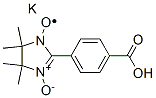
What is Carboxy-ptio?
Description
A nitric oxide (NO) scavenger.? Carboxy-PTIO (148819-94-7) reacts with NO with 1:1 stoichiometry1 producing NO2–/NO3–.?? In LPS-induced endotoxin shock, carboxy-PTIO reversed hypotension and renal dysfunction and increased survival in a rat model.2 A very useful tool for probing the involvement of NO in physiological processes.3,4
Chemical properties
blue powder
The Uses of Carboxy-ptio
A water soluble, stable organic free radical that reacts stoichiometrically with NO. Carboxy-PTIO converts NO to NO2 and does not dramatically affect other NO related metabolites. This scavenger allows for the specific investigation of the effect of NO.
The Uses of Carboxy-ptio
Carboxy-PTIO is a NO scavenger. It reacts stoichiometrically with NO and can be used for EPR detection of NO.
The Uses of Carboxy-ptio
Carboxy-PTIO potassium salt has been used to check the generation of hydroxyl radicals or nitric in reaction mixtures to examine the generation of nitric oxide in reaction mixture. It has also been added to neurons to analyse its effect on glucose/oxygen/serum deprivation (GOSD) condition(4)
What are the applications of Application
Carboxy-PTIO, potassium salt is a water soluble and stable nitric oxide radical scavenger which reacts with nitric oxide
Definition
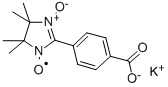
ChEBI: Potassium 2-(4-carboxylatophenyl)-4,4,5,5-tetramethylimidazoline-1-oxyl-3-oxide is a potassium salt having 2-(4-carboxylatophenyl)-4,4,5,5-tetramethylimidazoline-1-oxyl-3-oxide as the counterion. It has a role as a radical scavenger and an apoptosis inhibitor. It is a potassium salt and an organic radical. It contains a carboxylato-PTIO.
General Description
2-(4-Carboxyphenyl)-4,4,5,5-tetramethylimidazoline-1-oxyl-3-oxide?(carboxy-PTIO) is mainly considered as a scavenger of nitric oxide?(NO).
Biological Activity
A stable, water-soluble free radical that reacts stoichiometrically with NO. Almost twice as strong an inhibitor as N( ω )-nitroarginine or N-methylarginine.
Biochem/physiol Actions
Carboxy-PTIO can make a quick reaction with nitric oxide?(NO) to produce nitrogen dioxide (NO2). It can be used to prevent hypotension and endotoxic shock, stimulated by lipopolysaccharide in- vivo. Carboxy-PTIO can also block in vitro vascular relaxation, stimulated by NO.
Storage
+4°C
References
Akaike et al. (1993), Antagonistic action of imidazolineoxyl N-oxides against endothelium-derived relaxing factor/.NO through a radical reaction, Biochemistry, 32 827 Yoshida et al. (1994), Therapeutic effects of imidazolineoxyl N-oxide against endotoxin shock through its direct nitric oxide-scavenging activity; Biochem. Biophys. Res. Commun., 202 923 Hada et al. (2019), Nitric Oxide Is Involved in Heavy Ion-Induced Non-Targeted Effects in Human Fibroblasts; Int. J. Mol. Sci., 20 4327 Jin et al. (2020), A novel quinolinylmethyl substituted ethylenediamine compound exerts anti-cancer effects via stimulating the accumulation of reactive oxygen species and NO in hepatocellular carcinoma cells; Eur. J. Pharmacol., 885 173497
Properties of Carboxy-ptio
| Melting point: | 141-143°C |
| storage temp. | 2-8°C |
| solubility | H2O: >20 mg/mL |
| form | solid |
| color | blue |
| Water Solubility | Soluble in water. Also soluble in ethanol, methanol, DMSO or DMF. |
| Stability: | Stable for 2 years as supplied. Solutions in DMSO or distilled water may be stored at -20°C for up to 1 month. |
| CAS DataBase Reference | 148819-94-7(CAS DataBase Reference) |
Safety information for Carboxy-ptio
Computed Descriptors for Carboxy-ptio
New Products
9-Mesityl-10-methylacridinium perchlorate Sulfapyridine Fmoc-OSu (R)-(-)-2-Amino-1-propanol Cyclobutanone 5-bromo-4-fluoro-2-nitrobenzaldehyde 4 pentyn 1 ol N-Vinylformamide Phenethyl cinnamate Pyrrolo[1,2-a]pyrimidine-6-carboxylic acid, 4,6,7,8-tetrahydro-4-oxo-, sodium salt (1:1), (6S) Ethyl 3-phenylpropanoate β-Bromostyrene Methacrylate-PEG-Methacrylate, Mn:35000 2,4-Dihydroxyacetophenone 2-Chloro 5-Fluoro Pyridine Vasicinone 2-Chloroisonicotinic Acid Tween 80 or Polysorbate 80 5-Bromo-1-Pentyne 1-(2-Methyl-5-nitrophenyl)guanidine Nitrate Methyl trans-4-Aminocyclohexanecarboxylate Hydrochloride 2-Pentyn-1-oL 4-Nitrobenzotrifluoride N-(4-Cyano-3-(trifluoromethyl)phenyl)-2-methyloxirane-2-carboxamideRelated products of tetrahydrofuran

You may like
-
 Carboxy-PTIO potassium salt 98.00% CAS 148819-94-7View Details
148819-94-7 -
Carboxy-PTIO potassium salt CAS 148819-94-7View Details
148819-94-7 -
Fmoc-OSu 98+View Details
82911-69-1 -
(R)-(-)-2-Amino-1-propanol 35320-23-1 98+View Details
35320-23-1 -
1191-95-3 Cyclobutanone 98+View Details
1191-95-3 -
213382-45-7 98+View Details
213382-45-7 -
Fmoc-OSu 98+View Details
82911-69-1 -
(R)-(-)-2-Amino-1-propanol 35320-23-1 98+View Details
35320-23-1