
CARBETAMIDE
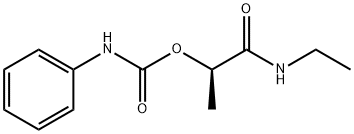
Synonym(s):(R)-(−)-1-(Ethylcarbamoyl)ethyl N-phenylcarbamate
- CAS NO.:16118-49-3
- Empirical Formula: C12H16N2O3
- Molecular Weight: 236.27
- MDL number: MFCD00135093
- EINECS: 240-286-6
- SAFETY DATA SHEET (SDS)
- Update Date: 2026-07-31 15:25:14
What is CARBETAMIDE?
Chemical properties
Carbetamide is a colorless, crystalline powder, or solid.
The Uses of CARBETAMIDE
Carbetamide is used in the determination of pesticides.
Definition
ChEBI: A carbamate ester obtained by the formal condensation of phenylcarbamic acid with the hydroxy group of N-ethyl-2-hydroxypropanamide.
Potential Exposure
Carbamate herbicide used to kill unwanted plants
Metabolic pathway
Photodegradation of carbetamide in solution with UV
irradiation in the presence of UV ? H2O2 and ? TiO2
primarily occurs at the o- and p-positions, but not at
the m-position of the phenyl ring, and the preferential
photoproduct isolated is ortho-hydroxylated
carbetamide. 5-Methyl-3-phenyl-oxazolidine dione is
isolated only in the presence of TiO2. The cyclization
may result from radical coupling with the dissolved
oxygen. N-De-ethylation of the ethylcarbamoyl group
and hydroxylation on the carbamoyloxy linkage occur
to yield free amine of carbetamide and lactamide
analogs. It is interesting to note that formulated
carbetamide is phototransformed to N-ethyllactamide-
4-aminobenzoate as a major product via the
rearrangement reaction similar to the Photo-Fries
reaction. The degradation kinetics of carbetamide and its
potential metabolites are measured at different
temperatures in both unsterilized and sterilized alkaline
soil.
The chemical degradation of carbetamide
importantly gives N-phenyl-3-methyloxazolidine-2,5-
dione which results in 2-(phenylcarbamoyloxy)-
propionic acid and N-phenyl-2-hydroxypropionamide
and the aniline in the soil. The purely biological
degradation of this compound cannot clearly yield
degradation products that are different from those by
chemical degradation in non-sterilized soils.
Shipping
UN2757 Carbamate pesticides, solid, toxic, Hazard Class: 6.1; Labels: 6.1-Poisonous materials. UN 2811 Toxic solids, organic, n.o.s., Hazard Class: 6.1; Labels: 6.1-Poisonous materials, Technical Name Required
Incompatibilities
Slowly hydrolyzes in water, releasing ammonia and forming acetate salts. Carbamates are incompatible with reducing agents, strong acids, oxidizing acids, peroxides, and bases. Contact with active metals or nitrides cause the release of flammable, and potentially explosive, hydrogen gas. Amides react with azo and diazo compounds to generate toxic gases. Flammable gases are formed by the reaction of organic amides with strong reducing agents such as hydrideds and active metals. Amides are very weak bases (weaker than water). Mixing amides with dehydrating agents such as phosphorus pentoxide or thionyl chloride generates the corresponding nitrile. The combustion of these compounds generates mixed oxides of nitrogen (NOx). This compound is decomposed by strong base or acid.
Waste Disposal
Do not discharge into drains or sewers. Dispose of waste material as hazardous waste using a licensed disposal contractor to an approved land fill. Consult with environmental regulatory agencies for guidance on acceptable disposal practices. Incineration with effluent gas scrubbing is recommended. Containers must be disposed of properly by following package label directions or by contacting your local or federal environmental control agency, or by contacting your regional EPA office.
Properties of CARBETAMIDE
| Melting point: | >110°C |
| Boiling point: | 378.73°C (rough estimate) |
| Density | 1.174 |
| refractive index | 1.5460 (estimate) |
| storage temp. | 0-6°C |
| solubility | Chloroform (Slightly), Methanol (Slightly) |
| pka | 13.22±0.70(Predicted) |
| form | neat |
| Water Solubility | 3.5g/L(20 ºC) |
| BRN | 8318291 |
| EPA Substance Registry System | Carbetamide (16118-49-3) |
Safety information for CARBETAMIDE
| Signal word | Danger |
| Pictogram(s) |
 Exclamation Mark Irritant GHS07  Health Hazard GHS08  Environment GHS09 |
| GHS Hazard Statements |
H302:Acute toxicity,oral H351:Carcinogenicity H411:Hazardous to the aquatic environment, long-term hazard |
| Precautionary Statement Codes |
P201:Obtain special instructions before use. P273:Avoid release to the environment. P308+P313:IF exposed or concerned: Get medical advice/attention. |
Computed Descriptors for CARBETAMIDE
New Products
N-Carbethoxy-4-piperidone 1-Aminocyclopentane carbonitrile Tetrabutylammonium perchlorate N,O-Dimethylhydroxylamine hydrochloride (RS)-beta-Amino-beta-(4-bromophenyl)propionic acid 2-Amino-5-bromo-4-(trifluoromethyl)pyridine N-Vinylformamide 4 pentyn 1 ol Phenethyl cinnamate Dipropyl disulfide Ethyl 3-phenylpropanoate β-Bromostyrene Methacrylate-PEG-Methacrylate, Mn:35000 2,4-Dihydroxyacetophenone 2-Chloro 5-Fluoro Pyridine Vasicinone 2-Chloroisonicotinic Acid Tween 80 or Polysorbate 80 5-Bromo-1-Pentyne 1-(2-Methyl-5-nitrophenyl)guanidine Nitrate Methyl trans-4-Aminocyclohexanecarboxylate Hydrochloride N-(4-Cyano-3-(trifluoromethyl)phenyl)-2-methyloxirane-2-carboxamide 2-Pentyn-1-oL 4-NitrobenzotrifluorideRelated products of tetrahydrofuran

You may like
-
 Carbetamide CAS 16118-49-3View Details
16118-49-3 -
 CARBETAMIDE CAS NO 16118-49-3View Details
16118-49-3 -
144-83-2 Sulfapyridine 98+View Details
144-83-2 -
29976-53-2 98+View Details
29976-53-2 -
6638-79-5 N,O-Dimethylhydroxylamine hydrochloride 98+View Details
6638-79-5 -
674783-97-2 98+View Details
674783-97-2 -
1-Aminocyclopentane carbonitrile 98+View Details
49830-37-7 -
Tetrabutylammonium perchlorate 1923-70-2 98+View Details
1923-70-2