
BUDIPINE
- CAS NO.:57982-78-2
- Empirical Formula: C21H27N
- Molecular Weight: 293.45
- MDL number: MFCD00866585
- EINECS: 261-062-4
- SAFETY DATA SHEET (SDS)
- Update Date: 2026-06-15 22:31:22
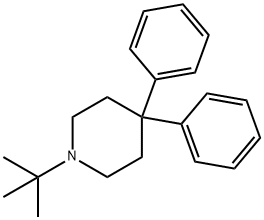
What is BUDIPINE?
Description
Parkinsan was launched in Germany as a centrally-active anti-Parkinsonian agent. It can be prepared in three steps: a Mannich-aldol sequence to assemble the 4-phenylpiperidine scaffold followed by a Friedel-Crafts reaction to introduce the second phenyl ring. Parkinsan is effective for the treatment of Parkinsonian tremors and is similar in action to, but more potent than, biperiden. It exhibits use-dependent, open channel, uncompetitive NMDA receptor antagonistic activity. This may occur by binding to the PCP site in addition to interacting with sigma, binding sites in the frontal cortex. Parkinsan is also an antagonist at presynaptic muscarinic autoreceptors but facilitation of direct or indirect dopaminergic transmission does not contribute to its actions. While its mechanism of action is not completely understood, it has a weak inhibitory effect on dopamine reuptake, inhibits evoked GABA release (with low affinity for GABA-A receptors and a lower affinity for benzodiazepine receptors), and has a weak inhibitory effect on MAO-B.
Originator
Byk Gulden (Germany)
Definition
ChEBI: Budipine is a diarylmethane.
Manufacturing Process
24.4 g of 1-(t-butyl)-4-hydroxy-4-phenylpiperidine are suspended in 150 ml of
anhydrous benzene. 61.5 g of finely pulverized anhydrous aluminum chloride
are added in portions thereto within 25 min while stirring. The reaction
temperature increases on starting addition of aluminum chloride to about
45°C. After about 20 min the temperature is increased to and maintained at
about 50° to 55°C for about 1 hour. The resulting reaction solution is cooled
to about 20°C and is poured into a mixture of ice and concentrated
hydrochloric acid. After warming the mixture to room temperature, the
hydrochloric acid layer together with the dark oil formed on decomposition is
separated from the benzene layer and is washed with benzene. Water is
added to said hydrochloric acid -oil phase, while stirring, in portions and in an
amount sufficient to produce an almost clear solution. Said acid solution is
rendered alkaline by the addition of 40% sodium hydroxide solution whereby the mixture is well cooled. The alkalized mixture is repeatedly extracted with
ether. The combined ether extracts are dried over anhydrous potassium
carbonate and are concentrated by evaporation of the ether. 24 g of the crude
base are obtained as residue in the form of yellowish oil. A water clear oil
boiling at 129-131°C/0.005 mm Hg is recovered by distillation of said crude
oil in a high vacuum. The oil solidifies to crystals on standing for a short
period of time. After recrystallization from aqueous dimethylformamide, the
resulting 1-methyl-4,4-diphenylpiperidine has a melting point of 72-74°C.
Its hydrochloride is produced by dissolving the base in acetic acid ethyl ester
and adding an ethereal hydrochloric acid solution thereto. After
recrystallization from acetic acid ethyl ester, the melting point of the
hydrochloride is 152-154°C.
brand name
Parkinsan
Therapeutic Function
Antiparkinsonian, Antidepressant
Properties of BUDIPINE
| Melting point: | 108.5°C |
| Boiling point: | 425.29°C (rough estimate) |
| Density | 0.9665 (rough estimate) |
| refractive index | 1.4900 (estimate) |
| storage temp. | 2-8°C |
| solubility | DMSO : 25 mg/mL (85.19 mM; Need ultrasonic) |
| pka | 10.36±0.10(Predicted) |
| form | Solid |
| color | Light yellow to khaki |
Safety information for BUDIPINE
| Signal word | Warning |
| Pictogram(s) |
 Exclamation Mark Irritant GHS07 |
| GHS Hazard Statements |
H302:Acute toxicity,oral H315:Skin corrosion/irritation H319:Serious eye damage/eye irritation H332:Acute toxicity,inhalation H335:Specific target organ toxicity, single exposure;Respiratory tract irritation |
| Precautionary Statement Codes |
P280:Wear protective gloves/protective clothing/eye protection/face protection. P310:Immediately call a POISON CENTER or doctor/physician. P305+P351+P338:IF IN EYES: Rinse cautiously with water for several minutes. Remove contact lenses, if present and easy to do. Continuerinsing. |
Computed Descriptors for BUDIPINE
New Products
N-Carbethoxy-4-piperidone 1-Aminocyclopentane carbonitrile Tetrabutylammonium perchlorate N,O-Dimethylhydroxylamine hydrochloride (RS)-beta-Amino-beta-(4-bromophenyl)propionic acid 2-Amino-5-bromo-4-(trifluoromethyl)pyridine N-Vinylformamide 4 pentyn 1 ol Phenethyl cinnamate Dipropyl disulfide Ethyl 3-phenylpropanoate β-Bromostyrene Methacrylate-PEG-Methacrylate, Mn:35000 2,4-Dihydroxyacetophenone 2-Chloro 5-Fluoro Pyridine Vasicinone 2-Chloroisonicotinic Acid Tween 80 or Polysorbate 80 5-Bromo-1-Pentyne 1-(2-Methyl-5-nitrophenyl)guanidine Nitrate Methyl trans-4-Aminocyclohexanecarboxylate Hydrochloride N-(4-Cyano-3-(trifluoromethyl)phenyl)-2-methyloxirane-2-carboxamide 2-Pentyn-1-oL 4-NitrobenzotrifluorideRelated products of tetrahydrofuran

You may like
-
 Budipine 98.00% CAS 57982-78-2View Details
57982-78-2 -
Budipine 95% CAS 57982-78-2View Details
57982-78-2 -
144-83-2 Sulfapyridine 98+View Details
144-83-2 -
29976-53-2 98+View Details
29976-53-2 -
6638-79-5 N,O-Dimethylhydroxylamine hydrochloride 98+View Details
6638-79-5 -
674783-97-2 98+View Details
674783-97-2 -
1-Aminocyclopentane carbonitrile 98+View Details
49830-37-7 -
Tetrabutylammonium perchlorate 1923-70-2 98+View Details
1923-70-2