
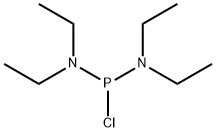
BIS(DIISOPROPYLAMINO)CHLOROPHOSPHINE
Synonym(s):Chlorobis(N,N-diisopropyl)phosphoramidite;Chlorobis(N,N-diisopropylamino)phosphine;Tetraisopropylphosphorodiamidous chloride
- CAS NO.:56183-63-2
- Empirical Formula: C12H28ClN2P
- Molecular Weight: 266.79
- MDL number: MFCD00061482
- SAFETY DATA SHEET (SDS)
- Update Date: 2026-05-27 23:59:12
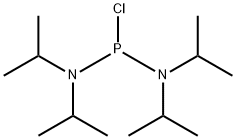
What is BIS(DIISOPROPYLAMINO)CHLOROPHOSPHINE?
Description
Bis(diisopropylamino)chlorophosphine is a white to off-white powder to crystalline organophosphorus compound, mainly used as an organic synthetic raw material or reaction reagent. It can be used in the synthesis of mixed phosphorothioate and methylenephosphine derivatives, etc. It is commonly used in chemical production and laboratory research.
Chemical properties
white to light yellow crystal powde
The Uses of BIS(DIISOPROPYLAMINO)CHLOROPHOSPHINE
Bis(diisopropylamino)chlorophosphine has been used in the synthesis of tert-butyl tetraisopropylphosphorodiamidite ligand for palladium-catalyzed Buchwald–Hartwig amination reaction.
It is also can be used to synthesize:
- acyclic N-phosphonio imine catalyst for selective epoxidations
- boryl-substituted methylenephosphonium derivatives
What are the applications of Application
Bis(diisopropylamino)chlorophosphine is a compound containing various amounts of diisopropylamine hydrochloride
Properties of BIS(DIISOPROPYLAMINO)CHLOROPHOSPHINE
| Melting point: | 100-104 °C(lit.) |
| Boiling point: | 291℃ |
| Flash point: | 130℃ |
| storage temp. | Store under inert gas |
| pka | 4.50±0.70(Predicted) |
| form | Powder |
| color | white to off-white |
| Sensitive | air sensitive, moisture sensitive |
| CAS DataBase Reference | 56183-63-2(CAS DataBase Reference) |
Safety information for BIS(DIISOPROPYLAMINO)CHLOROPHOSPHINE
| Signal word | Danger |
| Pictogram(s) |
 Corrosion Corrosives GHS05 |
| GHS Hazard Statements |
H314:Skin corrosion/irritation |
| Precautionary Statement Codes |
P260:Do not breathe dust/fume/gas/mist/vapours/spray. P280:Wear protective gloves/protective clothing/eye protection/face protection. P301+P330+P331:IF SWALLOWED: Rinse mouth. Do NOT induce vomiting. P303+P361+P353:IF ON SKIN (or hair): Remove/Take off Immediately all contaminated clothing. Rinse SKIN with water/shower. P305+P351+P338:IF IN EYES: Rinse cautiously with water for several minutes. Remove contact lenses, if present and easy to do. Continuerinsing. |
Computed Descriptors for BIS(DIISOPROPYLAMINO)CHLOROPHOSPHINE
New Products
N-Carbethoxy-4-piperidone 1-Aminocyclopentane carbonitrile Tetrabutylammonium perchlorate N,O-Dimethylhydroxylamine hydrochloride (RS)-beta-Amino-beta-(4-bromophenyl)propionic acid 2-Amino-5-bromo-4-(trifluoromethyl)pyridine N-Vinylformamide 4 pentyn 1 ol Phenethyl cinnamate Dipropyl disulfide Ethyl 3-phenylpropanoate β-Bromostyrene Methacrylate-PEG-Methacrylate, Mn:35000 2,4-Dihydroxyacetophenone 2-Chloro 5-Fluoro Pyridine Vasicinone 2-Chloroisonicotinic Acid Tween 80 or Polysorbate 80 5-Bromo-1-Pentyne 1-(2-Methyl-5-nitrophenyl)guanidine Nitrate Methyl trans-4-Aminocyclohexanecarboxylate Hydrochloride N-(4-Cyano-3-(trifluoromethyl)phenyl)-2-methyloxirane-2-carboxamide 2-Pentyn-1-oL 4-NitrobenzotrifluorideRelated products of tetrahydrofuran
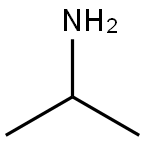
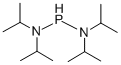
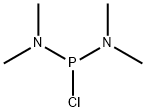
You may like
-
 56183-63-2 Bis(diisopropylamino)chlorophosphine 99%View Details
56183-63-2 -
 Bis(diisopropylamino)chlorophosphine CAS 56183-63-2View Details
56183-63-2 -
Bis(diisopropylamino)chlorophosphine CAS 56183-63-2View Details
56183-63-2 -
144-83-2 Sulfapyridine 98+View Details
144-83-2 -
29976-53-2 98+View Details
29976-53-2 -
674783-97-2 98+View Details
674783-97-2 -
1-Aminocyclopentane carbonitrile 98+View Details
49830-37-7 -
Tetrabutylammonium perchlorate 1923-70-2 98+View Details
1923-70-2
Statement: All products displayed on this website are only used for non medical purposes such as industrial applications or scientific research, and cannot be used for clinical diagnosis or treatment of humans or animals. They are not medicinal or edible.