
BIS(2,4-DINITROPHENYL) OXALATE
- CAS NO.:16536-30-4
- Empirical Formula: C14H6N4O12
- Molecular Weight: 422.22
- MDL number: MFCD00010712
- SAFETY DATA SHEET (SDS)
- Update Date: 2026-05-27 23:53:16
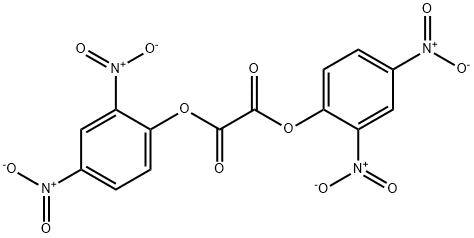
What is BIS(2,4-DINITROPHENYL) OXALATE?
Chemical properties
light yellow powder
The Uses of BIS(2,4-DINITROPHENYL) OXALATE
Bis(2,4-dinitrophenyl) oxalate was used in detection of fluorescent compound dansylalanine in buffer solution by flow injection analysis.
What are the applications of Application
Bis(2,4-dinitrophenyl) oxalate is a chemiluminescence reagent
General Description
Bis(2,4-dinitrophenyl) oxalate (DNPO) is a chemiluminescence reagent. Chemiluminescence produced in the oxidation of DNPO by hydrogen peroxide in the presence of a polycyclic aromatic hydrocarbon was monitored by spectroscopic methods. The kinetics of the imidazole-catalyzed decomposition of DNPO was investigated by the stopped-flow technique.
Properties of BIS(2,4-DINITROPHENYL) OXALATE
| Melting point: | 189-190 °C(lit.) |
| Boiling point: | 605.1±55.0 °C(Predicted) |
| Density | 1.759±0.06 g/cm3(Predicted) |
| storage temp. | −20°C |
| solubility | soluble in Benzene,Toluene |
| form | powder to crystal |
| color | White to Light yellow |
| Stability: | Stable. Incompatible with strong oxidizing agents, strong bases. |
| CAS DataBase Reference | 16536-30-4(CAS DataBase Reference) |
Safety information for BIS(2,4-DINITROPHENYL) OXALATE
| Signal word | Danger |
| Pictogram(s) |
 Flame Flammables GHS02  Exclamation Mark Irritant GHS07 |
| GHS Hazard Statements |
H228:Flammable solids H315:Skin corrosion/irritation H319:Serious eye damage/eye irritation |
| Precautionary Statement Codes |
P210:Keep away from heat/sparks/open flames/hot surfaces. — No smoking. P241:Use explosion-proof electrical/ventilating/lighting/…/equipment. P264:Wash hands thoroughly after handling. P264:Wash skin thouroughly after handling. P280:Wear protective gloves/protective clothing/eye protection/face protection. P302+P352:IF ON SKIN: wash with plenty of soap and water. P305+P351+P338:IF IN EYES: Rinse cautiously with water for several minutes. Remove contact lenses, if present and easy to do. Continuerinsing. P332+P313:IF SKIN irritation occurs: Get medical advice/attention. P337+P313:IF eye irritation persists: Get medical advice/attention. P370+P378:In case of fire: Use … for extinction. |
Computed Descriptors for BIS(2,4-DINITROPHENYL) OXALATE
New Products
N-Carbethoxy-4-piperidone 1-Aminocyclopentane carbonitrile Tetrabutylammonium perchlorate N,O-Dimethylhydroxylamine hydrochloride (RS)-beta-Amino-beta-(4-bromophenyl)propionic acid 2-Amino-5-bromo-4-(trifluoromethyl)pyridine N-Vinylformamide 4 pentyn 1 ol Phenethyl cinnamate Pyrrolo[1,2-a]pyrimidine-6-carboxylic acid, 4,6,7,8-tetrahydro-4-oxo-, sodium salt (1:1), (6S) Ethyl 3-phenylpropanoate β-Bromostyrene Methacrylate-PEG-Methacrylate, Mn:35000 2,4-Dihydroxyacetophenone 2-Chloro 5-Fluoro Pyridine Vasicinone 2-Chloroisonicotinic Acid Tween 80 or Polysorbate 80 5-Bromo-1-Pentyne 1-(2-Methyl-5-nitrophenyl)guanidine Nitrate Methyl trans-4-Aminocyclohexanecarboxylate Hydrochloride 2-Pentyn-1-oL 4-Nitrobenzotrifluoride N-(4-Cyano-3-(trifluoromethyl)phenyl)-2-methyloxirane-2-carboxamideRelated products of tetrahydrofuran

You may like
-
 Bis(2,4-dinitrophenyl) oxalate 95% CAS 16536-30-4View Details
16536-30-4 -
Bis(2,4-dinitrophenyl) oxalate CAS 16536-30-4View Details
16536-30-4 -
144-83-2 Sulfapyridine 98+View Details
144-83-2 -
29976-53-2 98+View Details
29976-53-2 -
6638-79-5 N,O-Dimethylhydroxylamine hydrochloride 98+View Details
6638-79-5 -
674783-97-2 98+View Details
674783-97-2 -
1-Aminocyclopentane carbonitrile 98+View Details
49830-37-7 -
Tetrabutylammonium perchlorate 1923-70-2 98+View Details
1923-70-2
Statement: All products displayed on this website are only used for non medical purposes such as industrial applications or scientific research, and cannot be used for clinical diagnosis or treatment of humans or animals. They are not medicinal or edible.