
BEPOTASTINE
- CAS NO.:125602-71-3
- Empirical Formula: C21H25ClN2O3
- Molecular Weight: 388.89
- MDL number: MFCD06798155
- EINECS: 200-258-5
- SAFETY DATA SHEET (SDS)
- Update Date: 2026-06-03 11:24:09
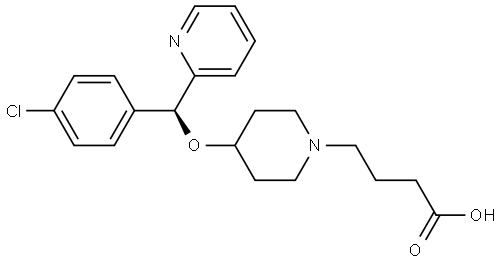
What is BEPOTASTINE?
Absorption
Tmax, after single dose, opthalmic = 1.2 hours; Cmax, 1.5%, opthalmic dose = 7.3 ±1.9 ng/mL; After 24 hours post-installation, levels of bepotastine are below quantifiable limit of 2 ng/mL. Minimal systemic absorption with opthalmic dosage form.
The Uses of BEPOTASTINE
Bepotastine is a histamine H1 receptor antagonist. Bepotastine suppresses some allergic inflammatory processes such as allergic rhinitis, chronic urticaria or pruritus associated with skin conditions (eczema/dermatitis, prurigo or pruritus cutaneus).
Indications
For the symptomatic treatment of itchy eyes (caused by IgE-induced mast cell degranulation) due to allergic conjunctivitis.
Background
Bepotastine is a non-sedating, selective antagonist of the histamine 1 (H1) receptor. Bepotastine was approved in Japan for use in the treatment of allergic rhinitis and uriticaria/puritus in July 2000 and January 2002, respectively, and is marketed by Tanabe Seiyaku Co., Ltd. under the brand name Talion. It is available in oral and opthalmic dosage forms in Japan. The opthalmic solution is FDA approved since Sept 8, 2009 and is under the brand name Bepreve.
Definition
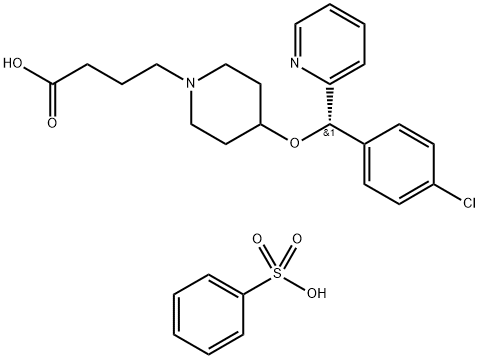
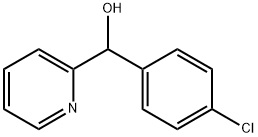
ChEBI: An ether that is (S)-(4-chlorophenyl)(pyridin-2-yl)methanol in which the hydroxyl hydrogen is substituted by a 1-(3-carboxypropyl)piperidin-4-yl group. A topical, selective and non-sedating histamine (H1) receptor anta onist used (as its benzenesulfonate salt) for treatment of itching associated with allergic conjunctivitis.
Pharmacokinetics
Bepotastine is a non-sedating, selective antagonist of the histamine 1 (H1) receptor. It belongs to the second-generation piperidine chemical class. It is a mast cell stabilizer and suppresses the migration of eosinophils into inflamed tissues. Furthermore, bepotastine does not interact with serotonin, muscarinic, benzodiazepine, and beta-adrenergic receptor that would otherwise result in adverse reactions such as dry mouth or sonmolence. Onset of action = 0.25 hours; Duration of action = 12-24 hours;
Metabolism
Minimal metabolism via CYP enzymes
Properties of BEPOTASTINE
| Melting point: | 56 - 58°C |
| Boiling point: | 546.8±50.0 °C(Predicted) |
| Density | 1.26 |
| storage temp. | -20°C Freezer, Under inert atmosphere |
| solubility | DMSO (Slightly), Methanol (Slightly) |
| form | Solid |
| pka | 4.44±0.10(Predicted) |
| color | White to Pale Beige |
Safety information for BEPOTASTINE
Computed Descriptors for BEPOTASTINE
New Products
3-AMINO-3-(2-CHLORO-PHENYL)-PROPIONIC ACID 4-Fluorophenylglycine 1-Boc-3-(cyanomethyl)azetidine Dimedone 1-N-Boc-3-(aminoethyl)azetidine N-BOC-piperidine-4-carboxylic acid 4,6-Dichlororesorcinol 5-Amino-2-Bromo-3-Chloropyridine 2-Picolinic acid N-oxide 4-Butyl Resorcinol 2-Bromo-5-Chloropyridine 5-Bromo-2-Hydroxy-3-Nitro Pyridine 2-Amino-4-phenyl-thiazole N-(4-Bromophenyl)-2-chloroacetamide TRIFLOURO ACETICACID-D METHANE SULFONIC ACID-D4 PHOSPORIC ACID-D3 85 W% IN D2O DEUTERIUM OXIDE FOR NMR BENZENE-D6 TOLUENE-D3Related products of tetrahydrofuran

You may like
-
 Bepotastine 98%View Details
 -
 190786-43-7 / 125602-71-3 98%View Details
190786-43-7 / 125602-71-3 -
 32008-59-6 PARAFORMALDEHYDE-D2 98%View Details
32008-59-6 -
CHLORO BENZENE-D5 3114-55-4 99%View Details
3114-55-4 -
PHENYL ACETYLENE-D 3240-11-07 99%View Details
3240-11-07 -
84358-13-4 N-BOC-piperidine-4-carboxylic acid 98+View Details
84358-13-4 -
84358-13-4 N-BOC-piperidine-4-carboxylic acid 98+View Details
84358-13-4 -
84358-13-4 N-BOC-piperidine-4-carboxylic acid 98+View Details
84358-13-4