
Aprindine
- CAS NO.:37640-71-4
- Empirical Formula: C22H30N2
- Molecular Weight: 322.49
- MDL number: MFCD00864718
- SAFETY DATA SHEET (SDS)
- Update Date: 2025-10-23 17:25:30
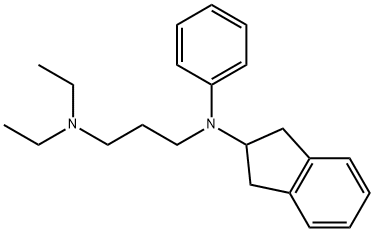
What is Aprindine?
Originator
Amidonal,Madaus,W. Germany,1976
The Uses of Aprindine
depressant (anti-arrhythmic).
Definition
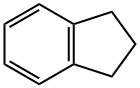
ChEBI: Aprindine is a member of indanes.
Manufacturing Process
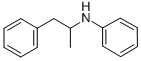
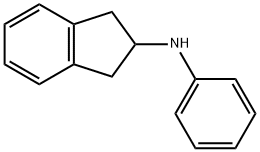
104.6 g (0.5 mol) N-phenyl-2-aminoindane and 2.5 liters benzene are
introduced into a reaction vessel of 5 liters, under an atmosphere of nitrogen.
37 g (0.95 mol) sodium amide are added and the mixture is stirred during 3
hours at room temperature.
119.7 g (0.8 mol) of γ-chloropropyl diethylamine are then quickly added. After
agitation during 1 hour at room temperature, the reaction mixture is refluxed
and stirred under nitrogen during 21 hours. The mixture is then allowed to
cool and poured onto ice. The obtained aqueous phase is extracted by means
of 500 cm3 of benzene. The benzene extract is washed two times with 200
cm3 of water and the benzene is then evaporated.
The residue is treated with 500 cm3 of hydrochloric acid (2 N). The obtained
solution is evaporated to dryness and the oily residue is recrystallized from
ethanol. 176.9 g (yield 89.4%) of dihydrochloride of N-phenyl-Ndiethylaminopropyl-
2-aminoindane are obtained, MP 208° to 210°C.
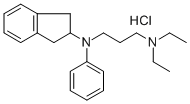
The dihydrochloride is converted into monohydrochloride by dissolving 26.36 g
(0.066 mol) of dihydrochloride into 158 cm3 of water, adding drop by drop a
suitable amount (0.066 mol) of caustic soda (1 N), evaporating the aqueous
solution to dryness, drying by means of benzene, filtering the formed sodium
chloride (3.8 g) and crystallizing the cooled obtained benzene solution. 22.6 g
(95%) of monohydrochloride are obtained, MP 120° to 121°C.
brand name
Fibocil (Lilly).
Therapeutic Function
Antiarrhythmic
Side Effects
Aprindine has a sustained activity. Because of serious side effects (agranulocytosis), aprindine should only be used for life-threatening arrhythmias otherwise refractory to therapy .
Properties of Aprindine
| Melting point: | 120-121 °C |
| Boiling point: | 450.9±45.0 °C(Predicted) |
| Density | 1.046±0.06 g/cm3(Predicted) |
| pka | pKa 4.53 (H2O) (Uncertain);10.16(H2O) (Uncertain) |
Safety information for Aprindine
Computed Descriptors for Aprindine
New Products
Cis-Tosylate Dibenzo[b,f][1,4]thiazepin-11(10H)-one Dibenzoyl-L-tartaric acid Anhydrous (Resolution Reagent) 1,2,3,9-Tetrahydro-9-Methyl-4H-Carbazole-4-One N-BOC-piperidine-4-carboxylic acid 1-Benzhydrylazetane-3-carbonitrile AMINO-(3-CHLORO-PHENYL)-ACETIC ACID 2-(2-Chlorophenyl)glycine (±)-amino(2-fluorophenyl)acetic acid 8-oxa-1,3-diazaspiro[4.5]decane-2,4-dione TRIFLOURO ACETICACID-D METHANE SULFONIC ACID-D4 PHOSPORIC ACID-D3 85 W% IN D2O DEUTERIUM OXIDE FOR NMR TOLUENE-D3 BENZENE-D6 1-Acetyl-4-(4-hydroxyphenyl)piperazine 1-(3-Chlorophenyl)piperazine hydrochlorideRelated products of tetrahydrofuran

You may like
-
 7292-71-9 AMINO-(3-CHLORO-PHENYL)-ACETIC ACID 98+View Details
7292-71-9 -
84145-28-8 98+View Details
84145-28-8 -
2-(2-Chlorophenyl)glycine 98+View Details
88744-36-9 -
8-oxa-1,3-diazaspiro[4.5]decane-2,4-dione 39124-19-1 98+View Details
39124-19-1 -
7292-71-9 AMINO-(3-CHLORO-PHENYL)-ACETIC ACID 98+View Details
7292-71-9 -
84145-28-8 98+View Details
84145-28-8 -
2-(2-Chlorophenyl)glycine 98+View Details
88744-36-9 -
8-oxa-1,3-diazaspiro[4.5]decane-2,4-dione 39124-19-1 98+View Details
39124-19-1