
1,3-Diaminopropane
Synonym(s):TMEDA;DAP;1,3-Diaminopropane;1,3-Propanediamine;Trimethylenediamine
- CAS NO.:109-76-2
- Empirical Formula: C3H10N2
- Molecular Weight: 74.12
- MDL number: MFCD00008228
- EINECS: 203-702-7
- SAFETY DATA SHEET (SDS)
- Update Date: 2026-08-25 20:17:46

What is 1,3-Diaminopropane?
Chemical properties
colourless liquid
The Uses of 1,3-Diaminopropane
1,3-Diaminopropane is commonly used in the preparation of cholinesterase inhibitors and thrombosis inhibitors. It is also used as a polymer cross linkage agent, polyurethane extender and spray coatings. It is involved in the preparation of agrochemicals and pharmaceutical intermediates. Further, it acts as a building block in the synthesis of heterocyclic compounds, which finds application in textile finishing. In addition to this, it is used as a ligand and form coordination complexes.
What are the applications of Application
1,3-Diaminopropane is a common synthesis reagent
Definition
ChEBI: An alkane-alpha,omega-diamine comprising a propane skeleton with amino substituents at positions 1 and 3.
Production Methods
1,3-Diaminopropane is produced in a twostage continuous process, under a pressure of 10 – 20 MPa. In a first reactor, acrylonitrile reacts with excess ammonia at 70 – 100 ℃ to give 2-aminopropionitrile and bis(cyanoethyl) amine. The mixture of aminonitriles is then hydrogenated in a downstream reactor over a fixed-bed catalyst (cobalt or nickel) at 60 – 120 ℃ to give 1,3-diaminopropane and bis (aminopropyl)amine. The yield of 1,3- diaminopropane can be increased by adding a polar solvent and water or by using a large excess of ammonia.
General Description
Water-white mobile liquid with an odor of amine.
Air & Water Reactions
Highly flammable. Water soluble.
Reactivity Profile
1,3-Diaminopropane is heat sensitive. 1,3-Diaminopropane may react with oxidizing agents.
Health Hazard
ACUTE/CHRONIC HAZARDS: 1,3-Diaminopropane is a strong irritant to eyes and skin: corrosive HAZARDOUS DECOMPOSITION PRODUCTS.
Fire Hazard
1,3-Diaminopropane is a flammable liquid.
Flammability and Explosibility
Flammable
Safety Profile
Poison by ingestion and skin contact. Experimental teratogenic effects. A severe skin and eye irritant. Flammable liquid when exposed to heat, sparks, or flame. When heated to decomposition it emits toxic fumes of NOx. See also AMINES.
Properties of 1,3-Diaminopropane
| Melting point: | -12 °C |
| Boiling point: | 140 °C(lit.) |
| Density | 0.888 g/mL at 25 °C(lit.) |
| vapor pressure | <8 mm Hg ( 20 °C) |
| refractive index | n |
| Flash point: | 120 °F |
| storage temp. | Store below +30°C. |
| solubility | DMSO (Slightly), Methanol (Slightly) |
| form | Liquid |
| pka | 10.94(at 10℃) |
| color | Clear |
| PH | >12 (100g/l, H2O, 20℃) |
| explosive limit | 2.8-15.2%(V) |
| Water Solubility | SOLUBLE |
| Sensitive | Air Sensitive |
| BRN | 605277 |
| Dielectric constant | 9.6(Ambient) |
| Stability: | Stable. Hygroscopic. Flammable - readily forms explosive mixtures with air. Incompatible with acid anhydrides, acid chlorides, acids, strong oxidizing agents. |
| CAS DataBase Reference | 109-76-2(CAS DataBase Reference) |
| NIST Chemistry Reference | 1,3-Propanediamine(109-76-2) |
| EPA Substance Registry System | 1,3-Diaminopropane (109-76-2) |
Safety information for 1,3-Diaminopropane
| Signal word | Danger |
| Pictogram(s) |
 Flame Flammables GHS02  Corrosion Corrosives GHS05  Skull and Crossbones Acute Toxicity GHS06  Health Hazard GHS08 |
| GHS Hazard Statements |
H226:Flammable liquids H290:Corrosive to Metals H302:Acute toxicity,oral H310:Acute toxicity,dermal H314:Skin corrosion/irritation H317:Sensitisation, Skin H334:Sensitisation, respiratory |
| Precautionary Statement Codes |
P210:Keep away from heat/sparks/open flames/hot surfaces. — No smoking. P280:Wear protective gloves/protective clothing/eye protection/face protection. P301+P312:IF SWALLOWED: call a POISON CENTER or doctor/physician IF you feel unwell. P303+P361+P353:IF ON SKIN (or hair): Remove/Take off Immediately all contaminated clothing. Rinse SKIN with water/shower. P305+P351+P338:IF IN EYES: Rinse cautiously with water for several minutes. Remove contact lenses, if present and easy to do. Continuerinsing. |
Computed Descriptors for 1,3-Diaminopropane
1,3-Diaminopropane manufacturer
New Products
5-bromo-4-fluoro-2-nitrobenzaldehyde (R)-(-)-2-Amino-1-propanol Cyclobutanone Fmoc-OSu 1-(2-Chloroethyl)pyrrolidine Hydrochloride 2-Amino-2-(4-methylphenyl)acetic acid Obidoxime hydrochloride API Decanoic acid, 2-[4-(phenylmethoxy)phenyl]ethyl ester Piperazine, 1-(3-methoxyphenyl)-, hydrochloride (1:1) 4-Bromo-2,6-difluoroaniline 4 pentyn 1 ol N-Vinylformamide Methacrylate-PEG-Methacrylate, Mn:35000 2,4-Dihydroxyacetophenone 2-Chloro 5-Fluoro Pyridine Vasicinone 2-Chloroisonicotinic Acid Tween 80 or Polysorbate 80 2-Pentyn-1-oL 4-Nitrobenzotrifluoride N-(4-Cyano-3-(trifluoromethyl)phenyl)-2-methyloxirane-2-carboxamide N-(4-fluoro-2-methoxy-5-nitrophenyl)-4-(1-methyl-1H-indol-3-yl)pyrimidin-2-amine Pirtobrutinib intd. 2-Butyn-1-oLRelated products of tetrahydrofuran
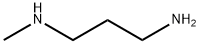
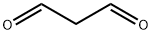
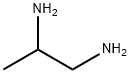
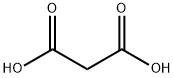
You may like
-
 109-76-2 98%View Details
109-76-2 -
 1,3-Diaminopropane, 98% 109-76-2 99%View Details
109-76-2 -
1,3-Diaminopropane CAS 109-76-2View Details
109-76-2 -
1,3-Diaminopropane CAS 109-76-2View Details
109-76-2 -
1,3-Diaminopropane CAS 109-76-2View Details
109-76-2 -
1,3-Diaminopropane CAS 109-76-2View Details
109-76-2 -
7250-67-1 1-(2-Chloroethyl)pyrrolidine Hydrochloride 98+View Details
7250-67-1 -
13227-01-5 98+View Details
13227-01-5