
ANTI-CERAMIDE
Synonym(s):Ceramide Antibody;Ceramide Antibody - Monoclonal Anti-Ceramide antibody produced in mouse
- Molecular Weight: 0
- MDL number: MFCD01865474
- Update Date: 2026-01-13 11:25:25
What is ANTI-CERAMIDE?
The Uses of ANTI-CERAMIDE
Monoclonal Anti-Ceramide antibody produced in mouse has been used in:
- immunohistochemistry
- immunolabeling in electron microscopy
- enzyme-linked immunosorbent assay (ELISA)
- immunoblotting
- immunoprecipitation
- as a probe to determine the presence and roles of ceramide in sphingomyelin pathway signaling and the regulation of protein phosphorylation.
General Description
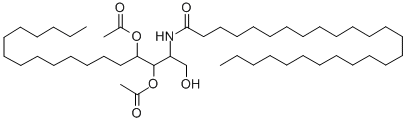
Ceramide is an endogenous lipid component of a novel biochemical pathway termed the sphingomyelin pathway. Ceramide is produced in response to cellular stimulation by hormones, cytokines and antigens. Ceramide synthesis is mediated either by the salvage pathway by the acylation of sphingosine or sphingolipids hydrolysis or by de novo pathway via dihydroceramide formation. Structurally, ceramides have a sphingoid base, a long-chain amino alcohol linked to fatty acid by an amide bond. Ceramide is generated by hydrolysis of sphingomyelin by sphingomyelinase.
Biochem/physiol Actions
Ceramide appears to have a role in mediating biological responses in a wide variety of cell types. Ceramide metabolites such as sphingosine and sphingosine-1-phosphate have potent biological activities of their own. They are directly involved in the proliferation and differentiation of skin cells and regulate skin barrier functionality. Ceramide based analogs are potential anti-tumor agents and are regarded as tumor suppressor lipid. Mechanisms for ceramide action involve regulation of protein phosphorylation via stimulation of a serine/threonine protein phosphatase, a proline-directed kinase and possibly other direct and/or indirect targets. Ceramide is emerging as an intracellular messenger than mediates effects on terminal differentiation and cell proliferation as well as apoptosis or cell death and cell-cycle arrest. The interrelationship of ceramide actions with other bioactive lipids and systems represents an area of active research.
Properties of ANTI-CERAMIDE
| storage temp. | 2-8°C |
| form | buffered aqueous solution |
Safety information for ANTI-CERAMIDE
Computed Descriptors for ANTI-CERAMIDE
New Products
9-Mesityl-10-methylacridinium perchlorate Sulfapyridine Fmoc-OSu (R)-(-)-2-Amino-1-propanol Cyclobutanone 5-bromo-4-fluoro-2-nitrobenzaldehyde 4 pentyn 1 ol N-Vinylformamide Phenethyl cinnamate Pyrrolo[1,2-a]pyrimidine-6-carboxylic acid, 4,6,7,8-tetrahydro-4-oxo-, sodium salt (1:1), (6S) Ethyl 3-phenylpropanoate β-Bromostyrene Methacrylate-PEG-Methacrylate, Mn:35000 2,4-Dihydroxyacetophenone 2-Chloro 5-Fluoro Pyridine Vasicinone 2-Chloroisonicotinic Acid Tween 80 or Polysorbate 80 5-Bromo-1-Pentyne 1-(2-Methyl-5-nitrophenyl)guanidine Nitrate Methyl trans-4-Aminocyclohexanecarboxylate Hydrochloride N-(4-Cyano-3-(trifluoromethyl)phenyl)-2-methyloxirane-2-carboxamide 4-Nitrobenzotrifluoride 2-Pentyn-1-oLRelated products of tetrahydrofuran
You may like
-
 Monoclonal Anti-Ceramide antibody produced in mouse CASView Details
 -
1191-95-3 Cyclobutanone 98+View Details
1191-95-3 -
Fmoc-OSu 98+View Details
82911-69-1 -
(R)-(-)-2-Amino-1-propanol 35320-23-1 98+View Details
35320-23-1 -
1191-95-3 Cyclobutanone 98+View Details
1191-95-3 -
213382-45-7 98+View Details
213382-45-7 -
Fmoc-OSu 98+View Details
82911-69-1 -
(R)-(-)-2-Amino-1-propanol 35320-23-1 98+View Details
35320-23-1