
Ceramide
- CAS NO.:104404-17-3
- Empirical Formula: C34H66NO3R
- Molecular Weight: 536.89
- MDL number: MFCD07783727
- EINECS: 309-560-3
- SAFETY DATA SHEET (SDS)
- Update Date: 2026-09-12 14:29:59
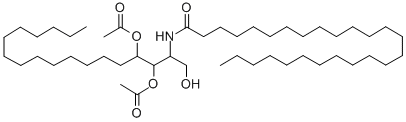
What is Ceramide?
Definition
ChEBI: N-octadecanoylsphingosine is a N-acylsphingosine in which the ceramide N-acyl group is specified as octadecanoyl (stearoyl). It has a role as a mouse metabolite. It is a N-acylsphingosine and a N-stearoyl-sphingoid base. It is functionally related to an octadecanoic acid.
Benefits
Ceramides are lipids, which are fatty acids that are produced in the sebaceous glands. Ceramides help to moisturise and strengthen the protective skin moisture barrier, and protect the skin from external aggressors such as weather and pollution.
Mode of action
Topically applied ceramide (Cer) could improve barrier function in three possible ways: (1) Cer in an appropriate formulation constructs (lamellar) liquid crystalline and/or gel structures; (2) Cer is likely incorporated into lamellar bilayer structures in the SC to repair incompetent bilayer structures; and/or (3) Cer penetrates into nucleated layers of the epidermis and becomes a precursor to endogenous Cer synthesis following hydrolysis to the sphingoid base and FA. In addition, Cer absorbed into nucleated layers of the epidermis could suppress KC proliferation and promote differentiation. Because Cer production is increased during KC differentiation, the stimulation of KC differentiation can increase de novo Cer production, thereby contributing to barrier formation[1].
References
[1] Kyong-Oh Shin. “Exogenous Ceramide Serves as a Precursor to Endogenous Ceramide Synthesis and as a Modulator of Keratinocyte Differentiation.” Cells (2022).
Properties of Ceramide
Safety information for Ceramide
Computed Descriptors for Ceramide
| InChIKey | XJRPTDNTEPSGLZ-UHFFFAOYSA-N |
| SMILES | C(OC(C)=O)(C(CCCCCCCCCCCCCC)OC(C)=O)C(CO)NC(CCCCCCCCCCCCCCCCCCCCCCCCC)=O |
New Products
5-bromo-4-fluoro-2-nitrobenzaldehyde (R)-(-)-2-Amino-1-propanol Cyclobutanone Fmoc-OSu 1-(2-Chloroethyl)pyrrolidine Hydrochloride 2-Amino-2-(4-methylphenyl)acetic acid β-Bromostyrene Ethyl 3-phenylpropanoate Phenethyl cinnamate Dipropyl disulfide 4 pentyn 1 ol N-Vinylformamide Methacrylate-PEG-Methacrylate, Mn:35000 2,4-Dihydroxyacetophenone 2-Chloro 5-Fluoro Pyridine Vasicinone 2-Chloroisonicotinic Acid Tween 80 or Polysorbate 80 2-Butyn-1-oL 2-Pentyn-1-oL 4-Nitrobenzotrifluoride N-(4-fluoro-2-methoxy-5-nitrophenyl)-4-(1-methyl-1H-indol-3-yl)pyrimidin-2-amine Pirtobrutinib intd. N-(4-Cyano-3-(trifluoromethyl)phenyl)-2-methyloxirane-2-carboxamideRelated products of tetrahydrofuran






You may like
-
 Fmoc-OSu 98+View Details
82911-69-1 -
(R)-(-)-2-Amino-1-propanol 35320-23-1 98+View Details
35320-23-1 -
7250-67-1 1-(2-Chloroethyl)pyrrolidine Hydrochloride 98+View Details
7250-67-1 -
13227-01-5 98+View Details
13227-01-5 -
7250-67-1 1-(2-Chloroethyl)pyrrolidine Hydrochloride 98+View Details
7250-67-1 -
13227-01-5 98+View Details
13227-01-5 -
7250-67-1 1-(2-Chloroethyl)pyrrolidine Hydrochloride 98+View Details
7250-67-1 -
13227-01-5 98+View Details
13227-01-5