
7-METHOXY-3,7-DIMETHYLOCTANAL
- CAS NO.:3613-30-7
- Empirical Formula: C11H22O2
- Molecular Weight: 186.29
- MDL number: MFCD00007015
- EINECS: 222-784-5
- SAFETY DATA SHEET (SDS)
- Update Date: 2026-05-28 05:48:13
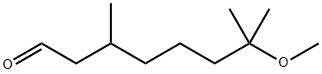
What is 7-METHOXY-3,7-DIMETHYLOCTANAL?
Chemical properties
clear colorless liquid
Chemical properties
Methoxydihydrocitronellal is a colorless liquid with a fresh, green, blossom odor and is used in perfumery in floral compositions for fresh, green nuances.
Occurrence
Has apparently not been reported to occur in nature.
The Uses of 7-METHOXY-3,7-DIMETHYLOCTANAL
It is used in many types of floral fragrances, in floral bases, particularly recommended for Ylang-Ylang bases. It blends very well with the “rose” alcohols, with the Cinnamic derivatives and with the Eugenols, Benzylacetate and other common ingredients. It needs more fixation than Hydroxycitronellal which in itself is a fixative, but it also offers fresh-green, almost vegetable-green notes, not found in Hydroxycitronellal, and not found so pleasantly effective in Cyclamen aldehyde. Its softness makes it easy to use, hard to overdose.
Preparation
By catalytic methylation of hydroxycitronellal (Arctander, 1969)
Metabolism
On rice and alfalfa, methoxycitronellal formed as a metabolite of the insect-growth regulator, methoprene, was converted to methoxycitronellic acid and hydroxycitronellic acid and their conjugates (Quistad et al. 1974)
Properties of 7-METHOXY-3,7-DIMETHYLOCTANAL
| Boiling point: | 60 °C (0.4 mmHg) |
| Density | 0.87 |
| refractive index | 1.4364-1.4384 |
| Flash point: | 98 °C |
| solubility | Almost insoluble in water, soluble in alcohol and oils, fairly soluble in Propylene glycol. |
| form | slightly oily liquid |
| color | A colourless liquid. |
| Odor | at 100.00 %. fresh melon floral lily sweet |
| EPA Substance Registry System | Octanal, 7-methoxy-3,7-dimethyl- (3613-30-7) |
Safety information for 7-METHOXY-3,7-DIMETHYLOCTANAL
| Signal word | Warning |
| Pictogram(s) |
 Exclamation Mark Irritant GHS07 |
| GHS Hazard Statements |
H315:Skin corrosion/irritation H319:Serious eye damage/eye irritation H335:Specific target organ toxicity, single exposure;Respiratory tract irritation |
| Precautionary Statement Codes |
P261:Avoid breathing dust/fume/gas/mist/vapours/spray. P305+P351+P338:IF IN EYES: Rinse cautiously with water for several minutes. Remove contact lenses, if present and easy to do. Continuerinsing. |
Computed Descriptors for 7-METHOXY-3,7-DIMETHYLOCTANAL
New Products
2-Bromo-4-hydroxypyridine Dibenzoyl-L-tartaric acid Anhydrous (Resolution Reagent) Dibenzo[b,f][1,4]thiazepin-11(10H)-one 1,2,3,9-Tetrahydro-9-Methyl-4H-Carbazole-4-One Cis-Tosylate 1-(4-methoxyphenyl)-4-(4-Nitrophenyl)Piperazine (IT-1) 2'-Fluoroacetophenone 1-aminocyclobutanecarbonitrile hydrochloride AMINO-O-TOLYL-ACETIC ACID N-Methyl-2-amino-2-methylpropionamide 4-(FMOC-AMINO)-TETRAHYDROPYRAN-4-CARBOXYLIC ACID 1-Aminocyclobutanecarboxylic Acid Hydrochloride METHANOL-D1(OD) TERTIARY BUTANOL-D9 N-ETHYL-D5-AMINE HYDROCHLORIDE BENZOIC ACID-D CHLOROFORM-D TOLUENE-D3 2-(2-Bromophenyl)ethanol Boc-D-Glu(OMe)-OMe 2,5 Dibromopyridine Ethyl 4-hydroxy-3-oxobutanoate Dimethyl (2S)-2-((tert-butoxycarbonyl)amino)-4-(cyanomethyl)pentanedioate 1-(3-Chlorophenyl)piperazine hydrochlorideRelated products of tetrahydrofuran

You may like
-
 1-aminocyclobutanecarbonitrile hydrochloride 845821-84-3 98+View Details
845821-84-3 -
98071-16-0 1-Aminocyclobutanecarboxylic Acid Hydrochloride 98+View Details
98071-16-0 -
106914-07-2 N-Methyl-2-amino-2-methylpropionamide 98+View Details
106914-07-2 -
129592-98-9 98+View Details
129592-98-9 -
4-(FMOC-AMINO)-TETRAHYDROPYRAN-4-CARBOXYLIC ACID 98+View Details
285996-72-7 -
1-aminocyclobutanecarbonitrile hydrochloride 845821-84-3 98+View Details
845821-84-3 -
98071-16-0 1-Aminocyclobutanecarboxylic Acid Hydrochloride 98+View Details
98071-16-0 -
 ADC-151View Details
27176-87-0